OEM & Manufacturing Insights
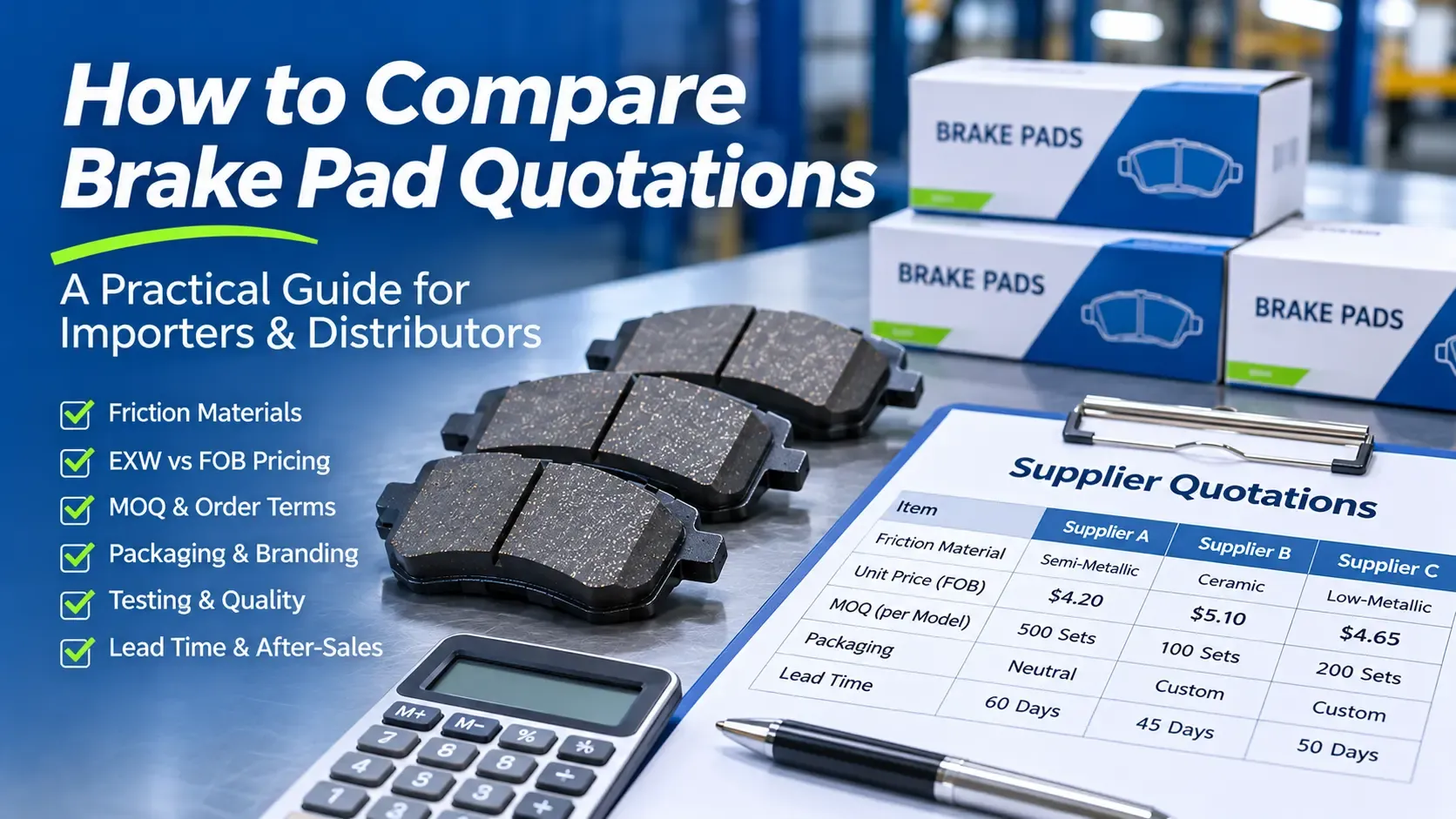
How to Compare Brake Pad Quotations from Different Manufacturers
Learn how to compare brake pad manufacturer quotations, including friction materials, MOQ, EXW vs FOB pricing, packaging, testing and hidden sourcing costs.
How to Compare Brake Pad Quotations from Different Manufacturers
A Practical Price Comparison Guide for Automotive Parts Importers and Distributors
You send the same brake pad inquiry to five manufacturers in China.
A few days later, you receive five quotations with surprisingly different prices.
One supplier quotes USD 3.50 per set. Another offers USD 5.20. A third quotes USD 6.80.
Does that mean the cheapest supplier is offering the best deal?
Not necessarily.
For automotive parts importers and distributors, comparing brake pad quotations involves much more than checking the unit price.
Differences in friction materials, product specifications, packaging, minimum order quantities, testing, and shipping terms can significantly affect the final cost.
In this guide, we'll explain how to compare brake pad manufacturer quotations accurately and make more informed sourcing decisions.
1. Make Sure You're Comparing the Same Brake Pad Reference
Before comparing prices, confirm that all suppliers are quoting the correct product.
Brake pads may be identified using:
- OE (Original Equipment) numbers.
- FMSI references.
- WVA numbers.
- Vehicle make and model.
- Production years.
- Front or rear axle position.
However, a matching OE number does not automatically guarantee identical product specifications.
Different vehicle variants may use different braking systems, even within the same model generation.
For accurate quotations, provide the most complete application information available.
Practical tip: Ask suppliers to confirm the brake pad dimensions, backing plate design, and application details before comparing their prices.
If you are preparing a new inquiry, our Brake Pad RFQ Checklist: How to Get an Accurate Quote explains what information manufacturers need to prepare accurate and comparable quotations.
2. Compare Friction Materials, Not Just Prices
Friction material is one of the most important factors influencing brake pad performance and manufacturing cost.
Three commonly available categories are:
Ceramic Brake Pads
Ceramic formulations are often selected for passenger car applications where braking comfort, noise, and dust performance are important.
Their cost and performance depend on the specific formulation and manufacturing process.
Semi-Metallic Brake Pads
Semi-metallic formulations contain metallic constituents and are commonly used in applications requiring reliable braking performance under demanding conditions.
Performance characteristics vary depending on the compound design.
Low-Metallic NAO Brake Pads
Low-metallic non-asbestos organic formulations offer another option for balancing friction performance, noise, wear, and cost.
When comparing quotations, ask each manufacturer to identify the friction material category and provide relevant technical information.
A ceramic quotation and a semi-metallic quotation should not be treated as identical products simply because they share the same vehicle application.
Even within the same material category, different formulations may have different performance characteristics.
3. Understand EXW vs FOB Brake Pad Pricing
International trade terms can make a significant difference when comparing supplier quotations.
Two commonly used terms are EXW and FOB.
EXW (Ex Works)
Under EXW terms, the seller makes the goods available at the agreed location, while the buyer takes on most transportation and export-related responsibilities.
Buyers should carefully clarify export clearance arrangements and local handling costs.
FOB (Free on Board)
Under FOB terms, the seller is responsible for delivering the goods on board the vessel at the named port of shipment and completing export clearance, as applicable under Incoterms 2020.
The buyer generally assumes the main ocean freight costs and subsequent responsibilities.
FOB is intended for sea or inland waterway transport. For containerized cargo handed to a carrier before loading, FCA may be more appropriate.
Example: Why EXW and FOB Prices Cannot Be Compared Directly
Consider two hypothetical quotations for the same brake pad reference:
Cost Item | Supplier A | Supplier B |
|---|---|---|
Quoted unit price | $4.20 EXW | $4.65 FOB |
Quantity | 1,000 sets | 1,000 sets |
Quoted goods value | $4,200 | $4,650 |
Estimated additional origin costs | $600 | Included under agreed FOB scope |
Comparable origin-stage total | $4,800 | $4,650 |
Illustrative figures only. Actual charges depend on the shipment, location, transport arrangements, and contractual terms.
Although Supplier A initially appears cheaper, its estimated origin-stage cost is higher.
This is why importers should compare quotations on a consistent delivery basis.
Always confirm the named port or place, the Incoterms version, and which charges are included.
4. Check Whether Prices Are Quoted Per Piece or Per Set
This is a surprisingly common source of confusion in brake pad purchasing.
Some suppliers quote per individual brake pad, while others quote per axle set.
For many passenger car disc brake applications, one axle set contains four individual friction pads.
However, product configurations can vary.
For example:
- USD 2.00 per individual pad.
- USD 8.00 per four-piece axle set.
These quotations may represent the same basic unit price.
Before comparing suppliers, confirm the exact number of pieces included in each quoted unit.
This is especially important when purchasing a combination of passenger car and commercial vehicle braking components.
5. Compare MOQ and Mixed-Model Ordering Conditions
A low unit price may become less attractive if the manufacturer requires a large minimum order quantity.
For example, one supplier may offer a lower price with an MOQ of 500 sets per reference.
Another supplier may quote a slightly higher price but accept 100 sets per reference.
For distributors managing multiple vehicle applications, the second option may reduce initial inventory investment.
Before placing an order, ask:
- What is the MOQ per reference?
- Can different references be combined?
- Can different friction materials be ordered together?
- Are there quantity-based price tiers?
- Does customized packaging affect the MOQ?
The most suitable supplier is not necessarily the one offering the lowest price at the highest quantity.
It is the one whose purchasing conditions fit your business.
For a more detailed explanation, read our Brake Pad MOQ Explained: How to Order Multiple Models Without Overstocking guide.
6. Check Packaging and Private Label Costs
If you're developing your own brake pad brand, packaging is another important factor.
A quotation may include standard neutral packaging but exclude customized retail boxes.
Ask whether the quoted price includes:
- Individual retail boxes.
- Custom logo printing.
- Product labels and barcodes.
- Inner and outer cartons.
- Packaging design or printing setup fees.
- Any minimum packaging production quantities.
For example, a packaging supplier may require several hundred boxes of the same size, even when the brake pad manufacturer accepts smaller quantities per reference.
This distinction matters when planning a new private label product range.
Make sure all suppliers quote comparable packaging specifications.
If you're considering launching your own product line, our How to Start Your Own Brake Pad Brand guide covers product selection, OEM manufacturing, packaging, and initial order planning.
7. Evaluate Quality Documentation and Testing
Brake pads are safety-critical automotive components.
A competitive quotation should be evaluated alongside the manufacturer's quality management and product validation capabilities.
Consider requesting information about:
- ISO 9001 and IATF 16949 quality management certifications.
- SAE J2522 friction performance testing.
- SAE J2521 noise evaluation.
- Shear strength testing.
- Dimensional inspection.
- Batch traceability.
- Product-specific regulatory approvals where required.
Quality management certifications do not automatically establish that every brake pad reference has the same performance or regulatory approval.
Ask suppliers to clarify which tests and approvals apply to the specific products being quoted.
A low price without sufficient product verification can create much higher costs later through returns, complaints, and damaged customer relationships.
For a more detailed quality evaluation framework, see our Brake Pad Testing & Quality Control: What Importers Should Check Before Bulk Orders.
8. Compare Lead Times and After-Sales Support
Price is only one part of the sourcing decision.
A supplier with unreliable delivery schedules may create inventory shortages, missed sales opportunities, and additional logistics costs.
When comparing quotations, confirm:
- Sample preparation time.
- First-order production lead time.
- Repeat-order lead time.
- Production capacity for your required references.
- Payment terms.
- Quality complaint handling procedures.
- Replacement or corrective action policies.
A professional manufacturer should provide realistic production estimates rather than promise an unusually short lead time without checking the order requirements.
9. Use a Standardized Brake Pad Quotation Comparison Checklist
To make your supplier evaluation easier, compare quotations using the same criteria.
Evaluation Item | What to Confirm |
|---|---|
Product reference | OE, FMSI, WVA, dimensions |
Friction material | Ceramic, semi-metallic, low-metallic NAO |
Unit price | Price per piece or per set |
Trade terms | EXW, FOB, FCA or other agreed terms |
MOQ | Minimum quantity per reference |
Mixed-model orders | Whether multiple references can be combined |
Packaging | Neutral or customized |
Testing | Relevant reports and specifications |
Lead time | Samples, initial order, repeat orders |
Payment terms | Deposit, balance and payment method |
After-sales support | Quality claims and corrective actions |
Using the same comparison framework helps buyers identify meaningful differences between manufacturers.
It also makes it easier to explain sourcing decisions to purchasing managers or business partners.
How to Make a Fair Supplier Comparison
A practical approach is to separate your evaluation into three areas.
Technical comparison: Confirm fitment, friction material, product construction, accessories, and relevant testing.
Commercial comparison: Compare unit price, MOQ, packaging, payment terms, and the cost of bringing the goods to the same delivery point.
Supplier reliability: Evaluate production consistency, communication, realistic lead times, and after-sales procedures.
Once these factors are aligned, price differences become easier to understand.
10. How Xinzhong Brake Supports International Brake Pad Buyers
At Xinzhong Brake, we understand that international distributors need more than competitive unit prices.
They need accurate product matching, consistent manufacturing quality, and practical purchasing conditions.
Our manufacturing capabilities include:
- More than 3,000 brake pad references.
- Ceramic, semi-metallic, and low-metallic NAO friction material options.
- OEM and private label brake pad manufacturing.
- Customized packaging solutions.
- ISO 9001 and IATF 16949 quality management systems.
- Friction performance and noise testing capabilities.
Our standard MOQ for regular brake pad models is generally 100 sets per reference, with mixed-model ordering options.
We typically quote on an FOB Qingdao basis, unless different terms are agreed.
For first orders, production lead time is generally around 45–60 days, depending on product references, quantities, and manufacturing arrangements.
We also generally offer regular samples free of charge, with international shipping costs covered by the customer.
To prepare an accurate quotation, we recommend sending your OE or FMSI references, preferred friction materials, estimated quantities, target market, and packaging requirements.
Meet Xinzhong Brake at Automechanika Shanghai 2026
If you're planning to attend Automechanika Shanghai 2026, we'd be happy to discuss your brake pad sourcing requirements in person.
Exhibition: Automechanika Shanghai 2026
Date: December 2–5, 2026
Location: National Exhibition and Convention Center (Shanghai), China
Our Booth: Hall 7.1, Booth E86 (7.1E86)
You can bring your existing brake pad quotation list or frequently purchased references.
Let's discuss product specifications, friction material options, and purchasing requirements together.
Before your visit, explore our Automechanika Shanghai 2026 Brake Pad Sourcing Guide for exhibition details and information about meeting our team.
Frequently Asked Questions
Why do brake pad prices vary between manufacturers?
Prices may vary because of friction material formulations, production costs, quality control, packaging, order quantities, and delivery terms.
Is the cheapest brake pad quotation always the best?
No. Buyers should evaluate product specifications, testing, manufacturing consistency, delivery conditions, and total sourcing costs.
Can I compare EXW and FOB prices directly?
No. EXW and FOB involve different seller and buyer responsibilities. Convert quotations to a comparable cost basis before making a decision.
What information should I provide to receive an accurate brake pad quotation?
Provide OE or FMSI references, vehicle application details, preferred friction materials, quantities, packaging requirements, destination market, and preferred trade terms.
Can I request samples before placing a bulk order?
Yes. Many manufacturers offer sample arrangements. Buyers should confirm sample costs, shipping charges, preparation time, and testing requirements.
Conclusion: Compare Total Value, Not Just Unit Price
When comparing brake pad manufacturers, the lowest unit price does not always represent the best purchasing decision.
Accurate fitment, suitable friction materials, consistent quality, practical MOQ conditions, clear delivery terms, and reliable after-sales support all contribute to long-term sourcing success.
A well-structured quotation comparison process helps importers reduce purchasing risks and build more dependable supplier relationships.
Looking for a brake pad manufacturer in China?
Send Xinzhong Brake your required references and purchasing specifications.
We'll be happy to review your requirements and prepare a quotation.
Need a Competitive Brake Pad Quotation?
Xinzhong Brake supports international distributors and private label brands with OEM brake pad manufacturing, multiple friction material options, and mixed-reference purchasing arrangements.
Send us your OE/FMSI references, preferred friction materials, target market, and estimated quantities.