OEM & Manufacturing Insights
Brake Pad Quality Consistency: A Guide for Distributors
Learn why batch-to-batch brake pad quality consistency matters and what distributors should check in formulation, raw materials, production and quality control.
Brake Pad Quality Consistency: Why Batch-to-Batch Control Matters for Distributors
A good brake pad sample does not automatically mean every future shipment will perform the same way.
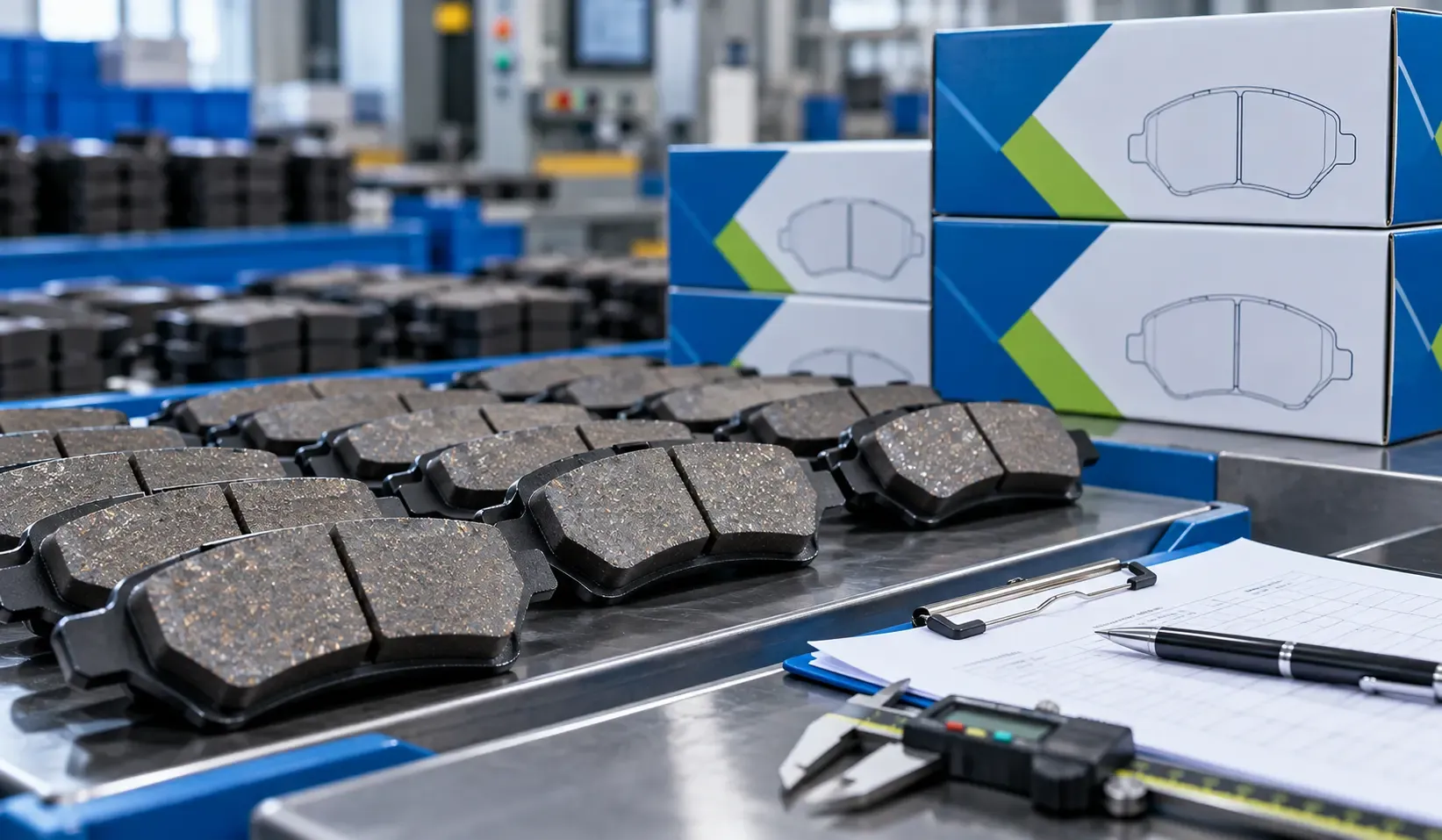
For distributors and importers, the real challenge is not only finding a brake pad that performs well once. It is finding a manufacturer that can reproduce that performance consistently across thousands of sets and multiple production batches.
A distributor may approve samples after testing noise, braking feel, fitment and dust. But if later batches use inconsistent raw materials or uncontrolled production parameters, the product received six months later may behave differently from the product originally approved.
That is why batch-to-batch consistency is one of the most important factors when evaluating a long-term brake pad supplier.
What Does Brake Pad Quality Consistency Mean?
Quality consistency means that brake pads manufactured at different times should remain within controlled specifications.
This includes more than appearance.
Important areas can include:
- Friction-material composition
- Friction performance
- Dimensions and fitment
- Pad thickness
- Bonding strength
- Hardness and density
- Noise behavior
- Wear characteristics
- Backing plate quality
- Shim and accessory quality
- Surface treatment
- Packaging and labeling
For distributors, consistency means customers should receive a predictable product whether they buy from the first shipment or a later production batch.
Why Batch Consistency Matters More Than a Perfect Sample
Samples are important because they allow buyers to evaluate a product before committing to a larger order.
But samples represent only a very small quantity.
The real manufacturing test begins when the supplier must reproduce the approved product at scale.
Imagine that a distributor approves a ceramic brake pad after road testing.
The sample provides:
- Acceptable braking feel
- Low visible dust
- No abnormal noise during testing
- Correct fitment
- Good surface finish
The distributor then places a bulk order.
If the manufacturer cannot maintain the same formulation, raw-material specifications and production process, later batches may not perform in exactly the same way.
This creates a dangerous sourcing problem:
The buyer approved one product, but the market may receive another.
For this reason, sample approval should be the beginning of quality control, not the end.
Where Can Brake Pad Batch Variation Come From?
Brake pad manufacturing involves multiple materials and production stages.
Variation can enter the process at several points.
1. Raw Material Variation
Friction materials contain multiple ingredients, such as fibers, fillers, binders, abrasives, lubricants and friction modifiers.
If the specification, source or proportion of these materials changes, product performance may also change.
This is why raw-material control is an important part of brake pad manufacturing.
Manufacturers should have defined material specifications and incoming inspection procedures rather than purchasing ingredients only according to the lowest available price.
2. Formulation Control
The formulation is effectively the recipe behind the friction material.
Even when two products are both described as ceramic or semi-metallic, their actual formulations may be very different.
Once a buyer has approved a specific product, uncontrolled changes to that formulation can affect:
- Friction characteristics
- Noise
- Dust
- Wear
- Temperature behavior
- Cost
Distributors should therefore understand how suppliers manage approved formulations and production recipes.
For a deeper explanation of formulation selection, see our Brake Pad Formulation: What Distributors Should Know Before Choosing a Supplier guide.
3. Mixing Process
It is not enough to have the correct ingredients.
They also need to be measured and mixed consistently.
Poor control of weighing, mixing time or material distribution can create variation inside the friction compound.
A mature manufacturing process should define these parameters rather than relying mainly on operator experience.
4. Pressing Conditions
Pressure, temperature and time during the forming process can influence the physical properties of the brake pad.
If these parameters vary significantly between batches, density, bonding and other characteristics may also vary.
Controlled production parameters help reduce this risk.
5. Heat Treatment
Post-forming heat treatment is another important production stage.
Temperature profiles and treatment time should be controlled according to the manufacturing process.
Inconsistent heat treatment can affect the final characteristics of the friction material.
6. Backing Plate and Bonding Quality
The friction material is only one part of a brake pad.
Backing plate dimensions, surface preparation and bonding quality also matter.
For distributors, a product with good friction material but poor structural consistency can still create serious quality problems.
7. Finishing and Assembly
Slots, chamfers, shims, coatings and accessories can influence fitment and noise performance.
These details should remain consistent with the approved specification.
Changing an accessory or manufacturing detail without proper evaluation may affect the finished product even when the friction formulation remains unchanged.
What Should a Brake Pad Manufacturer Control?
A reliable quality system should control both the product and the process.
Product inspection asks:
“Does this brake pad meet the specification?”
Process control asks:
“Can we continue producing it within that specification?”
Both are important.
Typical control points may include:
Incoming Material Inspection
Raw materials and components should be checked against defined requirements before entering production.
Production Parameter Control
Important process parameters should be documented and monitored during manufacturing.
Dimensional Inspection
Brake pad length, height, thickness and other critical dimensions should be checked against product specifications.
This is especially important for aftermarket ranges covering thousands of vehicle applications.
Bonding and Structural Testing
Bonding strength and structural integrity should be monitored according to the manufacturer's quality-control requirements.
Friction Performance Testing
Friction and wear performance should be evaluated through appropriate testing procedures.
The specific testing method may depend on the product, market and customer requirements.
Final Inspection
Finished products should be inspected before packing and shipment.
This may include appearance, dimensions, marking, accessories, packaging and other customer-specific requirements.
Why Documentation Matters to B2B Buyers
A manufacturer saying “our quality is stable” is not enough.
The more useful question is:
How do you know it is stable?
This is where documentation becomes important.
Depending on the project, buyers may ask suppliers about:
- Inspection records
- Batch identification
- Raw-material control
- Production records
- Testing reports
- Non-conformance procedures
- Traceability systems
- Quality certifications
The goal is not to collect paperwork for its own sake.
The goal is to determine whether quality is controlled through a repeatable system rather than individual experience.
Traceability: Can the Supplier Find the Problem?
No manufacturing process can realistically guarantee that problems will never occur.
What matters is what happens when a problem appears.
Suppose a distributor receives a complaint from the market about a specific brake pad reference.
A useful traceability system should help the manufacturer investigate questions such as:
- When was this product manufactured?
- Which production batch did it come from?
- What materials were used?
- Were there any abnormal production records?
- Were other products produced in the same batch affected?
- What inspection results were recorded?
- What corrective action is required?
Without traceability, a quality complaint becomes guesswork.
For an importer managing thousands of brake pad sets, that creates unnecessary commercial risk.
Ask About Change Control
This is an area buyers sometimes overlook.
Imagine you approve a brake pad today.
Six months later, one raw material becomes more expensive or difficult to source.
What happens?
Does the supplier quietly replace it?
Or does the supplier evaluate the change and confirm whether product performance could be affected?
The same question applies to:
- Friction-material ingredients
- Backing plates
- Shims
- Adhesives
- Coatings
- Accessories
- Production processes
For long-term B2B sourcing, change control matters because consistency depends on controlling what changes.
How Can Distributors Evaluate Consistency Before Large Orders?
It is impossible to judge long-term consistency from one conversation or one photograph of a factory.
But buyers can reduce risk.
Start With Samples
First verify basic fitment and performance.
Our How to Evaluate Brake Pad Samples Before Bulk Orders guide explains what buyers can check during this stage.
Use a Trial Order
Instead of moving immediately from several samples to a very large order, consider a controlled trial order.
This allows you to evaluate not only the product but also the supplier's ability to manufacture, pack and deliver a larger quantity consistently.
Compare Samples With Production Goods
Keep approved samples or clearly documented specifications as a reference.
When bulk goods arrive, compare important characteristics against the approved standard.
Monitor Customer Feedback
Market feedback provides information that laboratory testing alone may not reveal.
Track complaints by:
- Part number
- Vehicle application
- Batch
- Complaint type
- Market
- Date
Patterns can help identify whether a problem is isolated or systematic.
Review Repeat Orders
Consistency becomes easier to judge over time.
If several repeat orders show stable quality, delivery and complaint levels, buyers gain stronger evidence about the supplier's manufacturing control.
Warning Signs Buyers Should Watch For
Certain situations deserve closer attention.
For example:
- Product appearance changes significantly between orders
- Packaging or markings change without explanation
- The supplier cannot identify production batches
- Technical specifications change frequently
- Samples and bulk goods are noticeably different
- The supplier cannot explain how formulations are controlled
- Quality complaints receive vague answers without investigation
- Different shipments show inconsistent fitment or accessories
- The supplier changes materials without communicating
One issue does not automatically mean the supplier is unreliable.
But repeated unexplained variation should not be ignored.
Questions to Ask Your Brake Pad Supplier
Before developing a long-term purchasing programme, distributors can ask:
- How do you control friction-material formulations between batches?
- How are incoming raw materials inspected?
- Which production parameters are recorded?
- How do you control brake pad dimensions?
- What friction and quality tests are performed?
- Can finished products be traced back to production batches?
- How are quality complaints investigated?
- What happens if a raw material or component needs to change?
- How do you ensure bulk production matches approved samples?
- What quality records can be provided for customer projects?
These questions help move supplier evaluation beyond price and catalogue size.
For more supplier-screening questions, see How to Evaluate a Brake Pad Supplier: 10 Questions to Ask.
Quality Consistency and Private Label Programs
Consistency becomes even more important when the brake pads are sold under your own brand.
Your customer does not know which factory manufactured the product.
They know the name printed on the box.
If quality varies between shipments, the distributor's brand takes the damage.
That is why private-label buyers should treat production consistency as part of brand management, not simply factory quality control.
A stable supply relationship should define:
- Product specifications
- Approved formulations
- Packaging requirements
- Marking requirements
- Quality expectations
- Change-control procedures
- Complaint handling
The larger your private-label programme becomes, the more important these controls become.
How Xinzhong Brake Approaches Quality Consistency
At Xinzhong Brake, brake pad manufacturing is managed under IATF 16949 and ISO 9001 quality-management systems.
Our product range covers multiple friction-material options and thousands of brake pad references for different vehicle applications and markets.
For distributor and private-label projects, we believe product approval should not stop at sending a sample.
Reference confirmation, formulation selection, production control, inspection and feedback from repeat orders all form part of building a stable long-term supply programme.
For new buyers, we recommend starting with reference cross-checking and samples, followed by a trial order before gradually expanding the product range and purchasing volume.
FAQ
Why can brake pads from different batches perform differently?
Differences in raw materials, formulation control, mixing, pressing, heat treatment, components or other production parameters can create variation if the manufacturing process is not properly controlled.
Does ISO or IATF certification guarantee every brake pad is perfect?
No certification can guarantee that defects will never occur. Quality-management systems provide frameworks for controlling processes, records, corrective actions and continual improvement. Buyers should still evaluate actual products and supplier performance.
Should distributors keep approved brake pad samples?
Keeping approved samples or clearly documented specifications can provide a useful reference when evaluating future bulk shipments.
Can manufacturers change a brake pad formulation after sample approval?
Changes may sometimes become necessary, but significant material or process changes should be properly evaluated and controlled. For B2B projects, buyers should discuss change-control expectations with the supplier.
How can I check whether bulk brake pads match the samples?
Buyers can compare dimensions, appearance, markings, components and relevant test results, while also using trial orders and market feedback to evaluate production consistency over time.
Final Thoughts
The best brake pad supplier is not simply the factory that can produce one excellent sample.
For a distributor, the more important question is:
Can the supplier reproduce the approved product again and again?
Stable formulation, controlled raw materials, documented production processes, inspection, traceability and change control are what turn a good sample into a reliable supply programme.
When comparing brake pad manufacturers, do not only ask what they can make today.
Ask how they make sure the next batch will still meet the standard you approved.
If you are developing a brake pad range for distribution or private label, Xinzhong Brake can help review your OE, FMSI or WVA reference list and discuss sample, trial-order and production requirements before bulk purchasing.