Sep 20, 2026OEM & Manufacturing Insights
Brake Pad RFQ Checklist: How to Get an Accurate Quote
Learn what brake pad importers and distributors should include in an RFQ, from FMSI and OE numbers to quantity, friction material, packaging and certification.
Brake Pad RFQ Checklist: What Buyers Should Send Suppliers for an Accurate Quote
“Please quote brake pads for Toyota.”
We receive inquiries like this from time to time. The problem is that there is no single price for “Toyota brake pads.”
Different models, pad shapes, friction materials, accessories, packaging requirements and order quantities can all change the quotation.
For brake pad importers, distributors and private-label brands, a detailed RFQ does more than help a supplier quote faster. It also makes quotations from different suppliers easier to compare.
Here is the information worth preparing before you send your next brake pad RFQ.
1. Start With the Exact Brake Pad Reference
Vehicle make and model alone are often not enough to identify a brake pad.
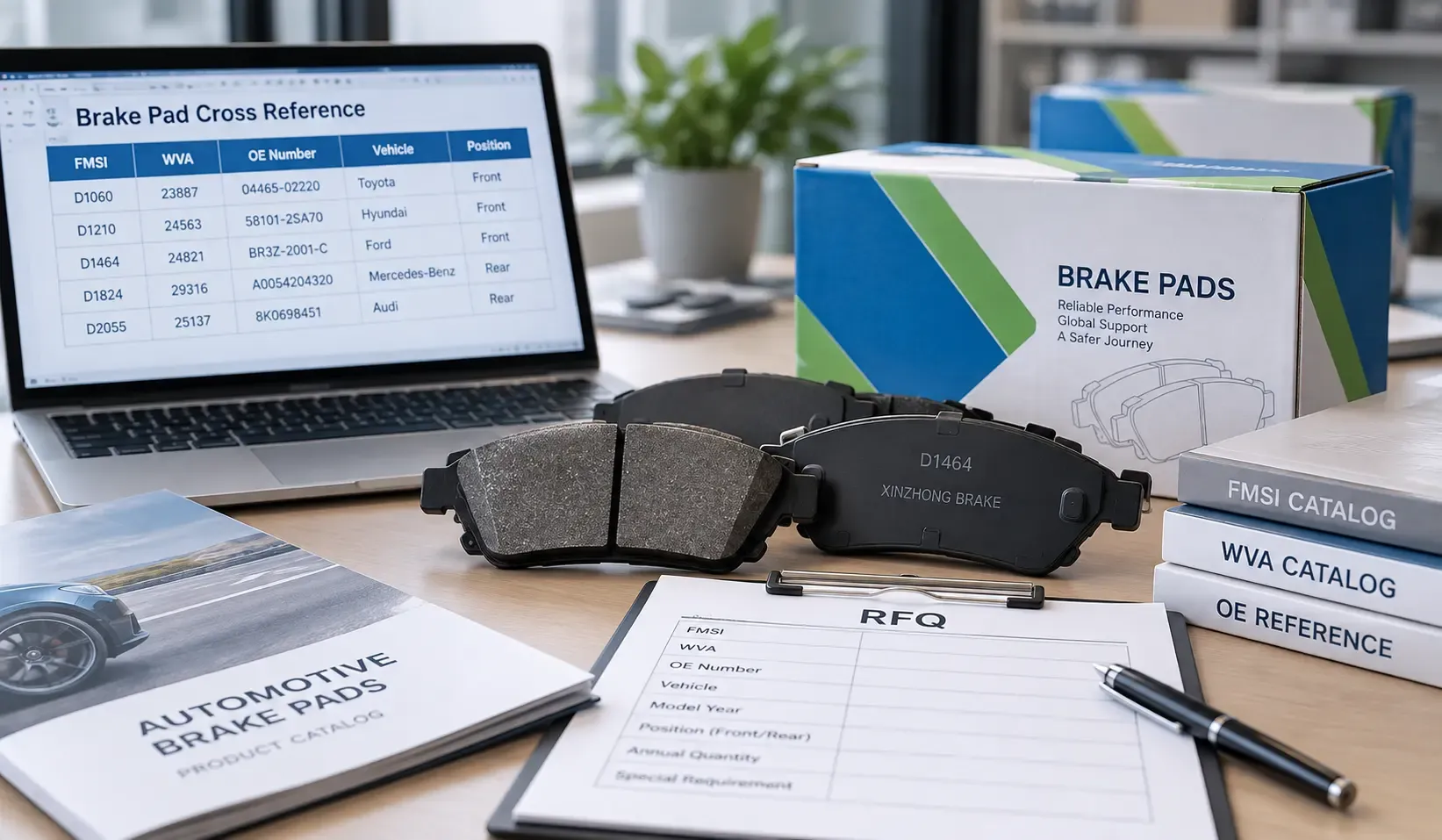
Whenever possible, provide one or more reference numbers, such as:
- FMSI number
- WVA number
- OE number
- Your current supplier's reference
- Your own internal SKU
For example:
Item | Example |
|---|---|
FMSI | DXXXX |
WVA | XXXXX |
OE | XXXXX-XXXXX |
Position | Front |
Vehicle | Toyota XXXXX |
The more identification information you provide, the easier it is for the supplier to cross-check the correct pad shape and application.
This becomes especially important when the same vehicle model uses different brake systems depending on model year, engine, trim level or market.
If you are unfamiliar with these reference systems, see our guide to FMSI, WVA and OE brake pad numbers.
2. Include Vehicle Application and Axle Position
If reference numbers are unavailable, provide detailed vehicle information instead.
At minimum, this should include:
Make + Model + Model Year + Front/Rear
Engine size, chassis code or brake system information may also be useful for applications with multiple configurations.
Simply writing “Toyota Corolla brake pads,” for example, can create unnecessary identification work and increase the risk of quoting the wrong reference.
For large sourcing lists, we recommend putting the application information into an Excel sheet rather than sending vehicle names individually through email or WhatsApp.
3. Tell the Supplier Your Expected Quantity
Quantity is one of the most important pieces of information in a brake pad quotation.
A price for 20 sets cannot normally be compared directly with a price for 500 or 2,000 sets.
For a multi-reference order, you can provide estimated quantities by SKU:
Reference | Quantity |
|---|---|
DXXXX | 100 sets |
DXXXX | 200 sets |
DXXXX | 50 sets |
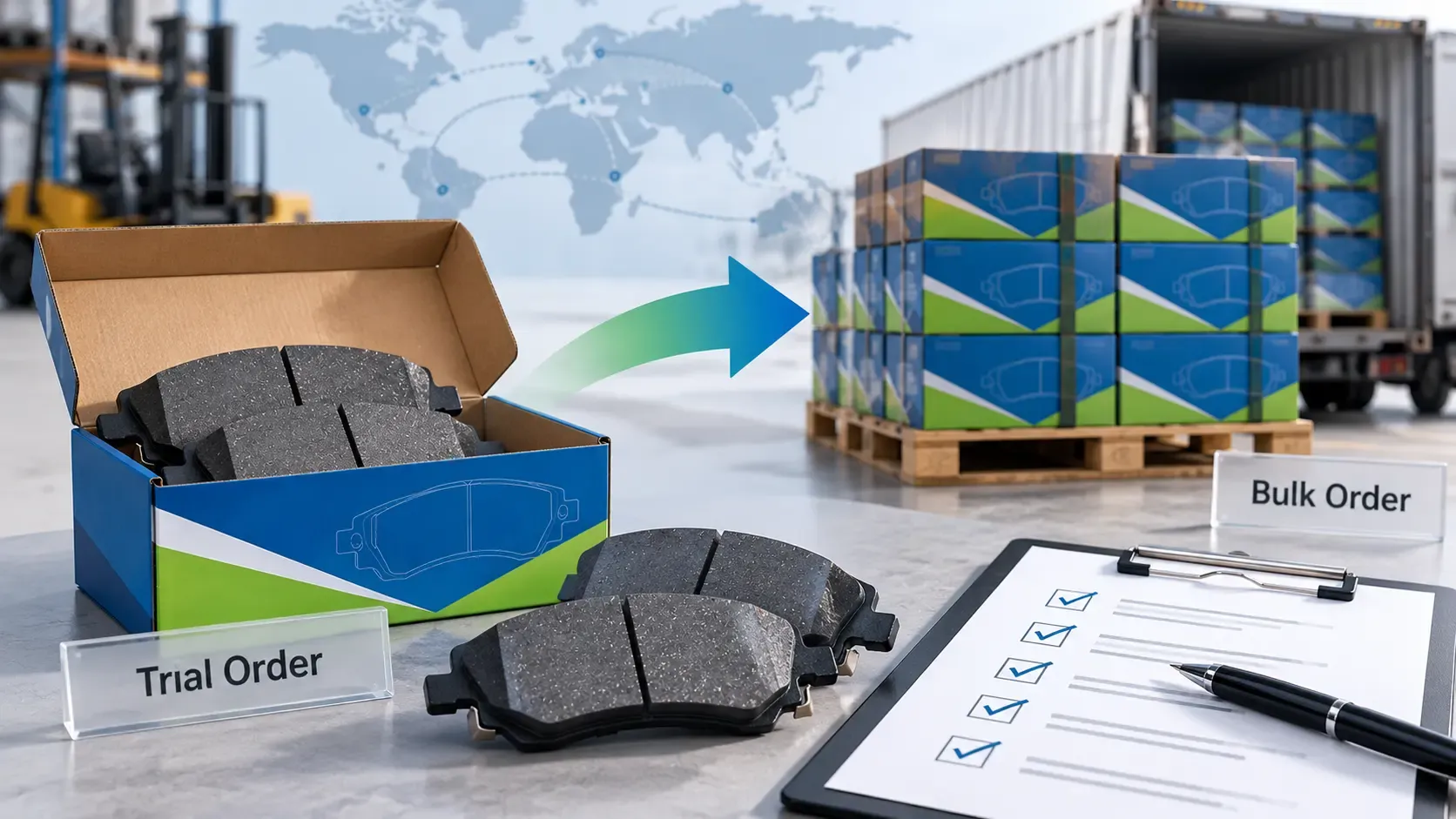
If you are testing a new supplier and do not yet know the final volume, say so.
For example:
Initial trial order: 50–100 sets per reference. Larger quantities will follow after market testing.
That gives the supplier much more useful information than simply asking for “your best price.”
You can also read our guide to brake pad MOQ for distributors if you are planning a mixed-SKU order.
4. Specify the Friction Material You Need
“Brake pad” does not describe one universal product specification.
Depending on your market and product positioning, you may require:
- Ceramic
- Semi-metallic
- Low-metallic
- Copper-free ceramic
But buyers should go one step further.
Tell the supplier what matters in your market.
For example, are your customers especially concerned about low noise? Low dust? Initial bite? High-temperature performance? Rotor friendliness?
A distributor selling into a price-sensitive market may have very different requirements from a private-label brand positioning itself as a premium replacement line.
The right question is therefore not simply:
Which material is best?
It is:
Which formulation fits my target market, vehicle coverage and price positioning?
5. Confirm Hardware and Accessory Requirements
Two quotations for the same FMSI reference may still represent different products.
One supplier may quote the pad set only, while another quotation includes accessories such as:
- Shims
- Wear sensors
- Clips
- Springs
- Other fitting hardware
That difference affects both cost and what you eventually receive.
If your current product includes specific hardware, send photos or list the accessories in the RFQ.
For replacement programs, it is also useful to tell the supplier whether the accessories must match your existing specification.
6. Define Your Packaging Requirement
Packaging is another common reason why two apparently similar quotations are not actually comparable.
Tell the supplier whether you need:
Neutral packaging, supplier-brand packaging or private-label packaging.
For private-label projects, it helps to provide information about:
- Box design
- Brand artwork
- Label requirements
- Barcode
- Part number
- Country-of-origin marking
- Carton requirements
If your packaging is still being developed, tell the supplier early. Packaging MOQ, printing method and setup requirements may affect the project.
7. State Your Certification and Market Requirements
Do not assume every brake pad specification is suitable for every destination market.
Tell the supplier where the products will be sold and whether you have specific certification or documentation requirements.
Depending on the project, buyers may ask about areas such as:
- Quality management system certification
- Product testing
- Material or performance reports
- Market-specific product approvals
- Traceability documentation
The important point is simple:
Ask for the documents your market actually requires rather than treating certificates as a generic checklist.
If certification is a mandatory purchasing condition, make that clear before requesting samples or negotiating the final order.
8. Give Your Target Market
This part is frequently overlooked.
A supplier can give better recommendations when they know whether the brake pads are intended for Europe, the Middle East, Southeast Asia, Latin America or another market.
Market information can affect:
- Vehicle coverage
- Friction-material selection
- Packaging
- Product positioning
- Certification requirements
You do not need to disclose your entire business strategy.
Even a simple sentence such as:
These products are for our aftermarket distribution program in Saudi Arabia
gives the supplier useful context.
9. Clarify the Trade Terms and Destination
A brake pad price without commercial terms can easily create confusion.
Specify whether you need:
- EXW
- FOB
- CIF
- Another agreed Incoterm
If you need a freight-inclusive quotation, provide the destination port or other necessary delivery information.
Also confirm the required quotation currency.
This makes it much easier to compare offers on the same basis.
10. Send the RFQ as a Structured Product List
If you are sourcing dozens or hundreds of brake pad references, do not put the entire request into a long message.
A simple spreadsheet works much better.
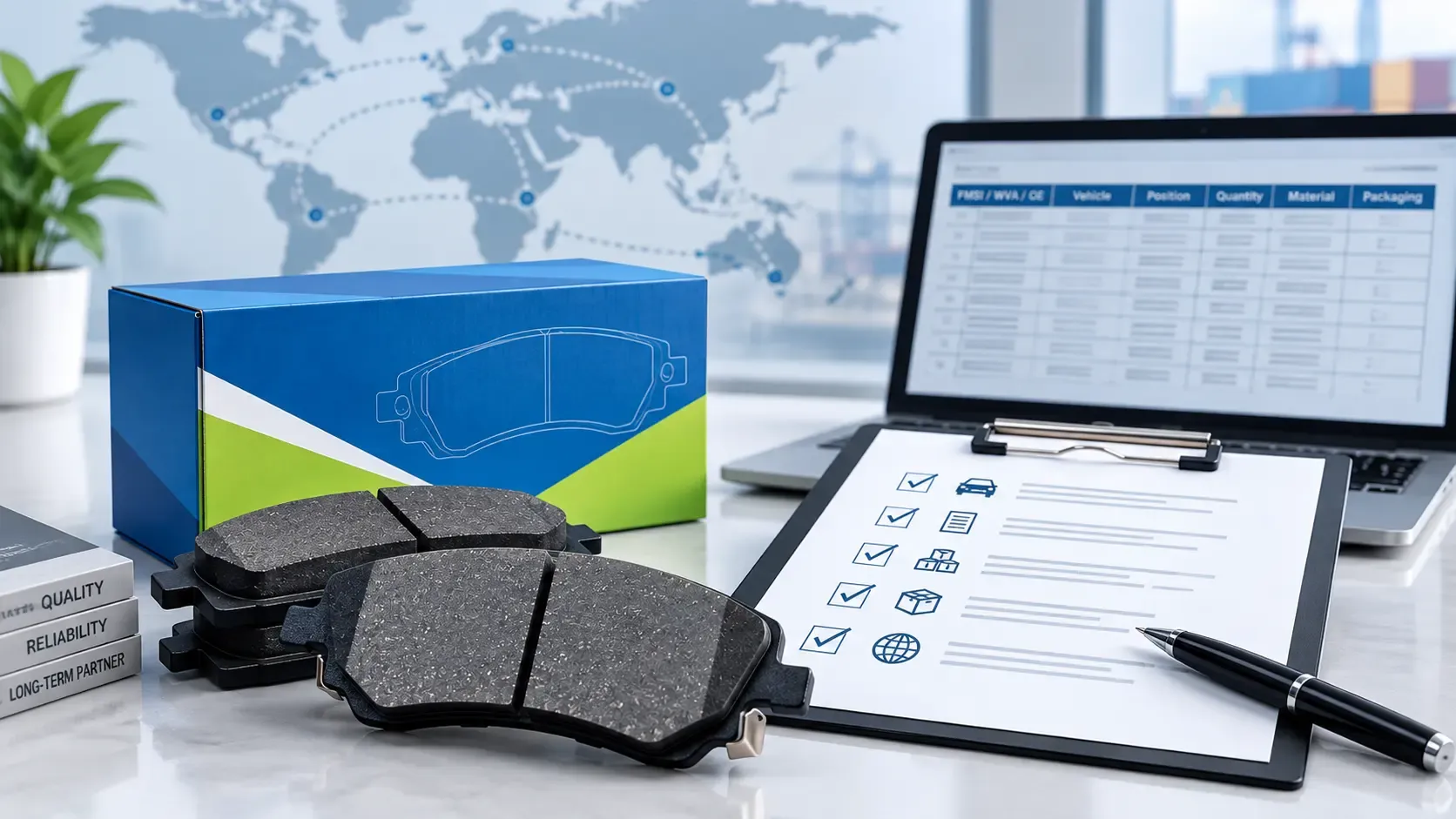
A practical RFQ can contain columns such as:
FMSI / WVA / OE | Vehicle | Position | Qty | Material | Accessories | Packaging |
|---|---|---|---|---|---|---|
Reference 1 | Application | Front | 100 | Ceramic | Shim | Private Label |
Reference 2 | Application | Rear | 50 | Ceramic | Standard | Private Label |
You can then add your general requirements separately:
Market:
Certification requirement:
Trade term:
Destination:
Quotation currency:
Sample requirement:
This format allows both sides to identify missing information before an order reaches production.
Why the Cheapest Quotation May Not Actually Be the Cheapest
Suppose Supplier A quotes $5.00 and Supplier B quotes $5.50.
At first glance, Supplier A appears cheaper.
But what if Supplier B's quotation includes the required shim, hardware and custom packaging while Supplier A's does not?
You are no longer comparing the same product.
This is why professional brake pad sourcing should begin with a clear specification.
A good RFQ does not just help you get a price. It helps you get comparable prices.
That difference matters when you are managing dozens or hundreds of references.
Brake Pad RFQ Checklist
Before sending your next inquiry, check whether you have included:
✓ FMSI, WVA, OE or another reference number
✓ Vehicle application
✓ Front or rear position
✓ Estimated quantity by reference
✓ Friction-material requirement
✓ Hardware and accessories
✓ Packaging requirement
✓ Target market
✓ Certification or documentation requirements
✓ Trade terms and destination
✓ Sample requirements
You do not necessarily need every item for the first conversation.
But the more complete the information is, the faster a supplier can move from a rough estimate to a meaningful commercial quotation.
Need a Brake Pad Quotation?
If you already have a brake pad purchasing list, you do not need to reorganize everything before contacting us.
Send us your existing Excel sheet, OE list, FMSI/WVA references or current product list.
Xinzhong Brake can help review the references and prepare a quotation according to your target market, quantity, friction-material and packaging requirements.
For private-label and wholesale brake pad projects, contact us with your product list to start the RFQ review.