OEM & Manufacturing Insights
How to Start Your Own Brake Pad Brand in 2026
Learn how to start your own brake pad brand, from vehicle selection and friction materials to OEM manufacturing, MOQ, packaging and quality testing.
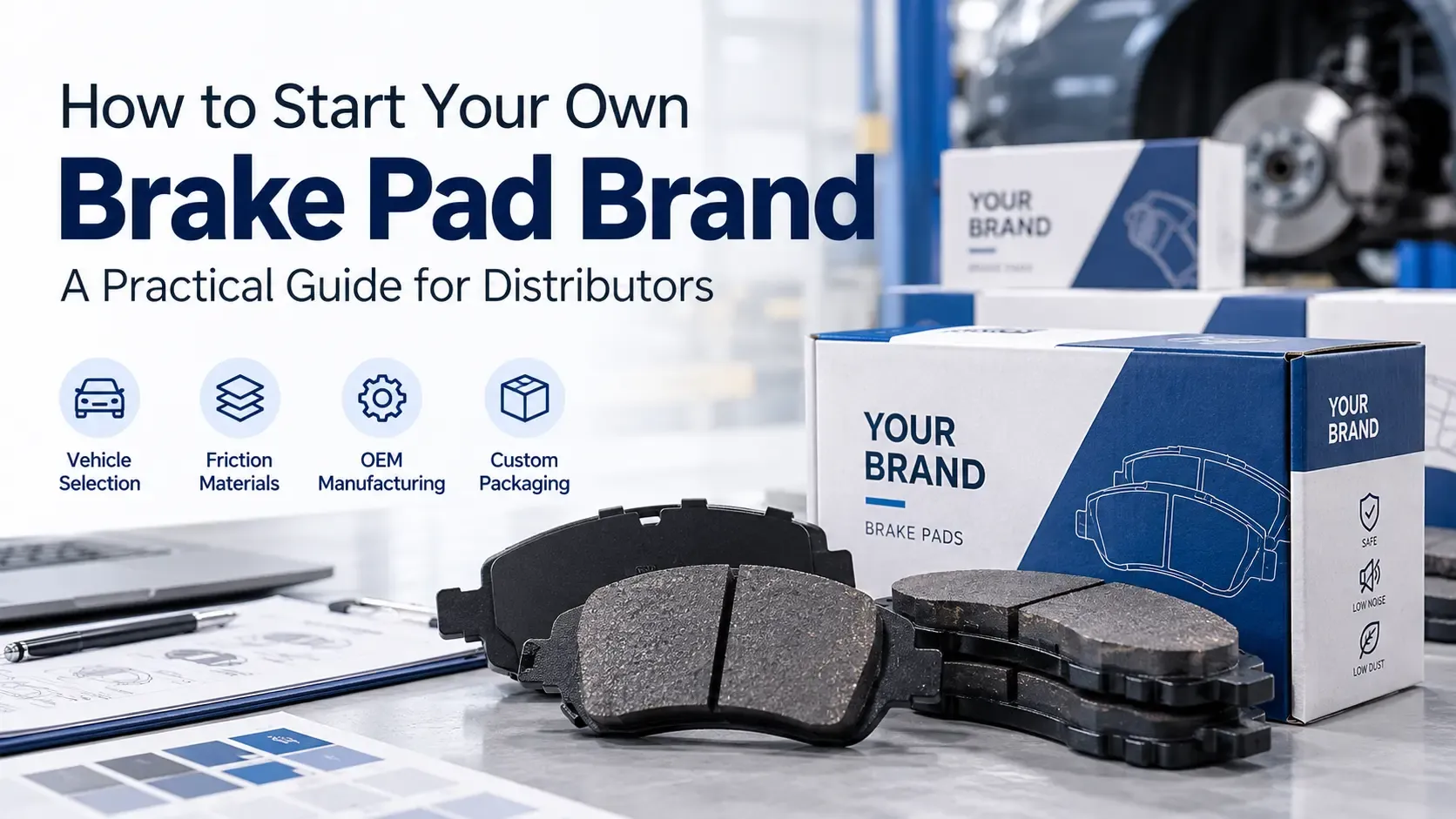
How to Start Your Own Brake Pad Brand: A Practical Guide for Distributors
Starting your own brake pad brand can be an attractive opportunity for automotive parts distributors, wholesalers, and importers.
Instead of competing only by selling existing brands, private label brake pads allow you to develop your own product identity, build customer relationships, and potentially improve long-term margins.
But launching a brake pad brand involves more than printing your logo on a box.
You need to select the right vehicle applications, choose suitable friction materials, evaluate manufacturing quality, and manage your initial inventory carefully.
This guide explains seven practical steps to help you start a private label brake pad business.
1. Understand Your Target Market Before Choosing Products
One of the biggest mistakes new brake pad brands make is trying to cover too many vehicle models from the beginning.
A better approach is to start with the vehicles that generate consistent demand in your market.
For example:
- Middle Eastern markets: Toyota, Nissan, Hyundai, Kia, and popular Chinese vehicle brands.
- Southeast Asian markets: Toyota, Honda, Perodua, Proton, and other locally popular models.
- African markets: Toyota, Nissan, Hyundai, and various Japanese and Korean applications.
- European markets: Volkswagen, BMW, Mercedes-Benz, Audi, and other established brands.
These are general examples. Actual demand varies by country and should be verified using local sales data.
Before contacting a manufacturer, prepare a list of your 10–20 most frequently requested brake pad applications.
Whenever possible, include OE numbers, FMSI references, vehicle production years, and front or rear axle positions.
Starting with the right products is more important than starting with a large catalog.
2. Choose the Right Brake Pad Friction Material
Your friction material selection will influence how customers experience your brand.
Three common options are:
Ceramic Brake Pads
Ceramic formulations are often selected for passenger vehicles where braking comfort, noise, and dust performance are important.
They can be suitable for distributors positioning their brands in the mid-range or premium aftermarket.
Semi-Metallic Brake Pads
Semi-metallic formulations contain metallic components and are widely used across automotive applications.
Depending on the formulation, they can provide effective braking performance under demanding operating conditions.
Low-Metallic NAO Brake Pads
Low-metallic non-asbestos organic formulations offer another approach to balancing friction performance, noise, wear, and cost.
There is no universally superior friction material.
The correct choice depends on vehicle application, operating conditions, local customer preferences, and the performance of the specific formulation.
When discussing options with your manufacturer, ask for available technical information and relevant test results.
3. Find a Reliable OEM Brake Pad Manufacturer
Choosing the right manufacturing partner is one of the most important decisions when launching a private label brake pad brand.
A reliable manufacturer should offer more than competitive pricing. Look for consistent product quality, suitable friction material options, accurate vehicle coverage, and clear communication.
Before making a decision, consider checking:
- Manufacturing facilities and production capabilities.
- Quality management certifications.
- Available brake pad reference numbers.
- Friction material options and testing procedures.
- Private label packaging capabilities.
- Minimum order quantities and production lead times.
If you're planning to visit China, automotive trade shows can be a great opportunity to evaluate potential suppliers in person.
For example, Automechanika Shanghai 2026, taking place from December 2–5, brings together automotive aftermarket manufacturers and buyers from around the world.
Instead of relying only on catalogs and emails, you can examine actual brake pad samples, compare manufacturing capabilities, and discuss your private label requirements directly with suppliers.
A short face-to-face conversation can often reveal details that are difficult to evaluate through online communication alone.
4. Understand MOQ and Your Initial Investment
MOQ, or minimum order quantity, is a common concern for new brake pad brands.
Some buyers assume they must order thousands of sets for every reference.
In reality, MOQ policies vary depending on the manufacturer, product availability, packaging requirements, and whether new tooling is needed.
For example, an existing brake pad model may have different production requirements from a model requiring a new mold.
Before placing an order, ask:
- What is the MOQ per reference?
- Can multiple references be combined in one order?
- Is customized packaging available for smaller quantities?
- Are there additional costs for new tooling?
- Can repeat orders use the same specifications and packaging?
For new brands, a focused initial range often makes more commercial sense than purchasing hundreds of slow-moving references.
5. Develop Your Private Label Packaging
Packaging plays an important role in how customers recognize and remember your brand.
Professional brake pad packaging should be attractive, practical, and informative.
Common customization options include:
- Brand name and logo.
- Custom printed retail boxes.
- Product reference labels.
- Vehicle application information.
- Barcodes and batch identification.
- Installation or safety information where required.
Make sure that packaging claims are accurate and that required product labeling complies with your destination market's regulations.
A strong brand is not built by packaging alone, but consistent packaging helps establish a recognizable identity.
6. Test Samples Before Placing a Bulk Order
Brake pads are safety-critical products, so sample evaluation should never be skipped.
Before committing to a commercial order, request samples for your priority applications.
Your evaluation may include:
- Dimensional and fitment verification.
- Friction performance.
- Noise and vibration behavior.
- Wear characteristics.
- Rotor compatibility.
- Packaging and labeling quality.
Ask your manufacturer about relevant testing, such as SAE J2522 friction performance testing and SAE J2521 noise evaluation.
For markets requiring product-specific approvals, verify the relevant certification requirements before importing or selling.
Sample testing helps reduce uncertainty, but it should be combined with ongoing production quality controls.
7. Build a Long-Term Relationship with Your Manufacturer
Launching your first brake pad order is only the beginning.
As your brand grows, you may need to expand your vehicle coverage, introduce additional friction formulations, and improve your packaging.
A reliable manufacturing partner should support these developments while maintaining consistent product specifications.
Discuss future requirements early, including:
- Additional vehicle applications.
- Repeat-order consistency.
- Production planning.
- Quality feedback and complaint handling.
- New product development.
- Branding and packaging updates.
The best supplier relationship is not simply about obtaining the lowest price today.
It is about building a dependable supply chain that supports your brand over time.
How Xinzhong Brake Supports Private Label Brake Pad Brands
At Xinzhong Brake, we work with international automotive aftermarket distributors and private label customers.
Our manufacturing capabilities include:
- More than 3,000 brake pad reference numbers.
- Ceramic, semi-metallic, and low-metallic NAO friction material options.
- OEM and private label manufacturing.
- Customized branding and packaging.
- ISO 9001 and IATF 16949 quality management systems.
- Friction performance and noise testing capabilities.
Whether you're launching a new brand or expanding an existing product range, we can help review your vehicle applications, product requirements, and manufacturing options.
Planning to attend Automechanika Shanghai 2026?
We'd be happy to meet you in person!
Xinzhong Brake will be exhibiting at Hall 7.1, Booth E86 (7.1E86), December 2–5, 2026.
Feel free to bring your frequently purchased OE or FMSI references, packaging ideas, or questions about friction materials.
Let's discuss how we can turn your private label brake pad project into a practical manufacturing plan.
You can also learn more about our participation in Automechanika Shanghai 2026 and arrange a meeting with our team before the show.
Frequently Asked Questions
Can I start my own brake pad brand without owning a factory?
Yes. Private label manufacturing allows distributors and importers to develop products under their own brands while working with an established brake pad manufacturer.
How much does it cost to start a brake pad brand?
The initial investment depends on the number of references, order quantities, packaging design, tooling requirements, testing, regulatory compliance, and logistics. There is no universal startup cost.
What is the minimum order quantity for private label brake pads?
MOQ varies by manufacturer, product reference, and customization requirements. Contact the manufacturer with your target models and estimated quantities for a specific assessment.
Can I customize the friction material?
Manufacturers may offer different existing formulations or discuss application-specific development. Availability depends on technical feasibility, validation requirements, and commercial conditions.
How many brake pad models should I launch first?
For many new distributors, beginning with 10–20 proven, fast-moving applications is a practical starting point. The final selection should be based on actual local demand and inventory budget.
Conclusion: Start Small, Build Quality, Grow Your Brand
Building a successful brake pad brand takes more than a logo and a competitive price.
It requires the right vehicle applications, consistent product quality, careful inventory planning, and a manufacturing partner who understands your business goals.
Start with the products your market needs most, validate their performance, and expand your range as customer demand grows.
Looking for a private label brake pad manufacturer in China?
Xinzhong Brake supports international distributors with brake pad manufacturing and customized branding solutions.
Send us your target market, preferred vehicle applications, and estimated order quantities.
Our team will be happy to discuss the available options.