Industry Trends & Market Insights
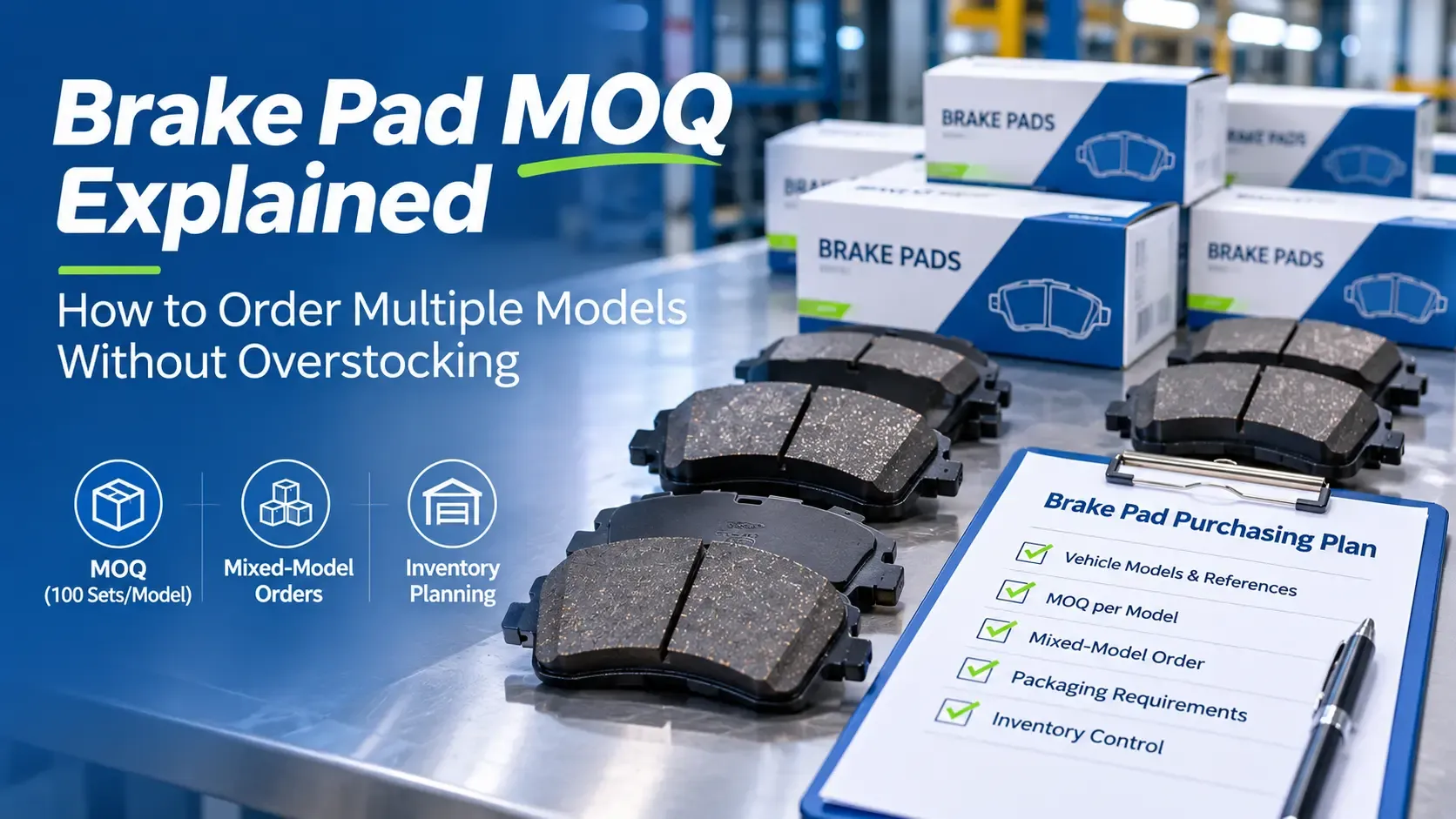
Brake Pad MOQ Explained: How to Order Multiple Models Without Overstocking
Understand brake pad MOQ, mixed-model orders, private label packaging and tooling requirements. Learn how to source wholesale brake pads without excess inventory.
Brake Pad MOQ Explained: How to Order Multiple Models Without Overstocking
A practical purchasing guide for automotive parts importers, wholesalers, and private label distributors.
When sourcing brake pads from China, one of the first questions buyers ask is:
What is your minimum order quantity?
The answer may sound simple. However, brake pad MOQ depends on several factors, including the product reference, friction material, production arrangements, packaging requirements, and whether new tooling is needed.
For distributors handling dozens of vehicle applications, understanding these factors can make a significant difference to inventory costs and purchasing efficiency.
In this guide, we'll explain how brake pad minimum order quantities work, whether you can combine different models in one shipment, and how to plan a practical first order.
1. What Does MOQ Mean in Brake Pad Manufacturing?
MOQ stands for Minimum Order Quantity.
In brake pad manufacturing, MOQ usually refers to the minimum quantity required for a specific product reference, rather than the total number of brake pads in an order.
For example, a manufacturer may require 100 sets per reference.
If you need five different brake pad references, the minimum order could be:
Brake Pad Reference | Quantity |
|---|---|
Model A | 100 sets |
Model B | 100 sets |
Model C | 100 sets |
Model D | 100 sets |
Model E | 100 sets |
Total | 500 sets |
This is an illustrative example, not a universal industry standard.
Different manufacturers may have different MOQ policies.
It is also important to clarify whether a supplier's quotation uses sets, individual pieces, or axle sets.
For many passenger car brake pad applications, one set contains four friction pads for one axle. However, configurations can vary, particularly for commercial vehicles.
Always confirm the quotation unit before comparing prices.
2. Why Do Brake Pad Manufacturers Require an MOQ?
MOQ is not simply a commercial restriction.
It is often related to production efficiency and manufacturing costs.
Brake pad production involves several operations, such as:
- Preparing friction material formulations.
- Arranging backing plates and other components.
- Molding and curing.
- Grinding and finishing.
- Inspection and packaging.
Producing very small quantities of multiple references can increase setup costs and reduce production efficiency.
For example, manufacturing 20 sets of five different models may require more production changes than manufacturing 100 sets of one model.
MOQ helps manufacturers balance production efficiency, material utilization, and order management.
However, minimum quantities may vary depending on available components, existing production schedules, and the manufacturer's operating arrangements.
3. Can You Mix Different Brake Pad Models in One Order?
Yes. Many manufacturers can arrange mixed-model orders, provided the minimum quantity for each reference is met.
This is particularly useful for distributors serving markets with diverse vehicle populations.
For example, an importer may need brake pads for:
- Toyota Corolla.
- Toyota Camry.
- Toyota Hilux.
- Honda Civic.
- Hyundai Tucson.
- Kia Sportage.
Instead of purchasing a large quantity of only one reference, the distributor can build a product range covering several popular applications.
However, mixed-model ordering does not automatically mean that the MOQ per reference is waived.
Before placing an order, confirm:
- The MOQ for each reference.
- Whether different friction materials can be included.
- Whether all models can be shipped together.
- Whether customized packaging affects minimum quantities.
- Whether production lead times differ between references.
A clear purchasing list helps both parties evaluate the order more efficiently.
4. How to Avoid Excess Inventory When Ordering Brake Pads
For importers, inventory management is often more important than obtaining the lowest possible unit price.
Ordering too many slow-moving brake pad references can tie up working capital and increase storage costs.
Here are three practical strategies.
Start With Your Fast-Moving Applications
Review your sales history or local market demand.
Identify the vehicle models that generate consistent replacement demand.
For a new distributor, starting with 10–20 carefully selected references may be more manageable than launching hundreds of models immediately.
The right number depends on your market and available budget.
Prioritize Proven References
Whenever possible, confirm OE, FMSI, or WVA references before ordering.
Vehicle model names alone may not be sufficient because different production years and brake systems can use different pads.
Accurate reference matching helps reduce returns and unsuitable inventory.
Plan Repeat Orders Instead of Overbuying
Rather than purchasing excessive quantities in the first shipment, consider a phased purchasing strategy.
Start with a focused range, monitor sales performance, and expand quantities based on actual demand.
Discuss production lead times and reorder planning with your manufacturer to avoid unnecessary stock shortages.
5. Does Private Label Packaging Affect MOQ?
Yes, it can.
Private label brake pads allow distributors to sell products under their own brands, but customized packaging may introduce additional minimum quantities.
For example, printed retail boxes are usually produced by packaging suppliers.
The packaging supplier may require a minimum production quantity for each box size or design.
This quantity is not necessarily the same as the brake pad production MOQ.
A manufacturer might accept 100 sets per brake pad reference while the packaging supplier requires a larger number of printed boxes.
Possible solutions include:
- Using one standardized box design across several compatible references.
- Applying reference-specific labels.
- Producing packaging for planned repeat orders.
- Starting with neutral packaging before introducing fully customized boxes.
Always confirm packaging requirements separately from brake pad manufacturing quantities.
6. What If Your Brake Pad Model Requires New Tooling?
Not every brake pad reference is available with existing production tooling.
Some applications, particularly newer vehicle models or less common regional vehicles, may require additional tooling development.
In these cases, the manufacturer may need to evaluate:
- Technical drawings and product dimensions.
- Backing plate specifications.
- Mold development costs.
- Expected purchasing volume.
- Sample validation requirements.
- Production feasibility.
New tooling costs should be discussed separately from regular product pricing.
A low initial order quantity does not necessarily make a new-tooling project commercially practical.
For buyers developing a private label brand, it is useful to distinguish between existing references and products requiring new development.
7. What Is Xinzhong Brake's Minimum Order Quantity?
At Xinzhong Brake, our standard minimum order quantity for regular brake pad models is generally 100 sets per reference.
We support mixed-model orders, allowing customers to combine different eligible references in one purchase.
Our manufacturing capabilities include:
- More than 3,000 brake pad references.
- Ceramic, semi-metallic, and low-metallic NAO friction materials.
- OEM and private label brake pad manufacturing.
- Custom packaging options.
- ISO 9001 and IATF 16949 quality management systems.
- Product testing and quality inspection.
For new customers, we can review the required references and discuss suitable friction material options before quotation.
Our usual first-order production lead time is approximately 45–60 days, depending on the references, order quantities, material availability, and production schedule.
New tooling and special packaging requirements may affect the timeline.
Can I Request Samples Before Bulk Production?
Yes. We generally provide regular brake pad samples free of charge, with international shipping costs covered by the customer.
Sample availability and preparation time depend on the requested references.
We recommend confirming fitment and evaluating product performance before committing to a larger commercial order.
8. Meet Xinzhong Brake at Automechanika Shanghai 2026
If you're planning to visit China this December, we'd be happy to discuss your brake pad sourcing requirements in person.
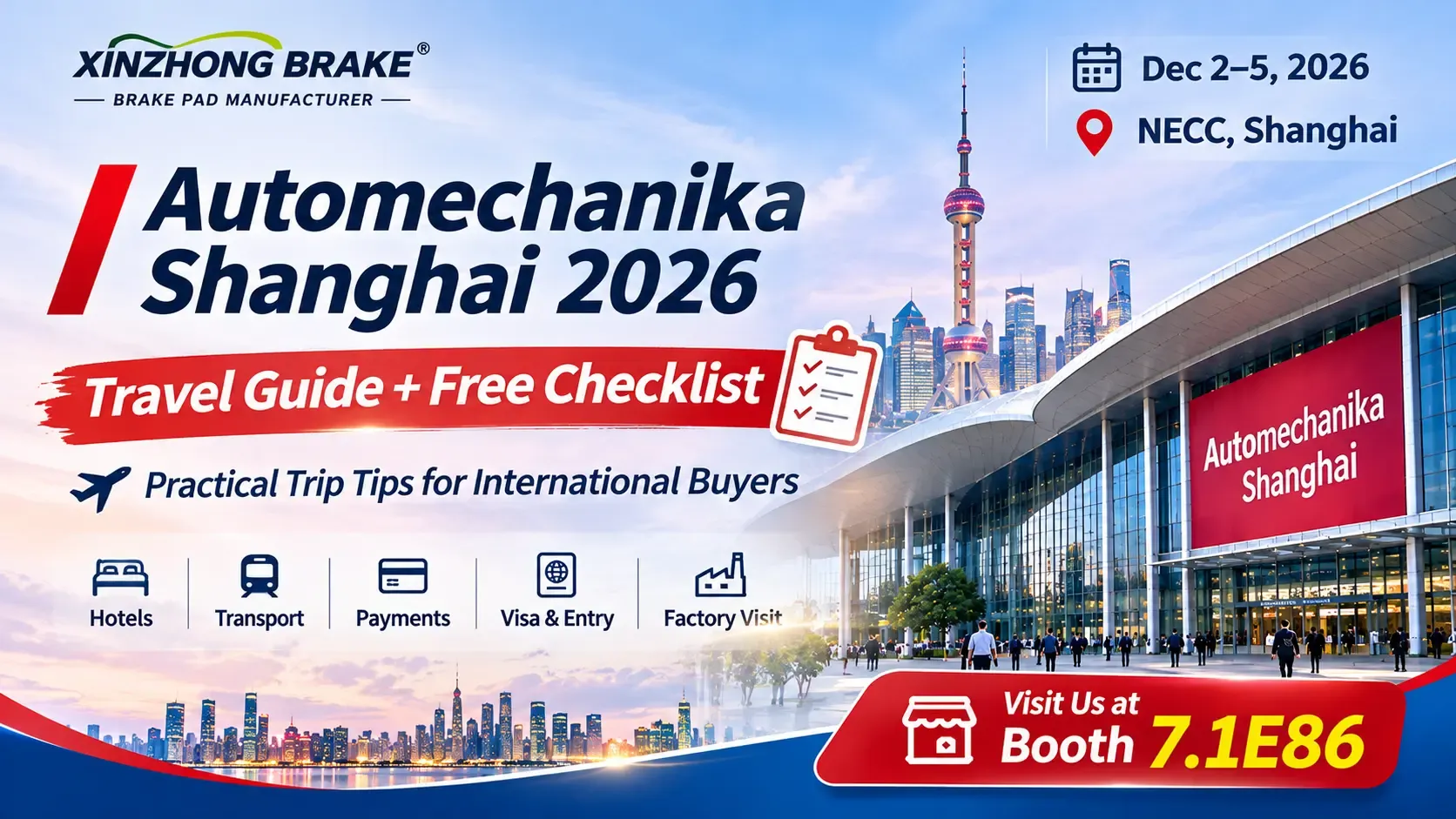
Xinzhong Brake will participate in Automechanika Shanghai 2026, December 2–5.
You can find us at:
Hall 7.1 | Booth E86 (7.1E86)
Bring your brake pad reference list, estimated purchasing quantities, or private label packaging ideas.
We can discuss model availability, friction material options, minimum order quantities, and production planning.
If you'd like to prepare in advance, visit our article about Automechanika Shanghai 2026 and Xinzhong Brake's exhibition participation for more details.
Frequently Asked Questions About Brake Pad MOQ
What is the typical MOQ for wholesale brake pads?
MOQ varies by manufacturer and product reference. Some manufacturers set minimum quantities per model, while others may offer different arrangements depending on production conditions.
Xinzhong Brake's standard MOQ for regular brake pad models is generally 100 sets per reference.
Can I order 50 sets of several different brake pad models?
This depends on the manufacturer's MOQ policy. At Xinzhong Brake, our standard requirement for regular models is 100 sets per reference. Special arrangements would need to be evaluated individually and should not be assumed.
Can ceramic and semi-metallic brake pads be included in the same shipment?
Yes, different friction material products can generally be combined in one shipment, subject to reference availability, minimum quantities, and production arrangements.
Is the MOQ the same for custom-branded brake pads?
Not always. Custom packaging and branding may involve additional minimum quantities or setup costs.
Does ordering more brake pads reduce the price?
Larger quantities may improve production efficiency and offer opportunities for more competitive pricing, but this depends on the reference, formulation, packaging, and overall order structure.
Conclusion: Build a Smarter Brake Pad Purchasing Plan
Understanding brake pad MOQ helps importers make better sourcing decisions.
Instead of focusing only on the minimum quantity, consider the complete purchasing picture: product demand, reference accuracy, friction materials, packaging requirements, production lead times, and inventory turnover.
For many distributors, a carefully planned mixed-model order is more useful than a large order concentrated in slow-moving products.