Sep 17, 2026OEM & Manufacturing Insights
Brake Pad Testing & Quality Control for Importers
Learn what brake pad importers and distributors should check before bulk orders, from friction performance and shear strength to dimensions, batch consistency and pre-shipment inspection.
Brake Pad Testing & Quality Control: What Importers Should Check Before Bulk Orders
A brake pad sample can look good, fit correctly and perform well during a short road test.
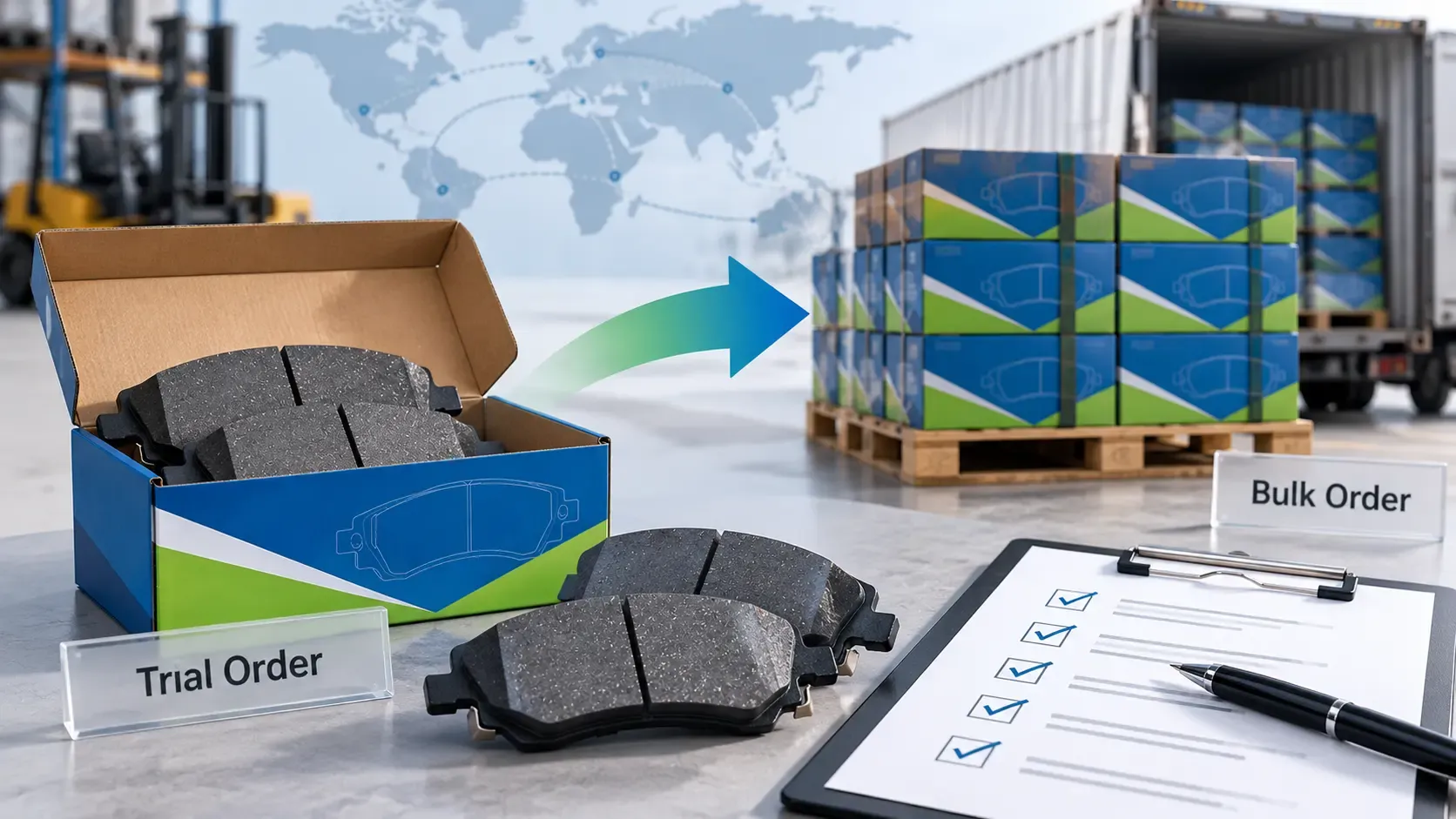
But that does not automatically mean the next 5,000 or 10,000 sets will deliver the same quality.
For brake pad importers and distributors, the real question before placing a bulk order is not simply:
“Can you guarantee the quality?”
Almost every supplier will say yes.
A better question is:
“How do you control and verify quality from raw materials to finished production?”
For B2B buyers, understanding a supplier’s testing and quality-control process can reduce quality claims, fitment problems and inconsistent performance after products enter the market.
Why Sample Approval Is Not Enough
Samples are important, especially when working with a new brake pad manufacturer. They allow buyers to check pad shape, dimensions, accessories, packaging and initial braking performance.
However, samples represent only a very small part of production.
Bulk orders introduce additional variables, including:
- Raw material consistency
- Mixing and formulation control
- Pressing and curing conditions
- Backing plate quality
- Production tolerances
- Batch-to-batch consistency
- Packaging and labeling accuracy
This is why sample approval should be treated as the beginning of quality verification rather than the end of it.
For a more detailed sample evaluation process, see our guide on How to Evaluate Brake Pad Samples Before Bulk Orders.
1. Check Friction Material Performance
The friction material is one of the most important factors affecting brake pad performance.
Depending on the target market, vehicle application and product positioning, buyers may source different formulations such as:
- Ceramic
- Semi-metallic
- Low-metallic
- Copper-free ceramic
The important point is not simply which formulation sounds more premium.
Importers should understand whether the selected formulation can provide appropriate and reasonably consistent friction performance under its intended operating conditions.
When evaluating a supplier, ask whether friction material performance is tested and whether relevant test data can be provided.
For private-label programs, the formulation should also be clearly defined before mass production so that the approved sample and bulk order are based on the same specification.
2. Review Braking Performance Test Data
A brake pad should not be evaluated only by appearance or material description.
Braking performance testing can provide buyers with more useful technical evidence about how a formulation behaves under controlled test conditions.
Depending on the manufacturer and testing capability, reports may include information relating to friction behavior, braking effectiveness, temperature response or other performance characteristics.
Importers do not necessarily need to become laboratory engineers.
But they should be able to ask:
What was tested?
Which formulation was tested?
Does the report correspond to the product I am buying?
This last question matters.
A supplier having a test report does not automatically mean every brake pad in its catalog uses exactly the same formulation or has identical performance.
3. Check Shear Strength and Bonding
Friction performance receives most of the attention, but the bond between the friction material and backing plate is also critical.
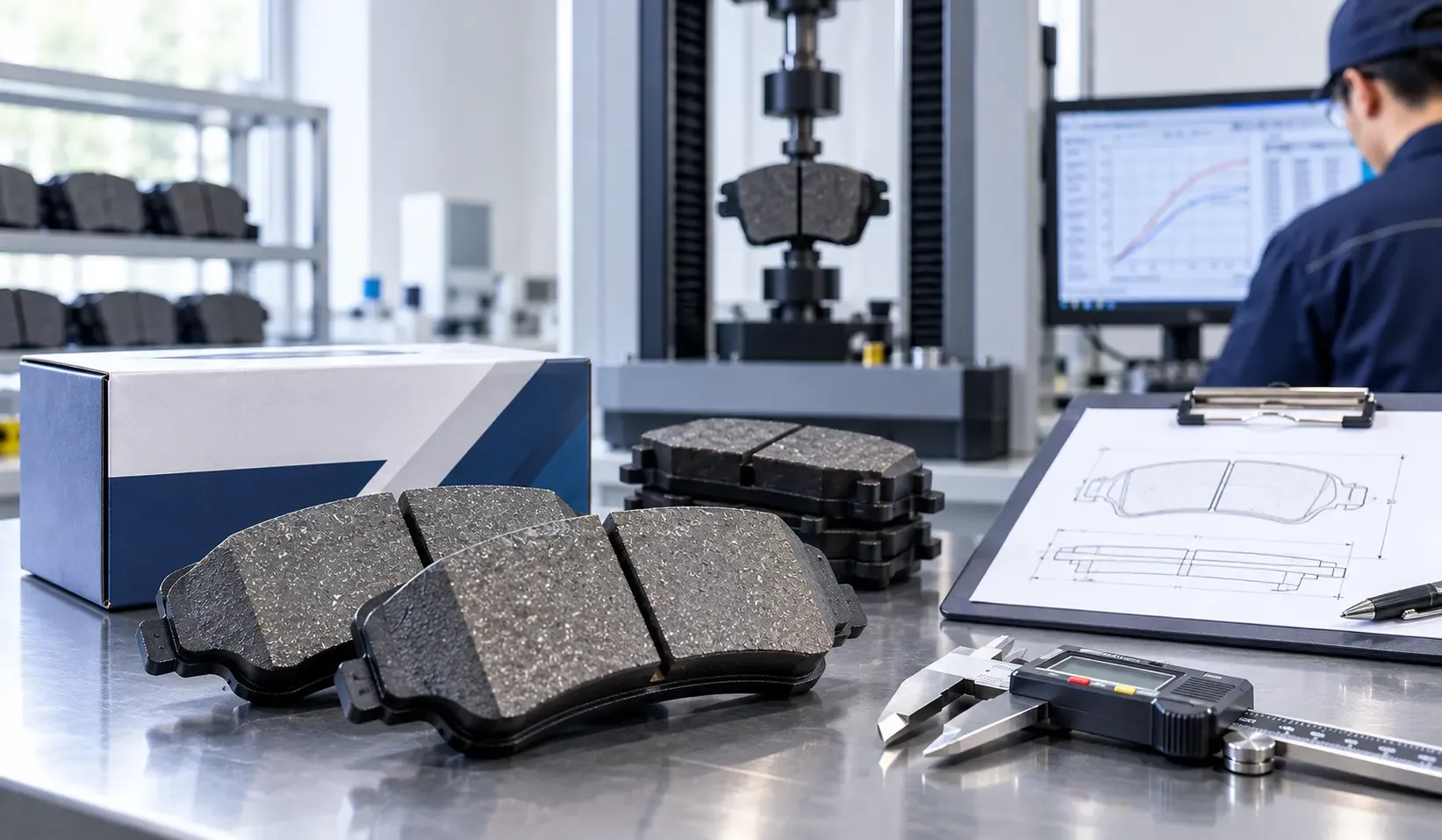
Shear strength testing helps evaluate how securely the friction material is attached to the backing plate.
For distributors sourcing brake pads in volume, this is particularly relevant because poor bonding can create serious quality problems even when the friction material itself is acceptable.
Buyers can ask the manufacturer whether shear testing is part of its quality-control process and whether representative reports are available.
The purpose is not simply to collect another PDF.
It is to understand whether the manufacturer has a repeatable method for verifying product construction.
4. Verify Dimensions and Fitment Before Production
One of the most avoidable problems in brake pad sourcing is ordering the wrong reference.
Vehicle names alone are often not enough.
The same model may use different brake systems depending on:
- Model year
- Engine
- Trim level
- Market
- Axle position
- Brake system configuration
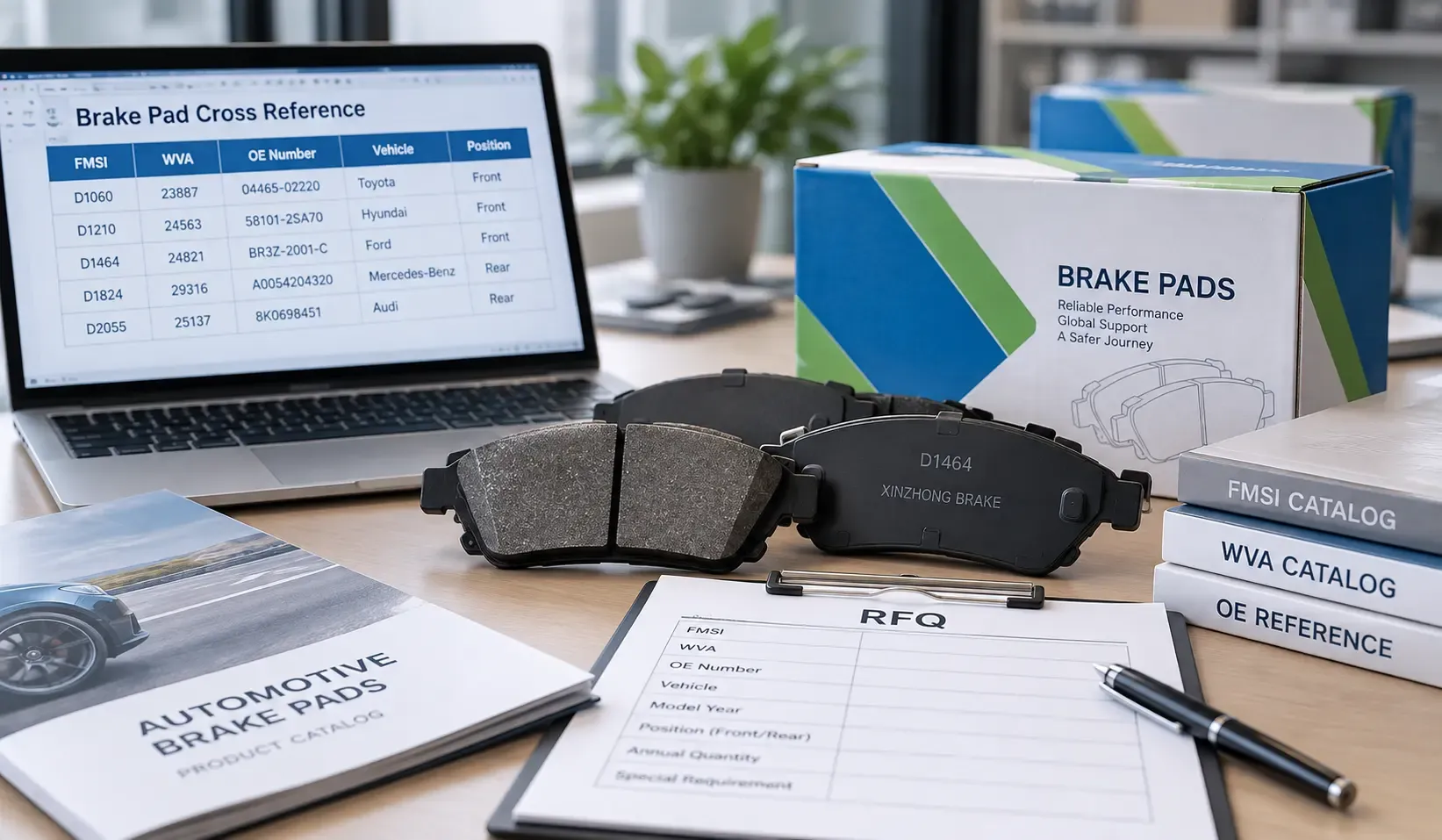
Before bulk production, buyers should confirm the product using several identifiers whenever possible:
FMSI / WVA reference + OE number + dimensions + pad shape + vehicle application
For critical references, checking a drawing or physical sample can further reduce fitment risk.
This is particularly important when developing a new market or purchasing references from a supplier for the first time.
You can also read our guide on How to Read Brake Pad Numbers: FMSI, WVA and OE Numbers for more information about brake pad identification.
5. Ask How Batch Consistency Is Controlled
This is where B2B quality control becomes very different from buying a few replacement sets.
A distributor does not only need one good brake pad.
It needs the first shipment, second shipment and future repeat orders to remain reasonably consistent with the approved specification.
Before placing volume orders, ask the supplier how it controls:
- Friction material formulation
- Raw material batches
- Mixing parameters
- Pressing process
- Heat treatment or curing
- Product dimensions
- Surface finishing
- Accessories
- Packaging
The goal is not to demand that every production unit be individually laboratory-tested.
The goal is to determine whether the factory has a controlled manufacturing process rather than relying primarily on final visual inspection.
6. Confirm In-Process and Final Inspection
Quality control should not happen only after production is finished.
A more complete system includes checks at different stages of manufacturing.
Depending on the product and factory process, these may include incoming material inspection, production parameter control, dimensional checks, appearance inspection and final product inspection.
Before shipment, buyers may also want confirmation of:
- Product reference and quantity
- Pad dimensions
- Accessories
- Labels
- Private-label printing
- Inner boxes and cartons
- Shipping marks
For private-label orders, packaging inspection deserves particular attention.
A perfectly manufactured brake pad packed under the wrong reference number can still become a costly commercial problem.
7. Make Sure the Test Report Matches Your Product
This is one of the easiest details for buyers to overlook.
When a supplier sends a test report, do not stop at seeing the words “PASS” or a laboratory stamp.
Check what the report actually represents.
For example:
Which brake pad or formulation was tested?
When was it tested?
What test was performed?
Which standard or method was used?
Can the supplier explain the important results?
Technical documents are useful only when they can be connected to the product being purchased.
A large folder full of certificates and reports is not automatically evidence that every reference in a supplier’s catalog has undergone every test shown.
Good sourcing decisions require understanding the scope of the evidence.
8. Define Quality Requirements Before the Purchase Order
Many quality disputes actually begin before production.
The buyer expects one thing.
The supplier assumes another.
Production starts without enough details being confirmed.
For bulk brake pad orders, important specifications should therefore be agreed before production, including:
- Product reference
- Vehicle application
- Friction formulation
- Dimensions
- Accessories
- Branding
- Packaging
- Labels
- Quantity
- Inspection requirements
For private-label projects, artwork and packaging specifications should also be approved before mass production.
Clear specifications reduce ambiguity when the finished goods are inspected.
A Practical Pre-Order Checklist for Brake Pad Importers
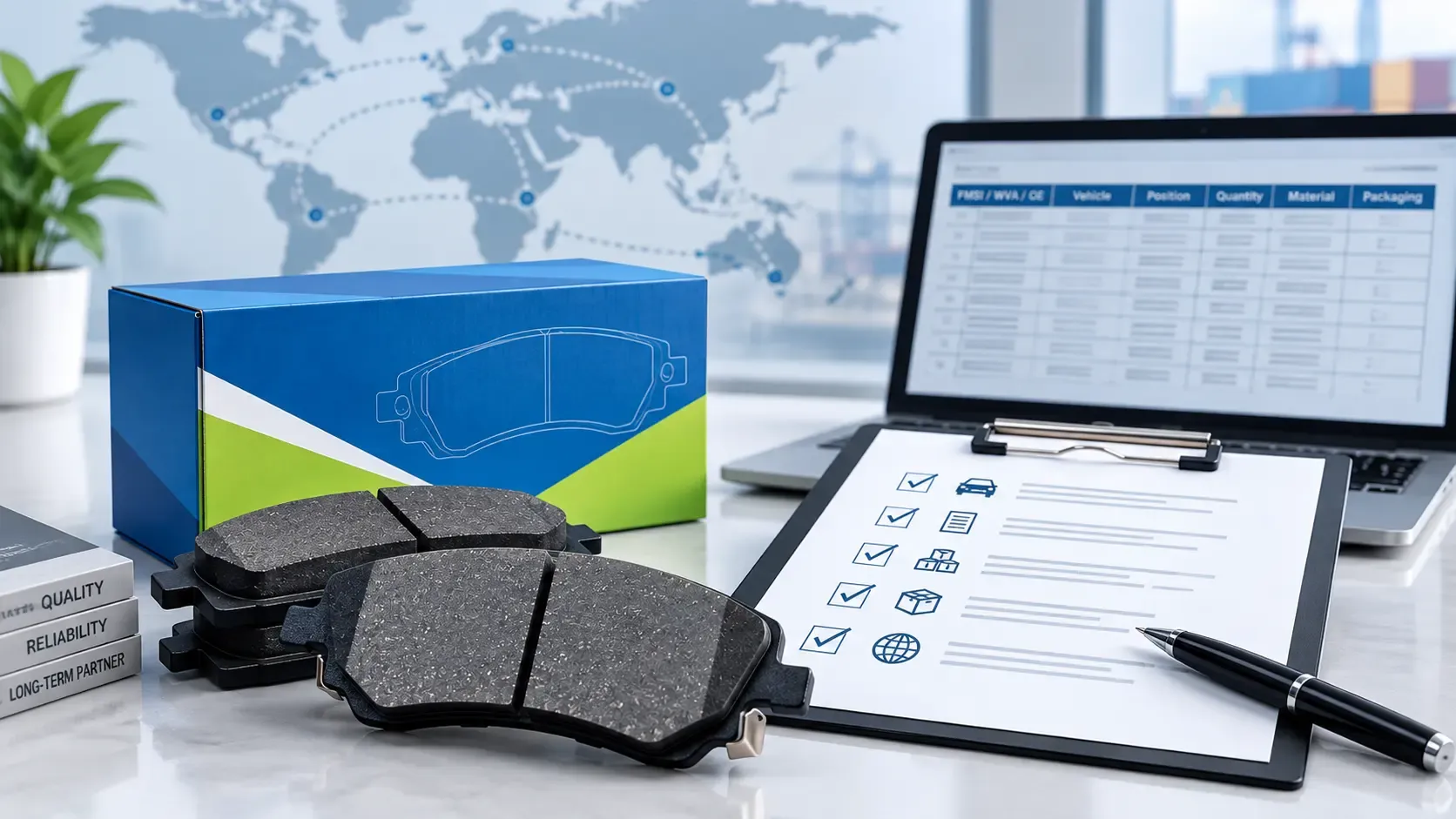
Before confirming a significant brake pad order with a new supplier, buyers should ideally be able to answer the following questions:
Check | What the Buyer Should Confirm |
|---|---|
Product identification | FMSI/WVA/OE, dimensions, shape and application |
Friction formulation | Ceramic, semi-metallic, low-metallic or other agreed formulation |
Performance evidence | Relevant available testing or technical data |
Bonding | Shear strength / bonding verification where applicable |
Sample | Approved before mass production |
Batch control | Production follows the agreed formulation and specifications |
Dimensions | Critical dimensions checked during production |
Accessories | Shims, clips, sensors or hardware confirmed |
Branding | Logo and printing approved |
Packaging | Box, labels, carton and shipping marks approved |
Final inspection | Quantity, appearance and specifications checked before shipment |
This checklist does not replace market-specific regulatory requirements or professional testing.
It gives importers a practical framework for discussing quality with a brake pad manufacturer before committing to volume.
Quality Control Is About Repeatability, Not One Perfect Sample
For distributors and importers, brake pad quality is not proven by one attractive sample.
The real test is whether the supplier can reproduce the agreed product consistently across hundreds or thousands of sets and across repeat orders.
That requires more than a final inspection.
It requires controlled materials, controlled production, appropriate testing, traceable specifications and clear communication between buyer and manufacturer.
Quality control is only one part of supplier evaluation. Buyers should also review manufacturing capability, communication and order-management processes before choosing a long-term partner.
When evaluating a new supplier, therefore, do not ask only:
“Is your quality good?”
Ask:
“Show me how you make sure the next batch is the same as the one I approved.”
That question tells you much more.
Discuss Your Brake Pad Sourcing Requirements
Xinzhong Brake supplies brake pads for distributors, importers and private-label programs.
If you are evaluating a new brake pad supplier, you can send us your OE numbers, FMSI/WVA references, vehicle application list or target-market requirements.
We can review the references with you and discuss available formulations, samples, packaging and bulk-order requirements.