Sep 23, 2026Brake Pad Knowledge
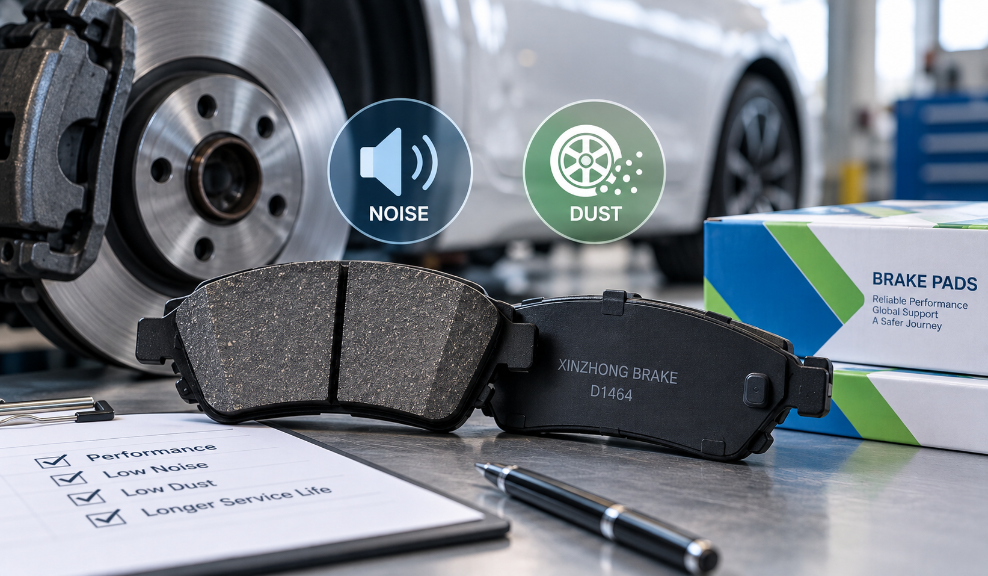
Brake Pad Noise and Dust: What Distributors Should Ask Suppliers
Learn what causes brake pad noise and dust, what suppliers can realistically control, and how distributors should evaluate formulations before bulk orders.
Brake Pad Noise and Dust: What Distributors Should Ask Suppliers
For brake pad distributors and importers, noise and dust are two of the most common performance concerns raised by customers.
A buyer may ask a supplier a seemingly simple question:
“Can you guarantee these brake pads have no noise and no dust?”
The technically responsible answer is not a simple yes.
Brake pad formulation has a major influence on noise and dust, but it is not the only factor. Rotor condition, vehicle design, installation, driving habits, temperature and bedding-in can all affect what the end user experiences.
For distributors, the better question is therefore not:
“Can you guarantee zero noise and zero dust?”
It is:
“What formulation and testing approach can help us achieve the noise, dust and braking characteristics required by our market?”
That difference matters when evaluating a brake pad supplier.
Why Do Brake Pads Produce Noise?
Brake noise is usually related to vibration within the braking system.
When the brake pad contacts the rotor, friction generates forces and vibration. Under certain conditions, these vibrations can become audible as squeal or other braking noises.
Several factors can influence this.
Brake Pad Formulation
Different friction formulations behave differently under temperature, pressure and speed.
The choice and balance of fibers, fillers, abrasives, lubricants, binders and other friction materials can influence both braking performance and NVH characteristics.
This is one reason distributors should not evaluate a formulation based only on whether it is called ceramic, semi-metallic or low-metallic.
If you want a broader comparison of the main friction-material families, see our [Brake Pad Materials: Ceramic vs Semi-Metallic vs Low-Metallic vs NAO] guide.
Rotor Condition
Even a well-designed brake pad may produce noise when paired with:
- Worn rotors
- Uneven rotor surfaces
- Excessive runout
- Corrosion
- Contamination
- Incompatible surface conditions
The brake pad and rotor work as a friction pair. Evaluating the pad without considering the rotor can therefore produce misleading conclusions.
Installation and Brake Hardware
Noise can also be affected by installation quality and related components.
Examples include:
- Incorrect installation
- Missing or damaged clips
- Poorly fitted shims
- Caliper problems
- Uneven pad movement
- Worn braking components
For distributors investigating a noise complaint, it is important to distinguish a friction-material problem from a vehicle or installation problem.
Bedding-In
New pads and rotors need an appropriate contact surface to develop stable friction behavior.
During the initial bedding period, braking characteristics may differ from their later stabilized performance.
A customer complaint immediately after installation therefore needs to be evaluated in context rather than automatically attributed to defective friction material.
Why Do Brake Pads Produce Dust?
Brake dust is a natural result of friction and wear.
During braking, microscopic material is worn from the friction surfaces. The visible amount and appearance of this dust can vary significantly between formulations and operating conditions.
For many passenger-car markets, especially where customers care about clean wheels, low-dust performance can be an important selling point.
But again, “low dust” and “no dust” are not the same thing.
A brake pad that experiences friction and wear cannot realistically be expected to generate absolutely zero particulate material under every operating condition.
Does Ceramic Mean No Dust and No Noise?
No.
This is one of the most common oversimplifications in aftermarket brake pad marketing.
Ceramic formulations are often selected for passenger-car applications where buyers prioritize characteristics such as:
- Lower visible wheel dust
- Comfortable braking
- Lower perceived noise
- Stable everyday performance
But the word ceramic alone does not guarantee those results.
Two suppliers can both describe their products as ceramic while using substantially different formulations.
Performance depends on the complete friction-material design, not simply the category name printed on the box.
Similarly, semi-metallic and low-metallic formulations should not automatically be classified as “noisy” or “bad.” Depending on the application and market, they may provide characteristics that buyers specifically need.
The correct formulation depends on the intended vehicle, operating conditions and target market.
Can a Brake Pad Supplier Guarantee Zero Noise?
Distributors should be cautious when a supplier gives an unconditional 100% no-noise guarantee without discussing the application.
A manufacturer can work to reduce the likelihood of noise through:
- Friction formulation development
- Chamfer and slot design
- Shim selection
- Manufacturing consistency
- Dimensional control
- Performance testing
But the manufacturer does not control every variable after the product leaves the factory.
Rotor condition, installation, caliper condition, driving behavior and operating environment remain outside the brake pad manufacturer's direct control.
A more meaningful discussion is about noise-control targets, formulation history, application suitability and sample validation.
Can a Supplier Guarantee Zero Brake Dust?
The same principle applies to dust.
Suppliers can develop formulations intended to reduce visible dust or achieve particular wear characteristics.
But claiming that a friction product will create absolutely no dust under every vehicle and driving condition is not technically realistic.
For a distributor, a better purchasing requirement might be:
“We need a low-dust formulation for passenger vehicles in our market, with wheel cleanliness and comfortable braking as priorities.”
That gives the manufacturer useful information for formulation selection.
Low Dust, Low Noise and Strong Braking Must Be Balanced
This is where brake pad sourcing becomes more complicated.
A friction formulation is not designed around one variable.
Manufacturers must consider multiple performance characteristics, including:
- Friction coefficient
- Friction stability
- Wear
- Rotor compatibility
- Noise
- Dust
- Temperature performance
- Pedal feel
- Durability
Optimizing one characteristic without considering the others can create a poor overall product.
For example, a distributor should not select a formulation simply because a sample appears to produce very little visible dust during a short test.
The more important question is whether the formulation provides the required overall performance balance for the target application.
What Should Distributors Ask Their Brake Pad Supplier?
Instead of asking only for “no noise and no dust,” give the supplier information about the actual market requirement.
A useful discussion can include:
Question | Why It Matters |
|---|---|
What vehicle applications are involved? | Different vehicles and brake systems have different requirements |
What market will the pads be sold in? | Driving conditions and buyer expectations differ |
Is low dust a major priority? | Helps guide formulation selection |
Is low noise a major priority? | Helps determine NVH-related requirements |
What material type is currently used? | Provides a comparison baseline |
Are there current customer complaints? | Helps identify the problem being solved |
What performance documents are available? | Provides technical evidence beyond sales claims |
Can samples be tested before bulk production? | Allows the buyer to validate the proposed formulation |
This gives the supplier enough information to recommend a formulation rather than simply agreeing to a marketing claim.
Evaluate Noise and Dust During the Sample Stage
For distributors, the sample stage is where expectations should begin turning into evidence.
Do not evaluate samples only by looking at the packaging, backing plate or friction surface.
The samples should help answer questions such as:
- Is braking feel appropriate?
- Is abnormal noise observed?
- What level of visible dust appears?
- Is wear acceptable?
- Does performance remain stable during repeated braking?
- Are the pads physically correct for the intended applications?
Whenever possible, compare the new sample against the product currently sold in your market.
That gives you a practical benchmark instead of judging the new pad in isolation.
Ask for Evidence, Not Just Promises
A supplier saying “our brake pads are very good” tells a professional buyer almost nothing.
For B2B purchasing, performance discussions should gradually move toward verifiable information.
Depending on the project, buyers may review:
- Friction-performance data
- Material information
- Dimensional inspection
- Shear-strength testing
- Wear-related testing
- Production quality-control records
- Relevant certification or compliance information
Testing does not mean every laboratory result can perfectly predict every real-world vehicle condition.
But it gives the buyer substantially more information than an unsupported promise.
For a broader look at what importers should verify, read [Brake Pad Testing & Quality Control for Importers].
How Xinzhong Brake Handles Noise and Dust Requirements
At Xinzhong Brake, we do not recommend choosing a brake pad formulation based only on labels such as “ceramic” or promises such as “zero noise and zero dust.”
We first look at the buyer's:
- Target market
- Vehicle applications
- Existing product positioning
- Noise and dust priorities
- Required braking characteristics
- Price positioning
Xinzhong Brake offers ceramic, semi-metallic, low-metallic and NAO formulations, allowing different programs to be matched with different market requirements.
For new distributor and private-label projects, samples can be used to evaluate the proposed formulation before moving to a larger order.
FAQ
Can Brake Pads Be Completely Dust-Free?
Brake dust is generated through friction and wear, so an absolute zero-dust claim under all operating conditions is not realistic. Formulations can, however, be developed to reduce visible dust depending on the application and performance requirements.
Are Ceramic Brake Pads Always Quieter?
Ceramic formulations are often chosen for applications where comfort and lower perceived noise are priorities, but the material category alone does not guarantee quiet operation. Formulation design, vehicle application, rotor condition and installation also matter.
Why Can the Same Brake Pad Be Quiet on One Car but Noisy on Another?
Noise is affected by the complete braking system. Differences in rotor condition, calipers, installation, vehicle design and operating conditions can change NVH behavior even when the friction material is the same.
Should Distributors Test Samples Before Ordering?
For a new supplier or formulation, sample evaluation is strongly recommended. It allows buyers to compare fitment and performance with their existing products before committing to a larger order.
Which Brake Pad Material Is Best for Low Dust?
There is no single material category that is automatically best for every application. The supplier should select or develop the formulation according to the target vehicle, market and required balance between dust, noise, braking performance and wear.
Looking for a Brake Pad Formulation for Your Market?
Do not start with “Give me your best brake pad.”
Tell us what your market actually needs.
Send Xinzhong Brake your target market, vehicle applications, current material type and performance priorities.
We can recommend a suitable ceramic, semi-metallic, low-metallic or NAO formulation for sample evaluation rather than simply promising “no noise, no dust.”