Brake Pad Knowledge
Are Copper-Free Brake Pads Better? Buyer Guide
Are copper-free brake pads better? Compare braking performance, noise, dust, wear and costs to make informed sourcing decisions.
Are Copper-Free Brake Pads Better? Performance, Noise, Dust & Buyer Considerations
Are copper-free brake pads better than conventional brake pads?
The short answer is: not necessarily. Copper-free brake pads can deliver excellent braking performance, low noise, controlled dust and good durability. However, these characteristics depend on the complete friction-material formulation, manufacturing quality and vehicle application, not simply the absence of copper.
For brake pad distributors, importers and private-label brands, the more useful question is whether a copper-free formulation meets the performance requirements, environmental expectations and price positioning of the target market.
This guide explains what buyers should evaluate before adding copper-free brake pads to their product range.
1. What Makes Copper-Free Brake Pads Different?
Copper has traditionally been used in certain brake friction materials to help manage heat transfer and contribute to friction characteristics.
However, concerns about copper released into the environment through brake wear have encouraged the development of alternative formulations.
Copper-free brake pads use other material combinations to achieve the intended friction, thermal and wear characteristics.
Depending on the formulation, these materials may include:
- Ceramic-related materials
- Mineral fibers
- Alternative metallic components
- Friction modifiers
- Fillers and binders
- Other reinforcing materials
The important point is that removing copper does not automatically improve or reduce braking performance.
The overall formulation must be engineered and validated as a complete friction system.
Buyers should also distinguish between copper-free marketing claims and measurable copper-content requirements. Some regulations and industry specifications define thresholds rather than requiring an absolute zero-copper result.
For a broader introduction to copper-free technology, read our Copper-Free Brake Pads: Buyer Guide for 2026.
2. Do Copper-Free Brake Pads Perform Better?
Braking performance is usually the first concern when evaluating a new friction-material formulation.
A properly developed copper-free brake pad can provide reliable braking under its intended operating conditions.
However, performance should be evaluated through several factors rather than a single material description.
Friction Stability
A brake pad should maintain suitable friction characteristics across the operating conditions for which it was designed.
Buyers should consider:
- Friction behavior at different temperatures
- Performance during repeated braking
- Recovery after high-temperature operation
- Friction consistency under different test conditions
A copper-free formulation may perform very well in these areas, but the result must be demonstrated through testing.
Heat Management
Copper can contribute to thermal behavior in friction materials.
When manufacturers reduce or remove copper, the formulation may need other materials to achieve the desired thermal characteristics.
This makes formulation development and validation particularly important.
Vehicle Application
A formulation suitable for an everyday passenger car may not be appropriate for a heavier SUV or a more demanding operating environment.
Distributors should therefore evaluate copper-free brake pads according to their actual vehicle applications rather than assuming one formulation is suitable for every reference.
Buyer takeaway: Ask suppliers for application-relevant performance data instead of accepting general claims such as high performance or premium quality.
3. Are Copper-Free Brake Pads Quieter?
Not automatically.
Brake noise is influenced by multiple factors, including friction-material properties, pad geometry, shims, hardware, rotor condition and the overall braking system.
Copper-free formulations can be designed for low-noise performance, but the absence of copper alone does not guarantee quieter braking.
When evaluating samples, buyers should consider:
- Low-speed squeal
- Noise during light braking
- Noise under different temperature conditions
- Compatibility with the intended brake system
- Consistency between production batches
For distributors operating in markets where brake squeal frequently leads to customer complaints, noise validation should be an important part of supplier selection.
A useful sourcing question is:
Can the manufacturer provide relevant noise-test results for the proposed formulation?
Where available, test reports such as those based on SAE J2521 can help buyers understand the scope of noise evaluation.
However, laboratory results should be interpreted alongside application-specific validation.
4. Do Copper-Free Brake Pads Produce Less Dust?
Brake dust is another important concern, particularly for passenger-car aftermarket products.
Some copper-free formulations are designed to deliver low visible dust, but copper-free does not automatically mean low-dust.
Brake dust depends on factors such as:
- Friction-material composition
- Pad and rotor wear
- Vehicle operating conditions
- Braking frequency and intensity
- Rotor compatibility
It is also important to distinguish between visible wheel dust and total brake-wear emissions.
A product that leaves less visible residue on wheels does not necessarily produce fewer airborne particles under all operating conditions.
For buyers developing a premium passenger-car range, low-dust performance can be a useful selling point when supported by suitable testing and product evaluation.
Buyer takeaway: Treat copper-free and low-dust as separate product specifications. Confirm both if they are important to your market.
5. Do Copper-Free Brake Pads Last Longer?
There is no universal answer.
Brake pad service life depends on the formulation, vehicle weight, driving conditions, braking behavior and interaction with the rotor.
A well-developed copper-free formulation may offer good wear resistance. However, another formulation may perform differently under the same conditions.
Distributors should evaluate two types of wear:
Brake pad wear: How quickly the friction material is consumed.
Rotor wear: How the brake pad affects the mating brake disc.
Both matter.
A brake pad that wears slowly but causes excessive rotor wear may not deliver the best overall value to the end customer.
When comparing suppliers, request relevant wear-test information and consider conducting field evaluations before placing large orders.
Avoid using fixed mileage claims unless they are supported by suitable evidence and clearly defined operating conditions.
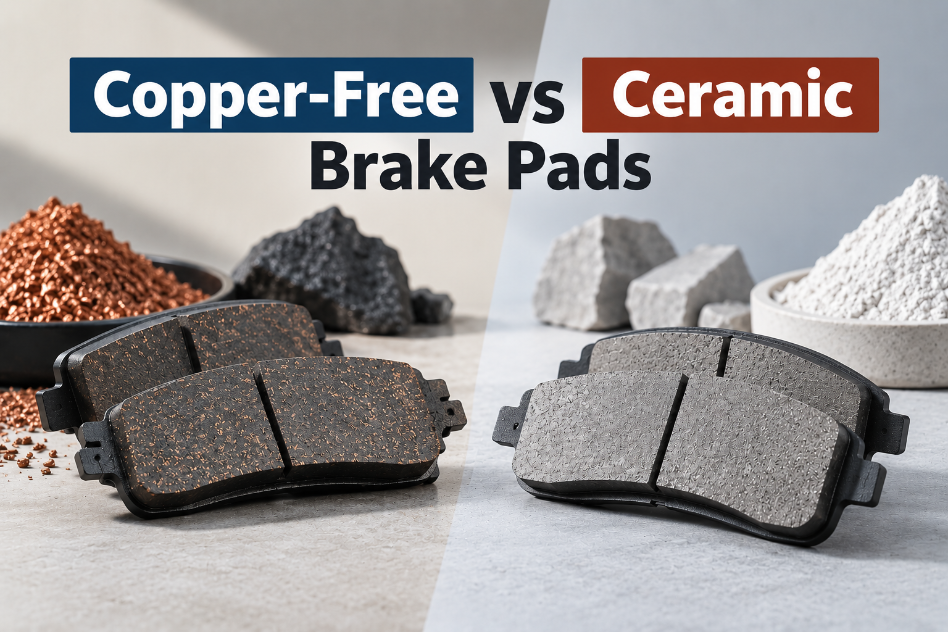
6. Copper-Free vs Ceramic Brake Pads: Which Should Buyers Choose?
One common misunderstanding is treating copper-free and ceramic as competing product categories.
They describe different characteristics.
Copper-free refers to copper content. Ceramic refers to a type of friction-material formulation.
A brake pad can therefore be both copper-free and ceramic.
Comparison | Copper-Free | Ceramic |
|---|---|---|
Main classification | Copper-content characteristic | Friction-material category |
Can offer low noise | Yes, depending on formulation | Yes, depending on formulation |
Can offer low dust | Yes, depending on formulation | Yes, depending on formulation |
Guarantees longer service life | No | No |
Suitable for private label | Yes | Yes |
Requires performance validation | Yes | Yes |
For importers, the correct choice depends on the combination of material requirements, target applications, performance expectations and commercial positioning.
Read our detailed comparison: Copper-Free vs Ceramic Brake Pads: What's the Difference for Distributors?.
7. Are Copper-Free Brake Pads More Expensive?
Copper-free brake pads are not necessarily more expensive than conventional alternatives.
Manufacturing costs depend on several factors:
- Raw material selection
- Formulation complexity
- Production volume
- Testing and validation requirements
- Vehicle application
- Packaging specifications
- Order quantity
Some copper-free formulations may require more expensive alternative materials or additional development work.
Others may be commercially competitive depending on the manufacturing process and product requirements.
For distributors, comparing only the purchase price can be misleading.
Two brake pads with the same FMSI or OE reference may have different friction formulations, quality requirements and test documentation.
A more meaningful comparison considers the total product value, including performance, consistency, customer complaints and potential warranty costs.
8. What Should Importers Check Before Buying Copper-Free Brake Pads?
Before selecting a copper-free brake pad supplier, buyers should evaluate both technical and commercial requirements.
Confirm the Copper-Content Specification
Ask the manufacturer what copper-free means for the proposed product.
For markets with specific copper-content restrictions, confirm the applicable threshold and request appropriate supporting documentation.
Do not assume that a general copper-free statement automatically establishes regulatory compliance.
Request Relevant Test Reports
Depending on the target market and product application, useful evaluation documents may include:
- Friction-performance test reports
- Noise-test reports
- Wear-performance data
- Shear-strength test reports
- Relevant copper-content documentation
Testing should be appropriate to the product and intended market.
A laboratory report for one formulation or reference should not automatically be treated as proof that every product in a supplier's catalogue performs identically.
Evaluate Representative Samples
Before approving a large order, select several references that represent your intended product range.
For example, a distributor may evaluate applications covering compact passenger cars, sedans and SUVs.
This helps determine whether the proposed formulation meets the requirements of different vehicle categories.
Check Production Consistency
Sample quality is important, but consistent bulk production is equally important.
Ask suppliers about their quality-control procedures, raw material management, traceability and production inspection processes.
Confirm Private-Label Requirements
If you are developing your own brake pad brand, clarify packaging, labeling, product claims and documentation before production.
Any copper-free, low-noise or low-dust claims should be consistent with the actual product and available evidence.
For more information on evaluating manufacturing quality, see our Brake Pad Testing & Quality Control: What Importers Should Check Before Bulk Orders.
9. When Should Distributors Consider Copper-Free Brake Pads?
Copper-free brake pads may be particularly relevant in several sourcing situations.
Entering Markets With Copper-Content Requirements
If your target market has applicable copper-content restrictions, the formulation and supporting documentation may become important purchasing requirements.
Buyers should confirm the rules applicable to their destination market and product category.
Developing a Premium Aftermarket Range
Copper-free formulations can form part of a differentiated product range, particularly when combined with validated comfort, noise and dust characteristics.
However, premium positioning should be supported by product performance rather than material terminology alone.
Expanding an Existing Product Portfolio
Distributors already selling ceramic, semi-metallic or NAO brake pads may consider copper-free alternatives for selected applications.
A phased introduction allows buyers to evaluate market acceptance without immediately replacing their entire product range.
Building a Private-Label Brand
For private-label importers, copper-free products can support a more clearly defined product strategy.
The key is to select formulations that match customer expectations, price positioning and target vehicle applications.
10. How Xinzhong Brake Supports Copper-Free Brake Pad Sourcing
Xinzhong Brake is a China-based brake pad manufacturer supplying international aftermarket customers.
We support multiple friction-material options, including ceramic, semi-metallic, low-metallic and NAO formulations, with copper-free options available for discussion according to application requirements.
For distributors and private-label brands, we recommend starting with a focused application list rather than immediately requesting quotations for an entire catalogue.
Our sourcing process can begin with:
- Reviewing your OE, FMSI or WVA references
- Confirming target vehicle applications
- Discussing friction-material and copper-content requirements
- Reviewing available technical documentation
- Arranging representative samples for evaluation
- Discussing packaging, quantities and production requirements
This approach helps buyers make informed decisions before expanding into larger purchasing programs.
Frequently Asked Questions
Are copper-free brake pads better than regular brake pads?
Not necessarily. Copper-free brake pads can provide excellent performance, but braking quality depends on the complete formulation, manufacturing quality and intended application.
Are copper-free brake pads quieter?
Some copper-free formulations are designed for low-noise performance, but copper-free does not automatically mean quieter. Noise performance should be evaluated through relevant testing.
Do copper-free brake pads create less dust?
Not always. Dust characteristics depend on the complete friction material, rotor interaction and operating conditions.
Are all ceramic brake pads copper-free?
No. Ceramic and copper-free describe different product characteristics. Buyers should confirm the copper-content specification with the manufacturer.
Do copper-free brake pads wear out faster?
Not necessarily. Wear performance varies by formulation, vehicle application and operating conditions. Buyers should evaluate both pad wear and rotor wear.
Are copper-free brake pads required in every country?
No. Requirements vary by market and jurisdiction. Importers should verify applicable regulations and documentation requirements for their destination market.
Can distributors order copper-free brake pads with private-label packaging?
Yes. Copper-free brake pads can be supplied for private-label programs, subject to formulation availability, application coverage, packaging requirements and order quantities.
Looking for a Copper-Free Brake Pad Manufacturer?
Choosing the right copper-free brake pads requires more than checking the material description.
The best sourcing decision considers braking performance, noise, dust, wear, product consistency and target-market requirements.
At Xinzhong Brake, we work with distributors, importers and private-label brands to identify suitable brake pad solutions for their applications.