Brake Pad Knowledge
Brake Fade Explained: Why Brake Pads Lose Friction at High Temperatures
What causes brake fade at high temperatures? Learn how friction materials affect brake fade, recovery, friction stability and SAE J2522 testing.
Brake Fade Explained: Why Brake Pads Lose Friction at High Temperatures
Understanding Brake Fade, Friction Stability, and Recovery Performance in Automotive Brake Pads
A brake pad may perform well during normal city driving but behave very differently after repeated braking at high temperatures.
This difference is one of the most important challenges in friction material engineering.
When braking performance decreases as temperatures rise, the phenomenon is commonly known as brake fade.
For automotive parts manufacturers, distributors, and private label brands, understanding brake fade is essential when evaluating brake pad quality, selecting friction materials, and comparing product performance.
But what actually causes brake fade? And how can manufacturers evaluate a brake pad's resistance to high-temperature friction loss?
This guide explains the science behind brake fade, the role of friction material formulations, and the importance of fade and recovery testing.
1. What Is Brake Fade?
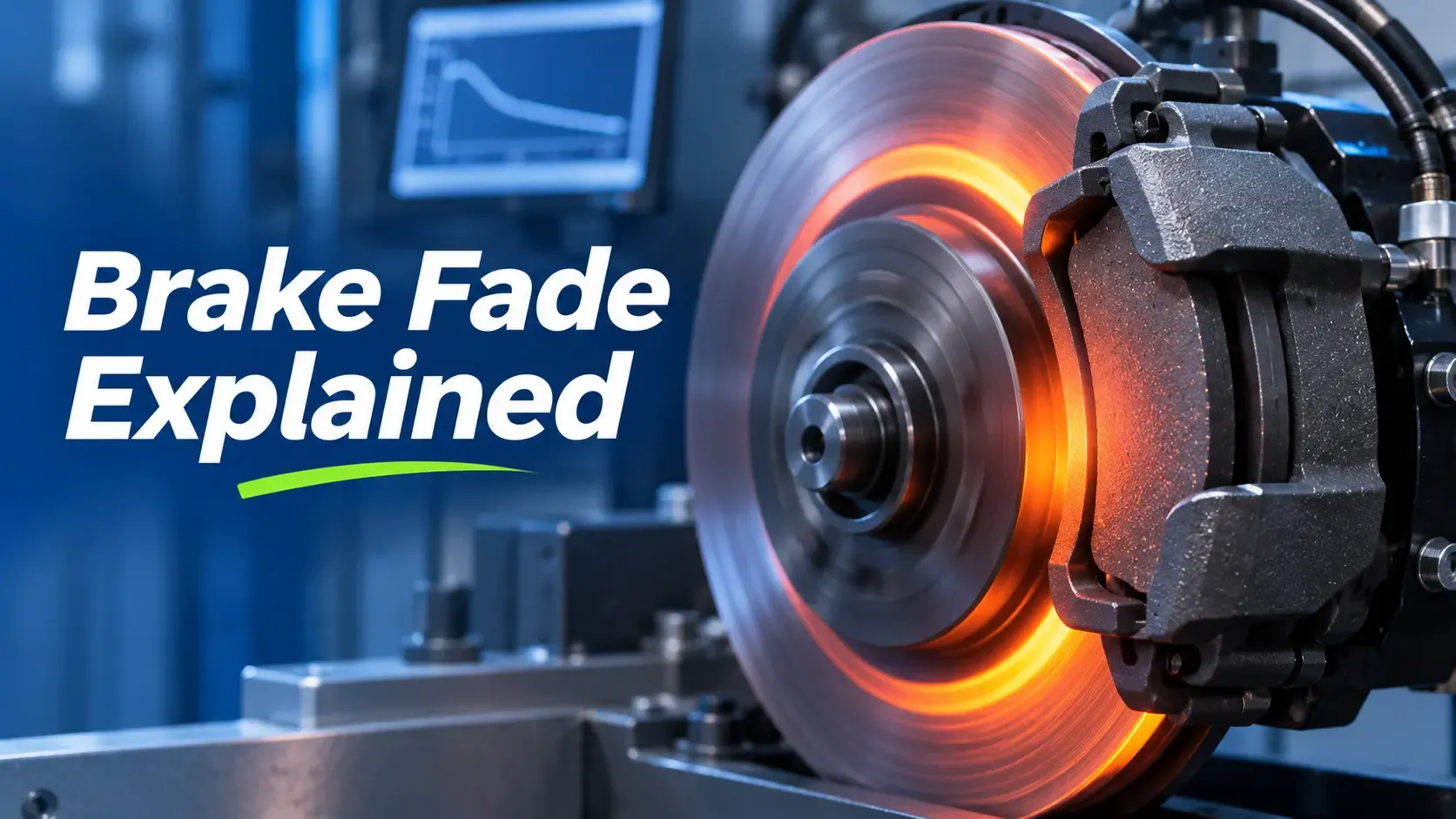
Brake fade refers to a reduction in braking effectiveness under certain operating conditions, commonly associated with excessive heat generated during braking.
In the context of brake pad friction materials, thermal fade occurs when the coefficient of friction decreases as operating temperatures increase.
During braking, kinetic energy is converted into heat through friction between the brake pads and the rotating brake disc.
Under normal conditions, the braking system dissipates much of this heat into the surrounding environment.
However, during repeated heavy braking, long downhill driving, or other demanding operating conditions, heat generation may exceed the system's ability to dissipate it.
As temperatures rise, the friction characteristics of the brake pad and disc interface may change.
This can reduce braking torque under otherwise comparable operating conditions.
It is important to distinguish friction material fade from other causes of reduced braking effectiveness, including brake fluid vaporization and hydraulic problems.
Although these conditions can produce similar symptoms for the driver, they involve different physical mechanisms.
2. What Happens to Brake Pad Friction at High Temperatures?
Brake pad friction is not determined by a single material ingredient.
Most conventional automotive brake pads use composite friction materials containing several functional groups:
- Fibers and reinforcing materials.
- Organic binders, commonly including phenolic resins.
- Abrasives and friction modifiers.
- Lubricants and solid friction-control additives.
- Fillers and other functional ingredients.
Each component influences the material's mechanical, thermal, and tribological behavior.
Tribology is the study of friction, wear, and lubrication between interacting surfaces.
As temperatures increase, several changes may occur within the brake pad and at the friction interface.
Thermal Changes in Organic Binders
Organic binders help maintain the structural integrity of the friction material.
At elevated temperatures, these binders may undergo chemical or physical changes.
Depending on the formulation and operating conditions, excessive heating can lead to degradation, changes in surface characteristics, and the release of volatile decomposition products.
These changes can affect friction behavior and material durability.
Changes in the Friction Interface
Brake pad friction does not occur through simple contact between two perfectly uniform surfaces.
Instead, microscopic contact regions and friction films develop between the pad and rotor.
These surface layers influence the effective contact conditions, friction coefficient, and wear behavior.
High temperatures may change the composition, thickness, and stability of these films.
In some circumstances, the resulting interface becomes less effective at generating friction.
Thermal Degradation and Surface Damage
Severe thermal exposure can also contribute to surface glazing, cracking, accelerated wear, or other material changes.
However, not every instance of brake fade causes permanent damage.
Some friction losses are largely reversible after cooling, while others may indicate more substantial material deterioration.
This distinction is why fade performance must be evaluated together with recovery performance.
3. Understanding the Brake Pad Friction Coefficient
The coefficient of friction, commonly represented by the Greek letter μ (mu), describes the relationship between friction force and normal force under defined conditions.
In simplified form:
μ = Friction Force / Normal Force
For a brake pad, the measured coefficient of friction depends on several factors, including:
- Temperature.
- Sliding speed.
- Contact pressure.
- Friction material formulation.
- Rotor material and surface condition.
- Bedding condition.
- Previous braking and thermal history.
Therefore, a brake pad does not necessarily have one constant friction coefficient under every operating condition.
A material may show relatively high friction at moderate temperatures but experience a significant reduction during repeated high-temperature braking.
Another formulation may exhibit a lower initial friction level but maintain more consistent behavior across the tested temperature range.
For many applications, friction stability is more informative than a single peak friction coefficient.
A meaningful technical comparison should examine how friction changes throughout the relevant operating conditions.
4. Brake Fade vs Brake Recovery: What's the Difference?
Brake fade and brake recovery are closely related but describe different performance characteristics.
Brake fade describes the reduction in friction performance during demanding braking conditions.
Brake recovery describes the material's ability to regain friction performance as conditions return toward a lower-temperature operating range.
Consider two hypothetical friction materials tested under comparable conditions.
Test Stage | Material A | Material B |
|---|---|---|
Initial friction coefficient | 0.42 | 0.42 |
Friction coefficient during fade | 0.30 | 0.37 |
Friction coefficient after recovery | 0.39 | 0.41 |
These values are illustrative examples, not actual Xinzhong Brake laboratory results.
Both materials begin at the same friction level.
However, Material A experiences a larger friction reduction during the fade stage.
Material B maintains more of its initial friction performance and returns closer to that level during recovery.
Under the hypothetical conditions shown, Material B demonstrates more favorable fade and recovery behavior.
Actual material evaluation requires the full test procedure, braking torque, temperature history, pressure, speed, and relevant acceptance criteria.
A single set of values is not sufficient to establish overall brake pad quality.
5. How Does Friction Material Formulation Affect Brake Fade?
One of the most common misunderstandings in the automotive aftermarket is that a friction material category automatically determines its high-temperature performance.
For example, ceramic brake pads are sometimes assumed to offer better thermal stability than all semi-metallic formulations.
This is an oversimplification.
Ceramic Brake Pads
Ceramic brake pads are commonly developed for passenger car applications where noise, dust, braking comfort, and friction stability are important considerations.
Their high-temperature behavior depends on the specific formulation, manufacturing process, and intended application.
Semi-Metallic Brake Pads
Semi-metallic formulations contain metallic constituents that can influence thermal conductivity, mechanical characteristics, and friction behavior.
They are widely used across different automotive applications.
However, metallic content alone does not guarantee superior fade resistance.
Low-Metallic NAO Brake Pads
Low-metallic non-asbestos organic formulations combine organic friction material systems with controlled metallic constituents.
Their thermal and friction characteristics depend on the selection and balance of their ingredients.
Why Formulation Matters More Than the Label
Two ceramic brake pads from different manufacturers may produce different fade and recovery results.
The same applies to semi-metallic and low-metallic formulations.
Material categories describe broad formulation families, not guaranteed performance levels.
For an introduction to these differences, see our article on Brake Pad Materials: Ceramic vs Semi-Metallic vs Low-Metallic vs NAO.
For technical sourcing decisions, the better question is not simply which material category is best.
It is:
Which tested friction formulation provides the required performance for the intended vehicle and operating conditions?
6. How Is Brake Fade Tested? Understanding SAE J2522
One widely recognized method for evaluating automotive friction material behavior is SAE J2522, also known as the AK Master test procedure.
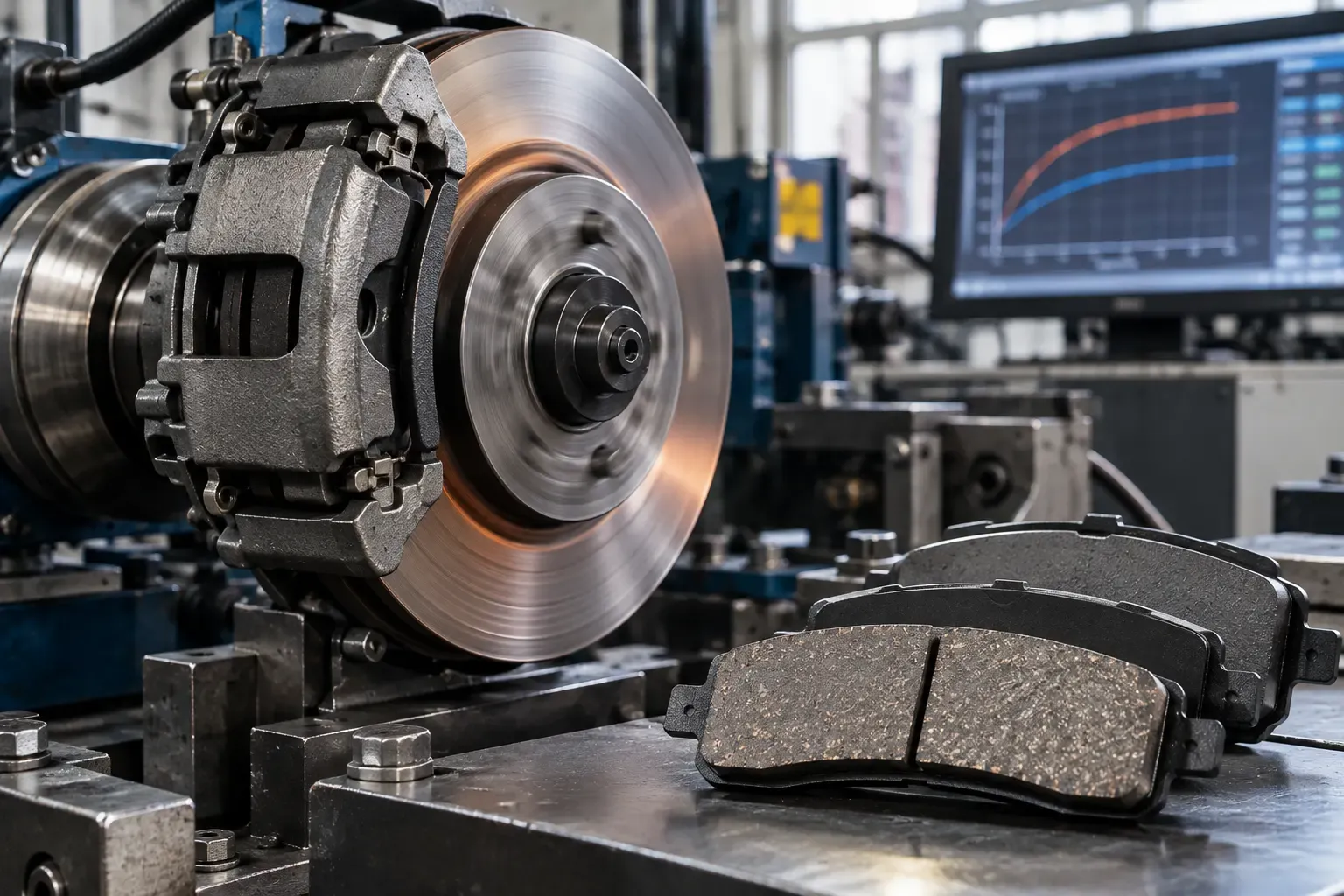
SAE J2522 is an inertia dynamometer test method designed to assess friction material effectiveness under different braking pressures, speeds, and temperatures.
The procedure includes multiple operating conditions rather than relying on a single high-temperature measurement.
Depending on the applicable edition and test setup, evaluation stages include:
- Initial friction behavior.
- Bedding or burnishing.
- Speed and pressure sensitivity.
- Cold braking performance.
- High-temperature performance.
- Fade testing.
- Recovery testing.
What Is a Brake Dynamometer?
A brake dynamometer is a laboratory test system that reproduces defined braking conditions using controlled mechanical inertia, speed, pressure, and thermal parameters.
During testing, measurements can include braking torque, pressure, speed, and temperature.
These measurements help engineers characterize friction performance under repeatable conditions.
What Should Buyers Look for in an SAE J2522 Report?
A useful test report should allow technical reviewers to understand:
1. Friction coefficient behavior
How does friction change across different temperatures, pressures, and speeds?
2. Fade performance
How much does friction decrease during the relevant fade sections?
3. Recovery behavior
How does friction respond during subsequent recovery sections?
4. Test conditions
What brake assembly, rotor, inertia, pressure, temperature, and test procedure were used?
5. Product identification
Can the tested formulation and reference be traced to the product being supplied?
SAE J2522 provides a standardized evaluation framework, but a test report should not automatically be interpreted as proof of regulatory approval or suitability for every vehicle application.
7. Why High-Temperature Brake Pad Performance Matters for Different Markets
The operating environment can influence the demands placed on a braking system.
For example, brake pads used in mountainous regions may experience repeated braking during long descents.
Commercial vehicles carrying heavy loads can place different thermal demands on braking systems compared with lightly loaded passenger cars.
Urban delivery vehicles may experience frequent braking cycles, while highway applications may involve different speed and energy conditions.
However, ambient temperature alone does not determine brake pad operating temperature.
Vehicle mass, braking energy, driving conditions, brake design, cooling, and the overall system configuration are also important.
For international distributors, this means that friction material selection should consider both the target market and the actual vehicle application.
A suitable brake pad should be evaluated against the intended performance requirements rather than selected solely on the basis of a ceramic or semi-metallic label.
8. What Should Importers Ask Brake Pad Manufacturers About Fade Resistance?
When evaluating a brake pad supplier, buyers can use the following technical questions.
Technical Question | Why It Matters |
|---|---|
Is SAE J2522 testing available? | Helps establish whether standardized friction evaluation data is available |
What are the fade and recovery results? | Provides information about thermal friction stability |
Which formulation was tested? | Helps connect laboratory data with the supplied product |
What rotor and brake assembly were used? | Supports meaningful comparison between test results |
Is the material intended for this vehicle application? | Helps prevent inappropriate formulation selection |
How is batch consistency controlled? | Helps assess production repeatability |
Can samples be provided for independent evaluation? | Allows buyers to verify performance before bulk purchasing |
Importers should also consider wear, noise, dust, mechanical integrity, and rotor compatibility.
Strong fade resistance does not automatically mean a brake pad performs well in every other category.
9. How Xinzhong Brake Approaches Friction Material Selection
At Xinzhong Brake, we supply brake pads for international aftermarket distributors and private label brands.
Our product range includes more than 3,000 references, with ceramic, semi-metallic, and low-metallic friction material options.
We recognize that selecting a suitable brake pad requires more than matching a vehicle reference or choosing a material category.
Important considerations include:
- Vehicle application and brake system compatibility.
- Intended market and operating conditions.
- Friction material characteristics.
- Quality management and production consistency.
- Relevant testing requirements.
- OEM and private label specifications.
Our quality management systems include ISO 9001 and IATF 16949, and our technical capabilities include friction performance and noise evaluation using SAE J2522 and SAE J2521 methodologies.
The availability and applicability of product-specific testing documentation should be confirmed for each requested reference or formulation.
For distributors evaluating new products, we can discuss friction material options and sample arrangements based on their purchasing requirements.
10. Frequently Asked Questions About Brake Fade
What causes brake fade?
Brake fade can result from excessive heat and changes in the friction behavior of the brake pad and rotor interface. Other braking-system problems, including brake fluid vaporization, can also reduce braking effectiveness but involve different mechanisms.
At what temperature do brake pads begin to fade?
There is no universal temperature at which all brake pads begin to fade.
The onset and severity of fade depend on friction material formulation, brake system design, test conditions, and thermal history.
Are ceramic brake pads more resistant to fade than semi-metallic pads?
Not necessarily.
Both categories contain a wide range of formulations. Performance should be evaluated using relevant testing data for the intended application.
Can brake pads recover after brake fade?
Some friction materials can regain much of their original friction performance as temperatures decrease.
However, severe overheating may produce lasting material or surface changes.
Does a higher friction coefficient always mean a better brake pad?
No.
Friction stability, fade resistance, recovery, wear, noise, rotor compatibility, and application requirements all contribute to brake pad performance.
What is the difference between SAE J2522 and SAE J2521?
SAE J2522 focuses on friction effectiveness under different operating conditions, including fade and recovery.
SAE J2521 is associated with brake noise evaluation.
They address different aspects of brake system performance.
Conclusion: High-Temperature Performance Is About Friction Stability
Brake fade is a complex phenomenon influenced by friction material chemistry, contact surface behavior, temperature, braking conditions, and system design.
Understanding brake fade helps automotive parts buyers move beyond general claims such as high performance or heat resistant.
A technically meaningful evaluation should consider the complete friction behavior of the material, including both fade and recovery.
For distributors and private label brands, this approach supports more informed product selection and supplier evaluation.
Looking for a brake pad manufacturing partner?
Xinzhong Brake supports international aftermarket buyers with multiple friction material options, OEM and private label manufacturing, and technical discussions based on specific vehicle applications.
Contact our team with your OE or FMSI references, target market, material preferences, and estimated quantities.