Sep 17, 2026OEM & Manufacturing Insights
How to Evaluate Brake Pad Samples Before Bulk Orders | B2B Guide
Learn how brake pad importers and distributors should evaluate samples before bulk orders, including fitment, friction material, testing, consistency and private label requirements.
How to Evaluate Brake Pad Samples Before Placing a Bulk Order
For brake pad importers, distributors, and private-label buyers, receiving a good-looking sample is not enough to approve a supplier.
A sample should help answer a much more important question:
Can this supplier consistently reproduce the same brake pad quality when the order increases from several sample sets to hundreds or thousands of sets?
That is why professional brake pad sample evaluation should cover more than appearance or a short road test. Buyers should verify fitment, friction material, dimensions, noise control, braking stability, manufacturing consistency, test documentation, and the supplier's ability to reproduce the approved specification during mass production.
This guide explains what B2B buyers should check before approving brake pad samples for a bulk order.
1. Confirm the Brake Pad Reference Before Testing
Before evaluating performance, first make sure you are testing the correct product.
Brake pads for the same vehicle model can vary by model year, engine, trim, axle position, brake system, or caliper configuration.
For each sample, confirm:
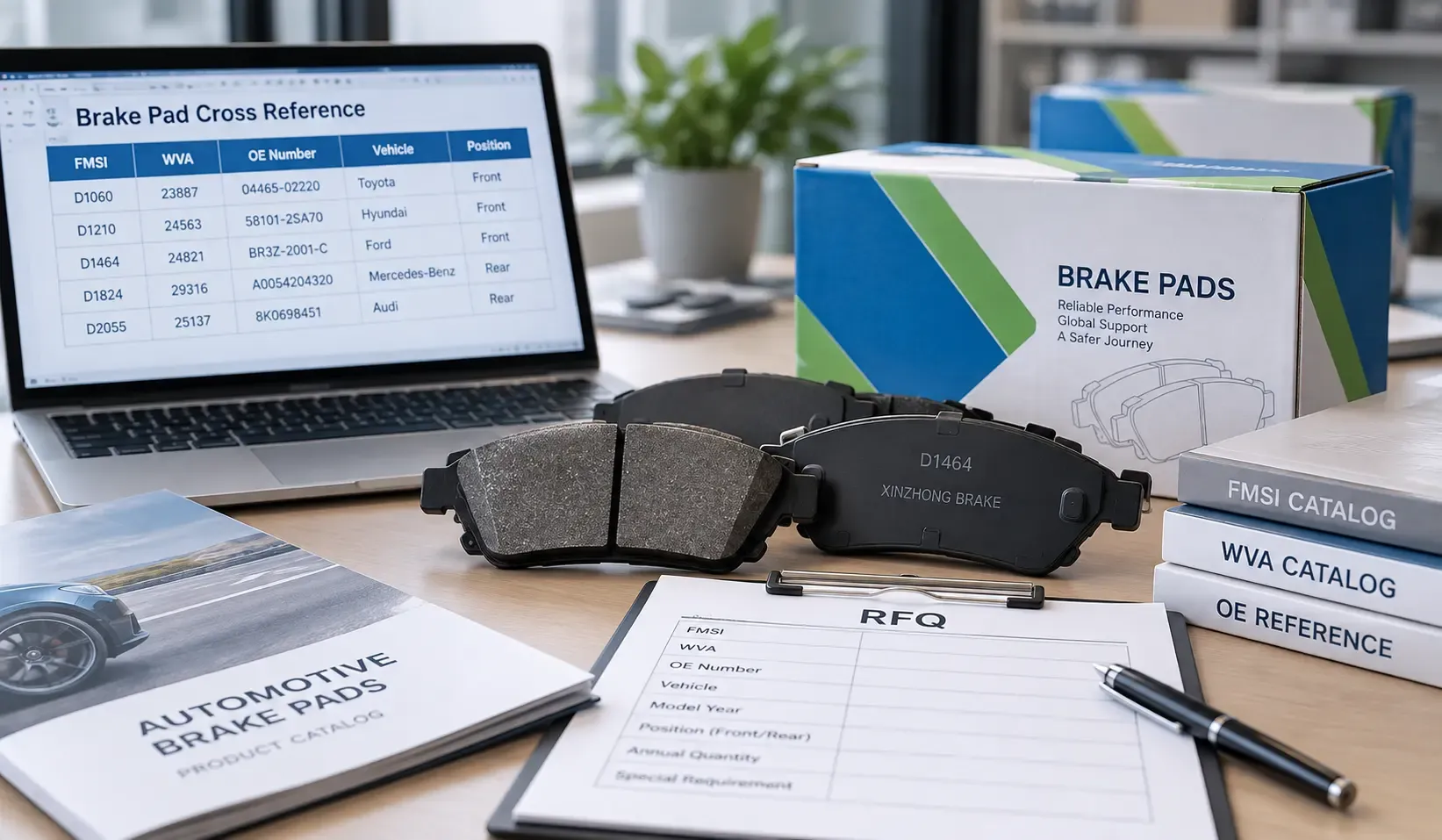
- FMSI or WVA reference where applicable
- OE cross-reference
- Vehicle application
- Front or rear axle position
- Pad dimensions
- Pad shape
- Wear sensor requirements
- Hardware or accessories
For international sourcing, sending only a vehicle name such as Toyota Camry or BMW 3 Series may not be enough.
A better RFQ includes the OE number, FMSI/WVA reference, vehicle application, and expected quantity whenever this information is available.
This reduces fitment errors before quotation and sampling even begin.
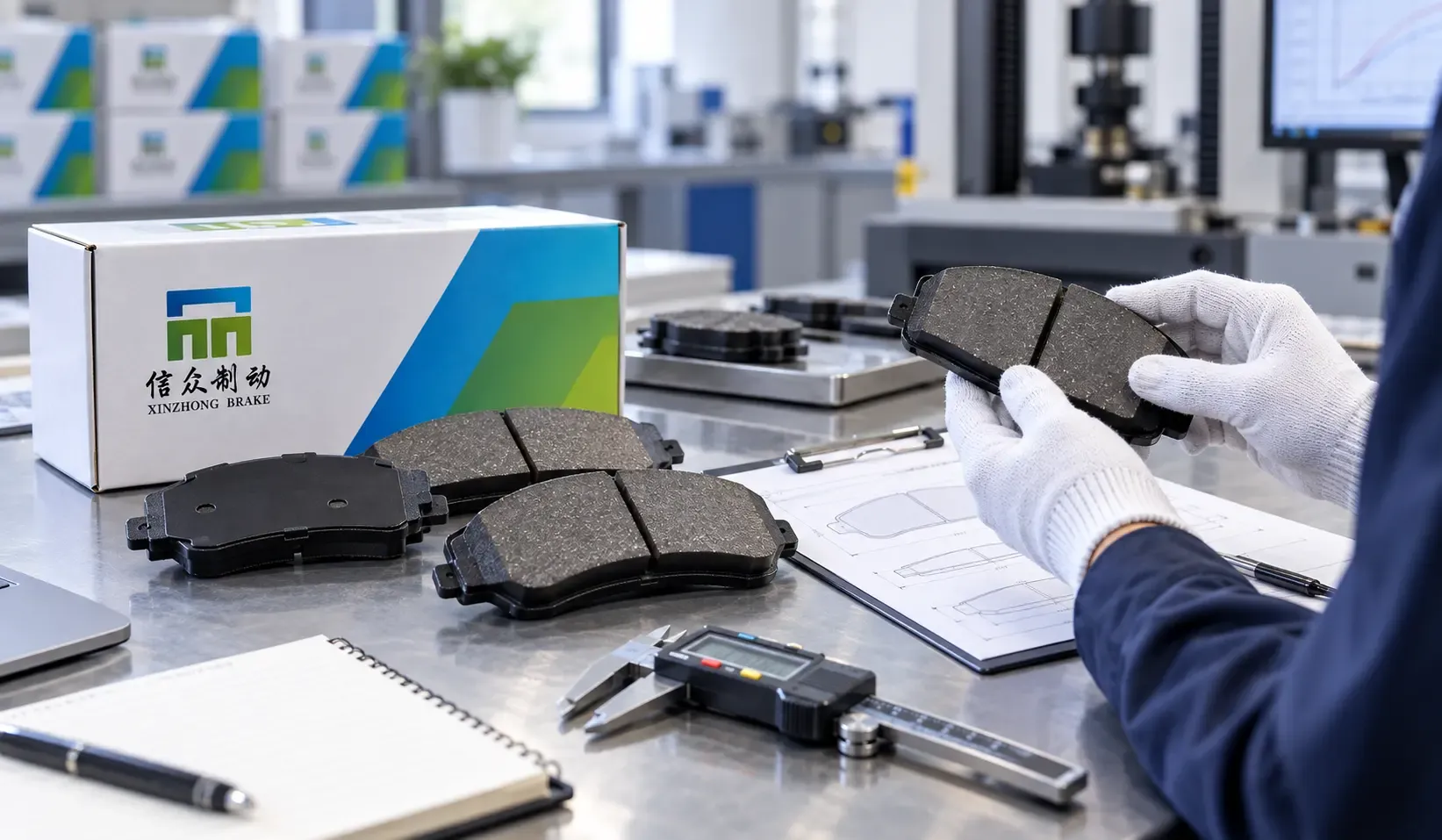
2. Check Dimensions and Physical Construction
The next step is dimensional inspection.
Compare the sample with your existing product, OE reference, technical drawing, or confirmed application data.
Important dimensions normally include:
Inspection Item | What to Check |
|---|---|
Length | Overall pad length |
Height | Overall pad height |
Thickness | Friction material and complete pad thickness |
Backing Plate | Shape, mounting points and dimensional accuracy |
Slot & Chamfer | Position and design |
Shim | Type, fit and attachment |
Wear Sensor | Position and compatibility where required |
Small dimensional differences can create installation problems, abnormal movement, noise, or returns.
For distributors managing hundreds of references, fitment accuracy is just as important as friction performancebecause one incorrect reference can create repeated complaints throughout the distribution chain.
3. Identify the Friction Material
Do not approve a brake pad simply because the supplier calls it ceramic.
Ask what formulation is actually being supplied.
Common aftermarket options include:
Ceramic Brake Pads
Often selected for passenger-car programs where buyers prioritize lower noise, cleaner wheels, and comfortable braking characteristics.
Semi-Metallic Brake Pads
Commonly considered where stronger thermal performance and braking response are required.
Low-Metallic Brake Pads
Often used in markets or vehicle applications where buyers want strong friction performance while accepting relatively higher dust or noise characteristics.
NAO Brake Pads
Non-asbestos organic formulations can be developed for different vehicle segments and market positioning.
The important point is not that one material is always better.
The correct formulation depends on:
- Target vehicle
- Vehicle weight
- Driving conditions
- Climate
- Market positioning
- Noise expectations
- Wear expectations
- Target price level
A professional brake pad manufacturer should therefore be able to recommend formulations according to the buyer's market instead of offering one compound for every application.
4. Ask for Test Data, Not Only Marketing Claims
Statements such as premium quality, long service life, or excellent braking performance are difficult for a professional buyer to evaluate.
Test data is more useful.
Depending on the product and target market, buyers can ask suppliers for available information covering areas such as:
- Friction performance
- Temperature behavior
- Wear performance
- Shear strength
- Compressibility
- Material properties
- Noise-related performance
- Dynamometer testing
The exact testing requirements depend on the market, application, and purchasing program.
More importantly, buyers should ask:
Does the test report correspond to the formulation being quoted and sampled?
A supplier may have many formulations. A report from another compound does not automatically represent the sample in your hand.
At Xinzhong Brake, formulation selection and available testing documentation can be discussed according to the buyer's target application and market requirements.
5. Evaluate Braking Performance Under Different Conditions
A short drive around the factory or warehouse is not enough to evaluate a brake pad.
Where practical, sample evaluation should consider different operating conditions.
Buyers may evaluate:
- Initial braking response
- Pedal feel
- Cold braking
- Repeated braking
- Higher-temperature braking
- Recovery after heating
- Noise
- Vibration
- Dust
- Pad and rotor wear
The evaluation criteria should also match the intended market.
For example, a distributor targeting daily passenger vehicles may place greater emphasis on low noise and comfortable braking.
A buyer serving heavier-duty or demanding applications may prioritize thermal stability and wear resistance.
The objective is not to find a brake pad that performs best in one single characteristic.
The objective is to find a formulation with the right balance of braking, comfort, durability, and cost for your market.
6. Check Noise-Control Features
Noise complaints can become expensive for distributors because the cost is rarely limited to replacing one set of brake pads.
Returns may also create:
- Workshop labor claims
- Distributor handling costs
- Customer complaints
- Brand reputation damage
When evaluating samples, inspect whether the pad design includes appropriate noise-control features such as:
- Shims
- Chamfers
- Slots
- Stable friction material
- Consistent backing plate construction
The required configuration varies by application, so buyers should compare the supplied pad with the confirmed specification rather than assuming every pad requires the same design.
7. Compare Multiple Samples for Consistency
This is one of the most overlooked steps.
Do not inspect only the best-looking pad in the sample box.
Compare several pieces.
Look for consistency in:
- Friction material appearance
- Pad thickness
- Backing plate dimensions
- Coating
- Slot position
- Chamfer shape
- Shim installation
- Printing and marking
- General workmanship
For B2B sourcing, consistency matters because your customer will not receive the exact sample you tested.
They will receive products from future production batches.
A supplier's real capability is therefore not demonstrated by producing one good brake pad.
It is demonstrated by producing the same acceptable brake pad repeatedly at scale.
8. Define the Approved Sample Before Mass Production
Once the sample passes evaluation, do not rely only on messages saying sample approved.
Create a clear approved specification.
Depending on the project, it can include:
- Product reference
- Vehicle application
- Dimensions
- Friction formulation
- Friction coefficient requirement where specified
- Backing plate specification
- Shim configuration
- Slot and chamfer design
- Accessories
- Surface coating
- Product marking
- Packaging
- Label
- Barcode
- Private-label requirements
The approved sample or specification then becomes the reference for mass production.
This is especially important for private-label programs because packaging and product specifications may both be customized.
9. Confirm Mass-Production Capability Before Ordering
A successful sample does not automatically mean the supplier is ready for your full program.
Before placing a bulk order, evaluate the factory itself.
Ask about:
- Available brake pad references
- Formulation capability
- Production capacity
- Quality management system
- Raw-material control
- Batch traceability
- Testing capability
- MOQ
- Production lead time
- Private-label packaging
- New-reference development capability
For distributors planning to expand a product line, broad reference coverage can also reduce supplier-management complexity.
Xinzhong Brake supports more than 6,600 brake pad references, over 200 friction formulations, and OEM/ODM and private-label programs for international aftermarket buyers.
Our manufacturing system operates under IATF 16949 and ISO 9001 quality management systems, with annual production capacity of approximately 30 million pieces.
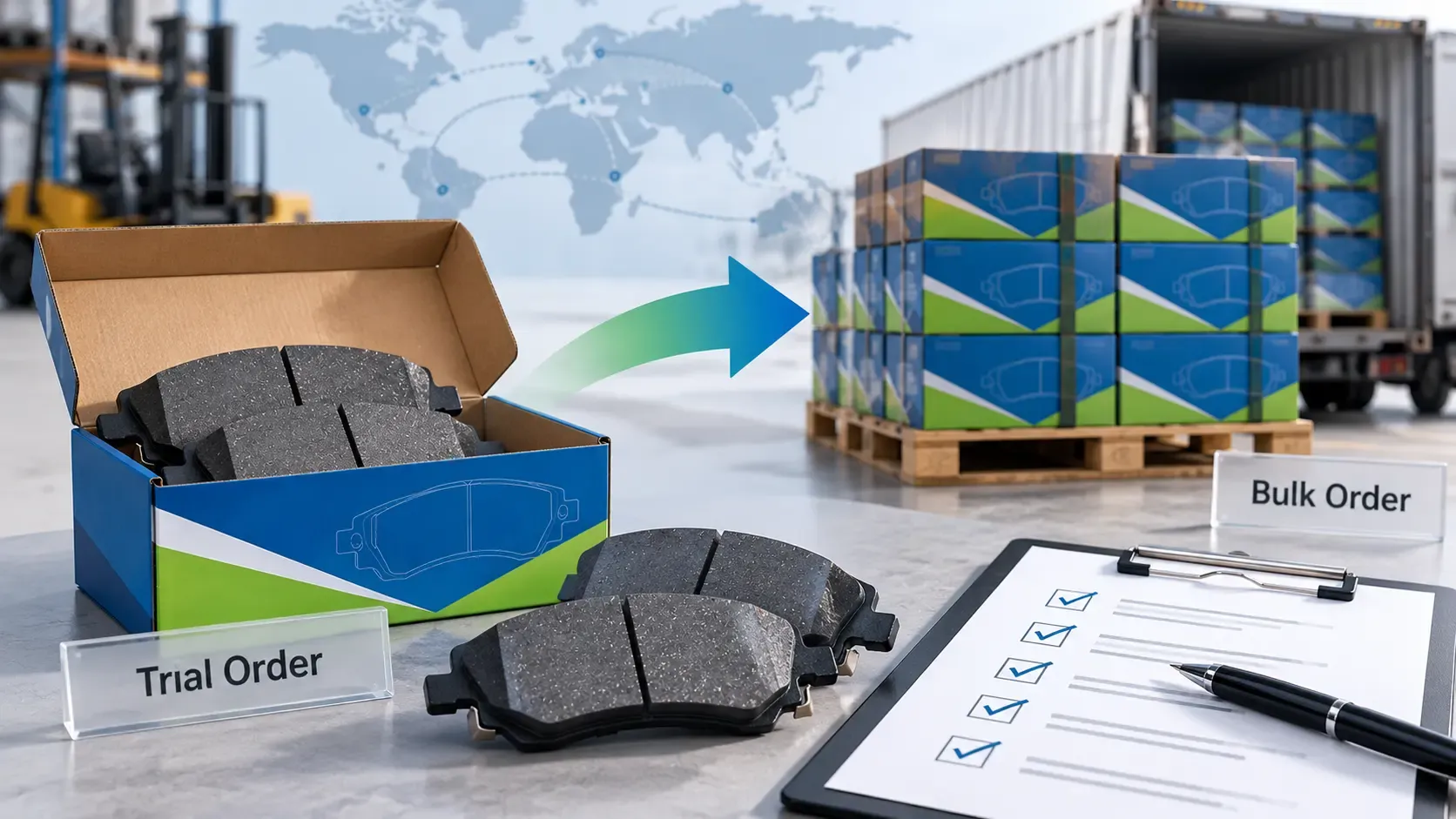
10. Use a Trial Order Before Scaling Up
For a new supplier relationship, moving directly from a few samples to a very large purchase order may create unnecessary risk.
A trial order gives both sides an opportunity to verify:
- Production consistency
- Packaging execution
- Label accuracy
- Lead time
- Export documentation
- Communication efficiency
- Product performance in the destination market
If the first production batch performs as expected, purchasing volume can then increase gradually.
For private-label distributors, this approach is particularly useful when introducing a new brake pad range.
Brake Pad Sample Approval Checklist
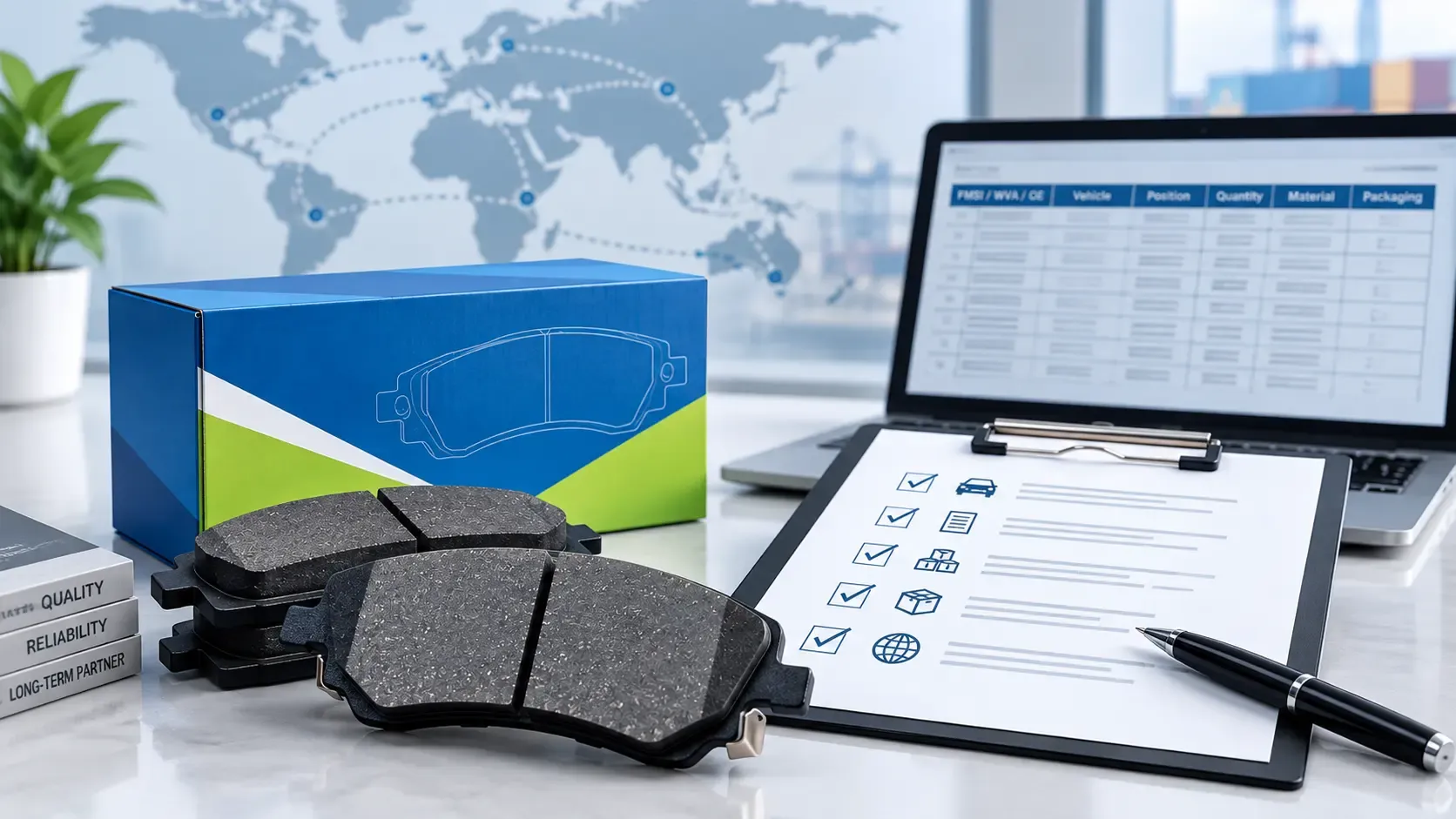
Before approving a brake pad supplier, buyers can use the following checklist:
Check | Status |
|---|---|
FMSI/WVA/OE reference confirmed | □ |
Vehicle application confirmed | □ |
Dimensions verified | □ |
Friction material confirmed | □ |
Shim/accessories confirmed | □ |
Sample appearance inspected | □ |
Multiple samples compared | □ |
Available test reports reviewed | □ |
Braking performance evaluated | □ |
Noise and dust evaluated | □ |
Packaging requirements confirmed | □ |
Private-label artwork confirmed | □ |
MOQ confirmed | □ |
Lead time confirmed | □ |
Mass-production specification recorded | □ |
What Should You Send a Brake Pad Manufacturer for Sample Development?
If you are requesting samples from a new supplier, providing complete information can significantly reduce unnecessary back-and-forth communication.
You can send:
- FMSI or WVA numbers
- OE numbers
- Vehicle application list
- Photos or drawings when necessary
- Current samples if reference identification is uncertain
- Required friction material
- Target market
- Estimated annual quantity
- Packaging requirements
- Required certifications or testing
For large sourcing programs, an Excel application list is usually more efficient than sending references individually.
FAQ
How many brake pad samples should a distributor test?
There is no universal number. It depends on the size of the sourcing program and the buyer's validation procedure. For a new supplier, buyers should consider testing representative high-volume references rather than selecting only one easy application.
Should I choose ceramic or semi-metallic brake pads for my private label?
It depends on your target vehicles, market positioning, driving conditions, customer expectations, and price level. A private-label program may use different formulations for different vehicle segments rather than one material across the entire range.
Can a brake pad manufacturer customize the friction material?
Manufacturers with formulation-development capability can offer different friction materials and performance positioning. Buyers should confirm whether customization requires additional MOQ, testing, or development time.
What information is needed for a brake pad quotation?
Providing FMSI, WVA, OE numbers, vehicle applications, quantity, material requirements, and packaging requirements usually results in a more accurate quotation.
Can I use my own brand and packaging?
Yes. Xinzhong Brake supports OEM/ODM and private-label brake pad programs, including customized product marking, boxes, labels, and packaging configurations according to project requirements.
Build Your Brake Pad Program from Samples to Mass Production
Sample approval should not be treated as a simple product check.
For professional importers and distributors, it is the first opportunity to verify whether a supplier can deliver the correct reference, appropriate formulation, consistent quality, and repeatable mass-production standard required for a long-term brake pad program.
Xinzhong Brake works with aftermarket distributors, importers, wholesalers, and private-label brands across international markets.
With 6,600+ references, 200+ formulations, IATF 16949 and ISO 9001 quality management systems, and approximately 30 million pieces of annual production capacity, we can support both existing brake pad programs and new private-label projects.
Need to evaluate a new brake pad supplier?
Send us your FMSI, WVA, OE numbers, vehicle application list, or current product samples. Our team can check available references, recommend suitable formulations, and prepare samples for evaluation.