Sep 14, 2026Brake Pad Knowledge
How to Read Brake Pad Numbers: FMSI, WVA & OE Numbers Explained for Buyers
Learn how FMSI, WVA and OE brake pad numbers work, how to cross-reference them, and what distributors should verify before placing bulk orders.
Brake Pad Numbers Explained: The Short Answer
If you source brake pads, you will often see several different numbers attached to the same product.
A brake pad may have an FMSI number, a WVA number, one or more OE numbers, and additional aftermarket cross-reference numbers.
They are not simply different names for the same thing.
For buyers, the easiest way to understand them is:
- FMSI helps identify standardized brake friction references widely used in the North American aftermarket.
- WVA is another widely used friction-product reference system, especially common in European and international catalogs.
- OE numbers are part numbers assigned by vehicle manufacturers.
- Aftermarket cross references connect the same or compatible brake pad to different supplier and brand catalogs.
The important sourcing lesson is simple:
A reference number helps you find the product. It does not replace fitment verification.
Before placing a bulk brake pad order, buyers should still confirm the dimensions, axle position, vehicle application and any hardware or sensor differences.
What Is an FMSI Brake Pad Number?
FMSI stands for the Friction Materials Standards Institute.
Founded in 1948, FMSI developed a standardized numbering system for automotive friction products. The system gives manufacturers, distributors and other aftermarket businesses a common way to identify brake friction references.
You may see an FMSI reference written like:
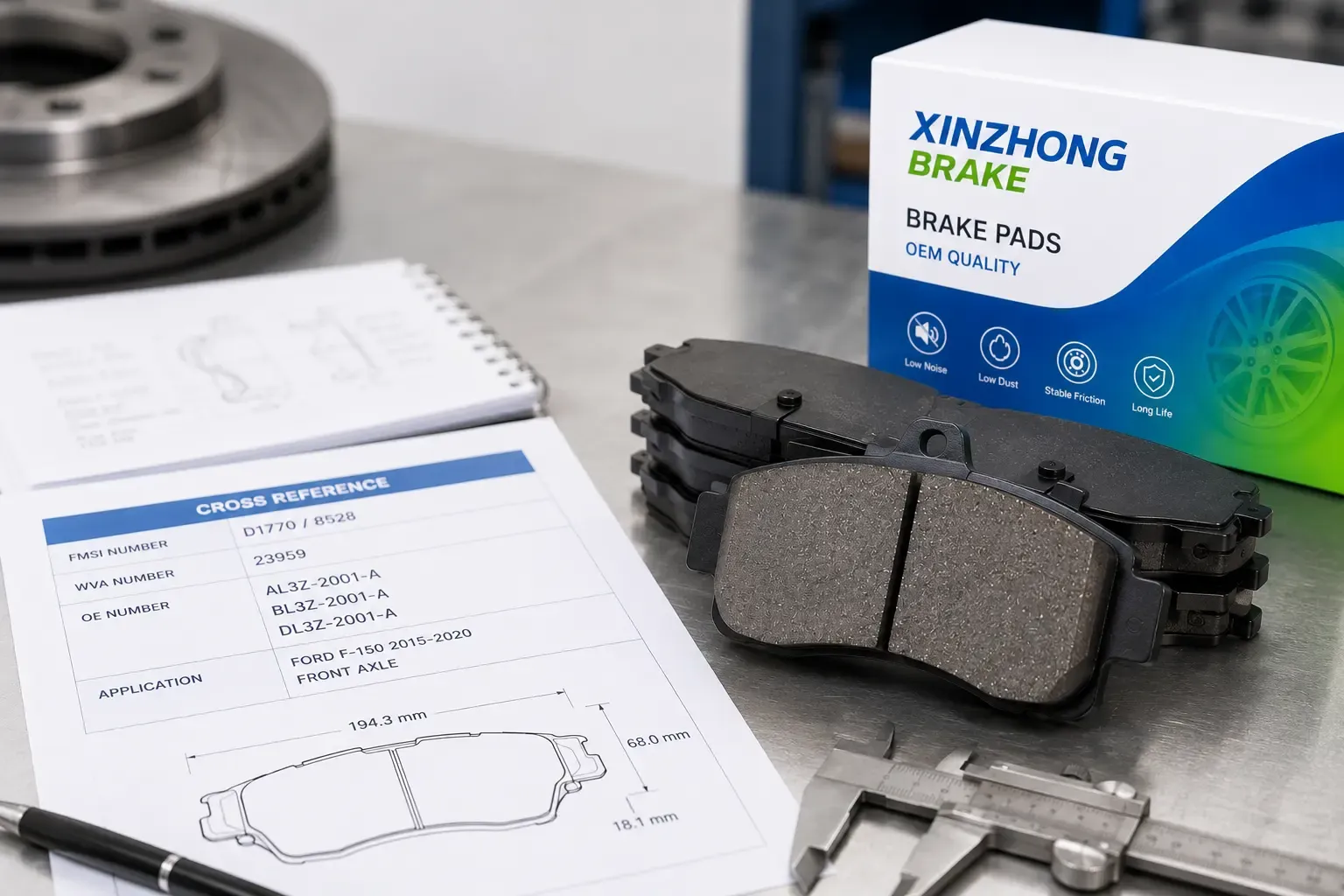
D1770 / 8528
or
8528-D1770
The D-number is especially useful when sourcing disc brake pads.
For example, one of our Ford F-150 references is:
FMSI D1770 / 8528
That number gives a buyer and manufacturer a much more precise starting point than simply asking for:
Ford F-150 brake pads
Why?
Because one vehicle model can use different brake pad shapes depending on model year, axle position, brake system and vehicle configuration.
For D1770, the reference corresponds to a large front brake pad family used on Ford F-150 and related light-truck applications. Our D1770 product specification uses a reference size of approximately 194.3 × 68 × 18.1 mm.
Buyer Tip
If your market commonly uses FMSI numbers, include the complete FMSI reference in your inquiry whenever possible.
It can dramatically reduce the time required to identify the brake pad you need.
What Is a WVA Number?
WVA is another reference system used for friction products and is commonly encountered in European and international brake pad catalogs.
A WVA number is usually a five-digit number, such as:
23959
One brake pad may therefore appear under:
- an FMSI number,
- a WVA number,
- one or more OE numbers,
- and several aftermarket brand numbers.
This is especially important for distributors sourcing brake pads across different markets.
A European buyer may send a WVA number, while a North American customer may identify a similar brake pad through an FMSI reference. A manufacturer therefore needs a reliable cross-reference system to connect these different numbering conventions.
Why WVA Numbers Matter for Buyers
WVA numbers can make communication much easier when you are working with European vehicle applications or European aftermarket catalogs.
Instead of sending only a vehicle description, a buyer can provide the WVA number as an additional identification reference.
However, the same rule still applies:
Do not rely on the WVA number alone when approving an order.
Always cross-check it against the pad dimensions, axle position, vehicle application and brake system.
What Is an OE Brake Pad Number?
OE stands for Original Equipment.
An OE number is a part number assigned by the vehicle manufacturer to identify a specific component used in its vehicles.
For example, a brake pad may be associated with Ford OE references such as:
- AL3Z-2001-A
- BL3Z-2001-A
- DL3Z-2001-A
Depending on the vehicle manufacturer, OE numbers may appear in very different formats.
That is why OE numbers are extremely useful for brake pad sourcing: they provide another strong reference point for identifying the required part.
Why Can One Brake Pad Have Multiple OE Numbers?
This often confuses buyers.
The same brake pad shape may have several OE references because vehicle manufacturers can:
- supersede an older part number with a newer one,
- use related references across different model years,
- use the same brake pad across several vehicle models,
- or assign different numbers to closely related applications.
Therefore, seeing several OE numbers for one brake pad does not automatically mean they are different products.
But buyers should also avoid assuming that similar-looking OE numbers are interchangeable.
The actual application still needs to be verified.
FMSI vs WVA vs OE: What Is the Difference?
The simplest way to understand the three systems is this:
Number Type | Main Purpose | Commonly Used By | Example |
|---|---|---|---|
FMSI | Standardized friction reference | North American aftermarket, manufacturers and distributors | D1770 / 8528 |
WVA | Friction-product reference | European and international aftermarket catalogs | 23959 |
OE | Vehicle manufacturer's original part number | Vehicle manufacturers, dealers and aftermarket suppliers | AL3Z-2001-A |
These numbers are not competitors.
They work together.
For a professional brake pad distributor or importer, the safest product identification normally comes from combining several references rather than depending on only one.
How Brake Pad Cross-Reference Numbers Work
This is where brake pad sourcing becomes more practical.
Imagine a buyer sends us:
FMSI D1770
Our job is not simply to find “D1770” in a catalog and quote immediately.
A proper cross-reference process may include checking:
FMSI → WVA → OE → Vehicle Application → Dimensions → Axle Position
The same process can start from another direction.
If a customer sends an OE number, we can work backwards:
OE Number → Cross Reference → Brake Pad Shape → Vehicle Application → Dimensions
This is why professional brake pad suppliers maintain large cross-reference databases.
A distributor may work with thousands of SKUs, and customers from different countries may use completely different numbering systems for the same application.
Why Vehicle Model Alone Is Not Enough
One of the most common mistakes in brake pad sourcing is identifying parts only by vehicle model.
For example:
Ford F-150 front brake pads
sounds specific.
In reality, it may still be incomplete.
The correct brake pad can vary according to:
- model year,
- front or rear axle,
- engine or vehicle configuration,
- brake system,
- rotor size,
- caliper design,
- and regional specification.
The same issue exists across passenger cars, SUVs and commercial vehicles.
This is why we recommend that professional buyers provide at least one recognized reference number whenever possible.
What Buyers Should Send When Requesting a Brake Pad Quote
If you are sending an RFQ to a brake pad manufacturer, more accurate information usually means faster quotation and fewer identification errors.
Ideally, provide:
- FMSI number, WVA number or OE number
- Vehicle make and model
- Model year
- Front or rear axle position
- Brake pad dimensions, if available
- Photos or drawings, especially for uncertain references
- Required friction material
- Estimated quantity
- Packaging or private label requirements
You do not necessarily need all of this information for every inquiry.
But for difficult or ambiguous applications, providing several identification points can prevent expensive mistakes before production.
Common Brake Pad Number Mistakes Buyers Should Avoid
1. Ordering by Vehicle Name Only
“Toyota brake pads” or “Ford F-150 brake pads” is usually not enough information for a bulk order.
Always narrow the application using reference numbers, model year and axle position.
2. Assuming One Cross Reference Means Exact Fitment
Cross-reference databases are useful, but they should not be treated as perfect.
Always verify important specifications before confirming a large order.
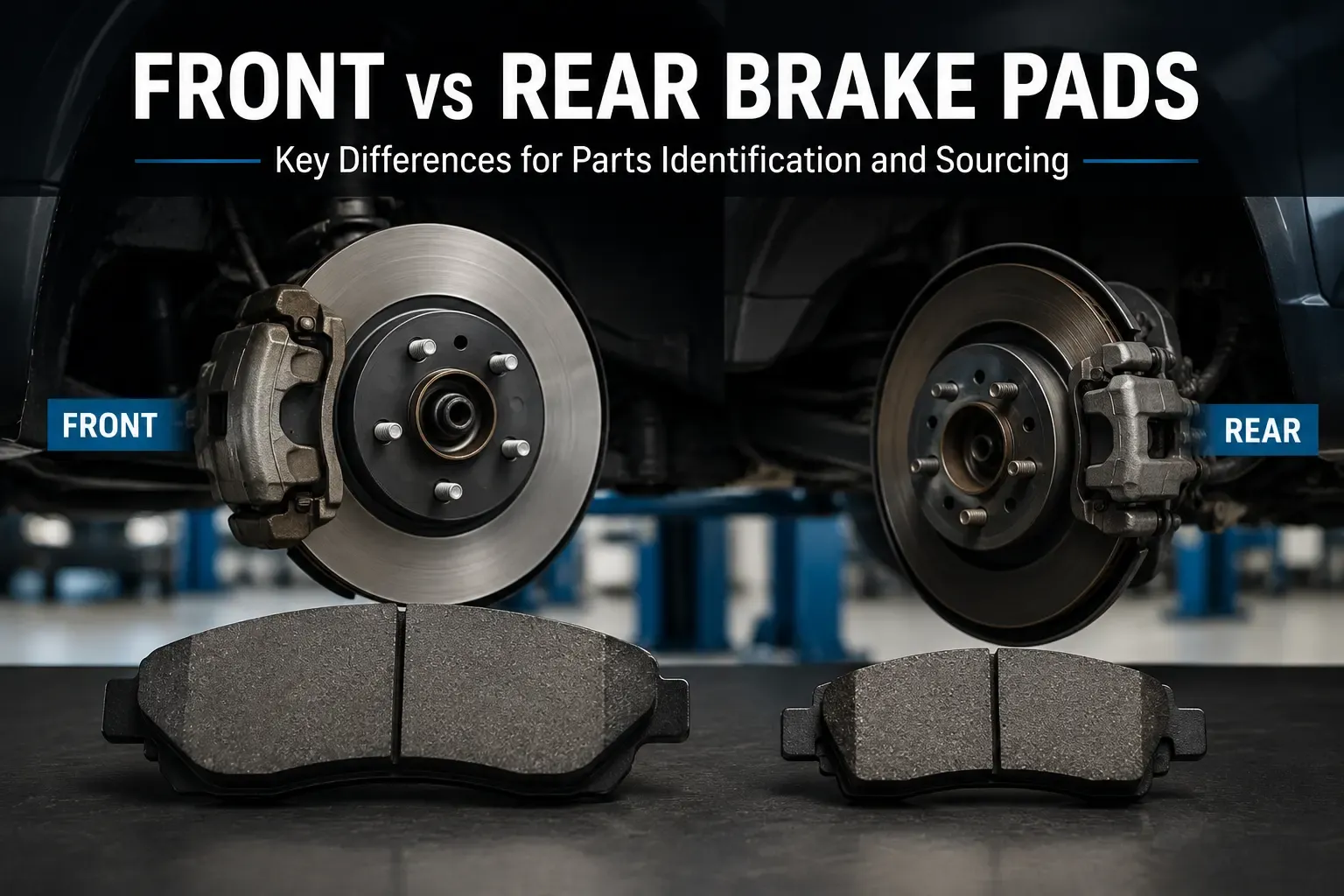
3. Ignoring Front and Rear Position
A vehicle may have completely different front and rear brake pad references.
Always state the axle position clearly.
4. Ignoring Dimensions
When two references appear similar, dimensions are one of the fastest ways to detect a mismatch.
Length, height and thickness should be checked whenever there is uncertainty.
5. Ignoring Hardware and Sensor Differences
Two brake pads can have very similar friction shapes but different wear sensors, clips, shims or other hardware.
For aftermarket programs, these details matter.
How Xinzhong Brake Helps Buyers Identify Brake Pad References
For distributors, importers and private label customers, product identification is often one of the first steps before quotation.
Xinzhong Brake supports 6,600+ brake pad references covering passenger cars, SUVs and commercial vehicle applications.
Our team can help buyers cross-check available information such as:
- FMSI references,
- WVA numbers,
- OE numbers,
- vehicle applications,
- pad dimensions,
- drawings,
- and customer samples.
Once the correct reference is confirmed, we can further discuss friction formulations, including ceramic, semi-metallic, low-metallic and NAO options, as well as OEM/ODM and private label requirements.
For buyers building a multi-reference brake pad program, this identification process is particularly important because even a small matching error can affect purchasing, inventory and downstream customer fitment.
Frequently Asked Questions
Is an FMSI number the same as an OE number?
No.
An FMSI number is a standardized friction-product reference used widely in the aftermarket, while an OE number is assigned by a vehicle manufacturer.
They can refer to the same brake pad application, but they belong to different numbering systems.
Is a WVA number the same as an FMSI number?
No.
Both can be used to identify friction products, but they are different reference systems.
FMSI references are especially common in North America, while WVA numbers are frequently encountered in European and international catalogs.
Can I order brake pads using only an OE number?
Often an OE number is enough to begin product identification.
However, for bulk orders, we still recommend verifying the vehicle application, axle position and dimensions before final confirmation.
Why does one brake pad have several OE numbers?
Vehicle manufacturers may supersede part numbers or use the same brake pad across several related applications.
As a result, one aftermarket brake pad reference can correspond to multiple OE numbers.
What if I only have a brake pad sample and no part number?
A physical sample can also be used for identification.
Clear photos, backing plate shape, dimensions, markings and hardware details can help a manufacturer locate the corresponding reference.
For difficult applications, sending an actual sample may be the safest option.
What information should I send for a brake pad quotation?
Send any available FMSI, WVA or OE numbers together with the vehicle application, axle position and required quantity.
If you need OEM or private label production, also include your preferred friction material, packaging requirements and target market.
Final Takeaway
FMSI, WVA and OE numbers may look complicated at first, but for professional brake pad buyers they all serve one basic purpose:
helping the buyer and supplier identify the correct product.
The safest sourcing process does not depend on a single number.
Instead, use reference numbers together with vehicle application, axle position, dimensions and other technical details to confirm the brake pad before placing a bulk order.
If you are sourcing brake pads for wholesale, distribution or your own private label brand, send us your FMSI, WVA, OE number or application list.
Xinzhong Brake can help you check available references and prepare a quotation for your market.