Brake Pad Knowledge
Copper-Free vs Ceramic Brake Pads: B2B Buyer Guide
Learn the difference between copper-free and ceramic brake pads, what each term means, and what distributors should check when sourcing brake pads.
Copper-Free vs Ceramic Brake Pads: What’s the Difference for Distributors?
When sourcing brake pads, buyers often see two terms used together: copper-free and ceramic.
They are not the same thing.
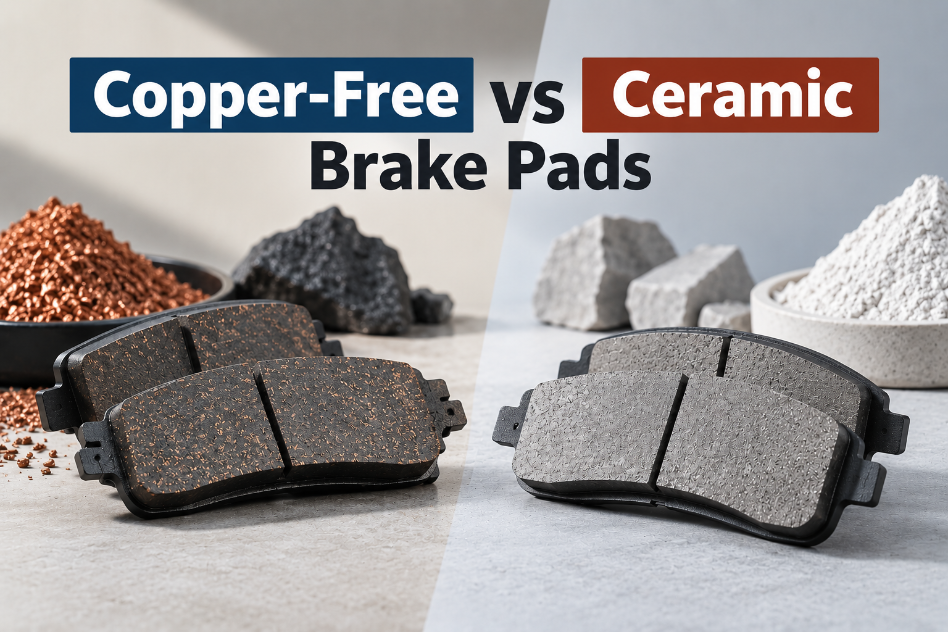
Copper-free describes the copper content of the friction material, while ceramic describes a type of friction-material formulation.
This means a brake pad can be both ceramic and copper-free at the same time.
For distributors, importers, and private-label brake pad brands, understanding this distinction is important. It affects how you compare quotations, evaluate samples, communicate product specifications, and build the right product range for your market.
Copper-Free vs Ceramic Brake Pads: Quick Comparison
Item | Copper-Free Brake Pads | Ceramic Brake Pads |
|---|---|---|
What the term describes | Copper content in the friction material | Friction-material formulation |
Main purpose | Reduce or eliminate copper content | Balance braking, noise, dust and comfort |
Can it be ceramic? | Yes | Yes |
Can it be non-ceramic? | Yes | — |
Typical buyer concern | Compliance, formulation and market requirements | Noise, dust, braking feel and positioning |
Suitable for private label | Yes | Yes |
The key point is simple:
Copper-free and ceramic should not automatically be treated as competing brake pad categories.
A supplier may offer a copper-free ceramic formulation, a copper-free NAO formulation, or other copper-free friction-material solutions depending on the application and target market.
What Are Copper-Free Brake Pads?
Copper has historically been used in some brake friction materials because it can contribute to heat transfer, friction stability and overall braking characteristics.
However, environmental concerns over copper released through brake wear have led to increasingly strict copper-content requirements in some markets.
As a result, friction-material manufacturers have developed alternative formulations designed to maintain braking performance while reducing or eliminating copper.
For distributors, the important question is therefore not simply:
“Do you have copper-free brake pads?”
A better sourcing question is:
“What copper-free formulation do you recommend for my target applications and market?”
If you need a broader introduction to copper-free technology and sourcing considerations, read our Copper-Free Brake Pads: Buyer Guide for 2026.
What Are Ceramic Brake Pads?
Ceramic brake pads generally use a friction-material formulation containing ceramic-related materials combined with fibers, fillers, binders and other friction modifiers.
They are commonly selected for passenger vehicles where buyers value characteristics such as:
- Lower visible brake dust
- Comfortable braking feel
- Reduced noise
- Stable everyday braking performance
- Cleaner wheel appearance
But the word ceramic alone does not tell a buyer everything about brake-pad performance.
Two ceramic brake pads from different manufacturers may have very different formulations and therefore different characteristics.
That is why professional sourcing should go beyond the material label.
Can Ceramic Brake Pads Be Copper-Free?
Yes.
This is probably the most important distinction for buyers.
A ceramic brake pad can be formulated without copper, which means copper-free ceramic brake pads are entirely possible and increasingly relevant for certain markets and product programs.
Likewise, copper-free technology is not necessarily limited to ceramic formulations.
Think about the terminology this way:
Ceramic = formulation category
Copper-free = copper-content requirement
They describe different aspects of the same product.
This distinction becomes particularly important when preparing RFQs.
Instead of requesting only:
Ceramic brake pads
a buyer can provide a more precise requirement such as:
Copper-free ceramic formulation for passenger-car applications, with low-dust and low-noise performance as key priorities.
That gives the manufacturer much more useful information when selecting or developing the formulation.
Which Is Better: Copper-Free or Ceramic?
This is actually the wrong comparison.
Because the two terms describe different characteristics, buyers should not ask whether copper-free is “better” than ceramic.
Instead, consider the requirements of the target market.
1. Target Market Requirements
Some markets place greater emphasis on copper-content restrictions or environmental requirements.
If you sell into these markets, copper content may become an important sourcing specification rather than simply a marketing feature.
2. Vehicle Applications
Different vehicle applications may require different friction characteristics.
A formulation suitable for a compact passenger car may not be the best choice for a heavier SUV or another demanding application.
This is why selecting one formulation for an entire catalogue can create problems.
3. Noise Expectations
For many aftermarket distributors, brake noise is one of the fastest ways to generate customer complaints.
If your market is particularly sensitive to squeal, formulation selection should consider noise performance alongside copper content.
For more on this issue, see our guide to Brake Pad Noise and Dust: What Distributors Should Ask Their Suppliers.
4. Brake Dust
Low visible dust can be an important selling point, particularly for passenger-car aftermarket programs.
However, buyers should avoid assuming that every product marketed as ceramic will automatically produce the same dust performance.
Actual formulation and testing matter more than the label.
5. Price Positioning
Your target price segment also matters.
A distributor building a premium private-label range may prioritize low dust, low noise and driving comfort.
Another buyer may need a more cost-sensitive formulation while still meeting defined performance requirements.
The correct formulation should therefore match both technical requirements and commercial positioning.
What Should Distributors Ask Suppliers?
When sourcing copper-free brake pads, avoid asking only for a catalogue and price list.
Give the supplier enough information to recommend the correct formulation.
A useful RFQ should include:
- OE, FMSI or WVA reference numbers where available
- Vehicle applications
- Target market
- Required copper-free specification
- Preferred friction-material type
- Noise and dust expectations
- Packaging requirements
- Private-label requirements
- Estimated order quantities
- Any required certifications or testing standards
This makes quotations much easier to compare.
More importantly, it reduces the risk of comparing two prices for products that look identical on paper but use very different friction-material solutions.
For a complete sourcing checklist, see our Brake Pad RFQ Checklist: What Buyers Should Send Suppliers for an Accurate Quote.
Don’t Evaluate a Brake Pad by the Formula Name Alone
Terms such as ceramic, semi-metallic, NAO and copper-free are useful, but they should never replace actual product evaluation.
Before committing to a large order, buyers should evaluate samples for factors such as:
- Fit and dimensions
- Friction stability
- Noise
- Dust
- Pedal feel
- Wear
- Rotor compatibility
- Bonding and structural quality
- Packaging consistency
For private-label programs in particular, sample validation gives both buyer and manufacturer an opportunity to adjust the product before larger quantities are produced.
Why Sample Testing Matters for Copper-Free Programs
Replacing copper is not simply a matter of removing one ingredient.
The friction system needs to be balanced using other materials so that the finished brake pad can achieve the intended braking characteristics.
That makes sample testing especially important when evaluating a new copper-free supplier.
Instead of immediately requesting quotations for hundreds of references, distributors can start with a smaller group of representative applications.
Choose several references covering different vehicle types or market segments, test them, collect feedback, and then expand the range.
This approach reduces sourcing risk while giving both sides useful information before bulk production.
Our guide How to Evaluate Brake Pad Samples Before Bulk Orders explains a practical sample-validation process for distributors.
Copper-Free Brake Pads for Private-Label Programs
For private-label buyers, copper-free products can also help create clearer product positioning.
For example, a distributor may build a passenger-car range around:
Copper-Free Ceramic + Low Dust + Low Noise
rather than selling products only under a generic “ceramic brake pad” description.
But the marketing claim should always match the actual formulation and supporting product documentation.
Before printing packaging or catalogues, confirm with your manufacturer:
- The exact formulation category
- Copper-content specification
- Available test data
- Recommended product claims
- Market-specific requirements
This avoids making claims that cannot later be supported.
How Xinzhong Brake Supports Copper-Free Brake Pad Programs
Xinzhong Brake supplies brake pads for passenger and commercial vehicle applications, with multiple friction-material options including ceramic, semi-metallic, low-metallic and NAO formulations.
For buyers developing copper-free programs, we can discuss formulation options based on:
- Target market
- Vehicle applications
- Product positioning
- Noise and dust requirements
- Order volume
- Private-label requirements
Rather than starting with a full catalogue, we recommend beginning with a focused application list.
Send us your OE, FMSI or WVA numbers, and we can cross-reference the applications and discuss suitable friction-material options for your program.
FAQ
Are copper-free brake pads the same as ceramic brake pads?
No. Copper-free describes the copper content of the friction material, while ceramic describes a type of friction-material formulation. A ceramic brake pad can also be copper-free.
Are all ceramic brake pads copper-free?
No. Buyers should not assume that a product is copper-free simply because it is described as ceramic. The actual formulation should be confirmed with the manufacturer.
Can non-ceramic brake pads be copper-free?
Yes. Copper-free formulations are not necessarily limited to ceramic brake pads.
Are copper-free brake pads better?
Not automatically. Performance depends on the complete friction-material formulation, vehicle application, manufacturing quality and target operating conditions.
What should importers check before buying copper-free brake pads?
Confirm the formulation, copper-content requirement, application coverage, available test data, noise and dust expectations, sample performance, packaging requirements and relevant market requirements.
Can I order copper-free brake pads with my own brand?
Yes. Private-label programs can combine copper-free formulations with customized packaging and product positioning, depending on supplier capabilities and order requirements.
Looking for Copper-Free Brake Pads for Your Market?
If you are an importer, distributor or private-label brake pad brand, send us your target application list.
OE, FMSI or WVA numbers are enough to start.
We can cross-reference your requirements and discuss suitable copper-free, ceramic and other friction-material options for your market.