Aug 9, 2026Brake Pad Knowledge
What Are Brake Pads? A Complete Guide to Types, Materials & Applications
Learn about brake pad types, materials, performance differences, and applications. A practical guide for distributors, importers, and automotive aftermarket buyers.
What Are Brake Pads?
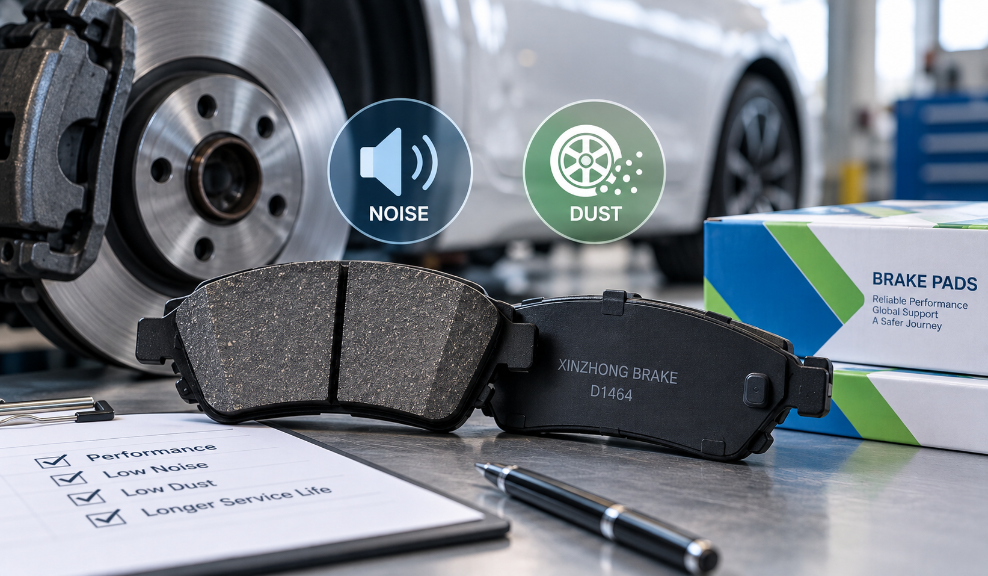
Brake pads are a critical component of a vehicle's disc braking system. They create friction against the brake disc or rotor, converting the vehicle's kinetic energy into heat and allowing the vehicle to slow down or stop.
However, not all brake pads are the same.
Different brake pad materials can provide very different levels of friction stability, noise control, dust generation, heat resistance, wear life, and braking performance.
For automotive aftermarket distributors, importers, wholesalers, and private label brands, choosing the right brake pad is therefore not simply about finding a compatible part number.
It is about matching the friction material, vehicle application, driving conditions, target market, and customer expectations.
This guide explains the major types of brake pads, their materials, characteristics, and typical applications.
How Do Brake Pads Work?
A typical disc brake system includes several key components:
- Brake disc or rotor
- Brake caliper
- Brake pads
- Hydraulic braking system
When the driver presses the brake pedal, hydraulic pressure activates the brake caliper.
The caliper pushes the brake pads against the rotating brake disc. The friction generated between the brake pad and disc slows the wheel and converts kinetic energy into heat.
Because braking generates significant heat and mechanical stress, the formulation of the brake pad has a major influence on braking performance.
A good brake pad should provide stable friction under different temperatures and operating conditions while maintaining acceptable levels of noise, wear, and dust.
What Are Brake Pads Made Of?
Modern brake pads are made from friction material formulations containing multiple types of raw materials.
A typical formulation may include:
- Fibers
- Fillers
- Friction modifiers
- Abrasives
- Lubricants
- Metallic components
- Resins and other binders
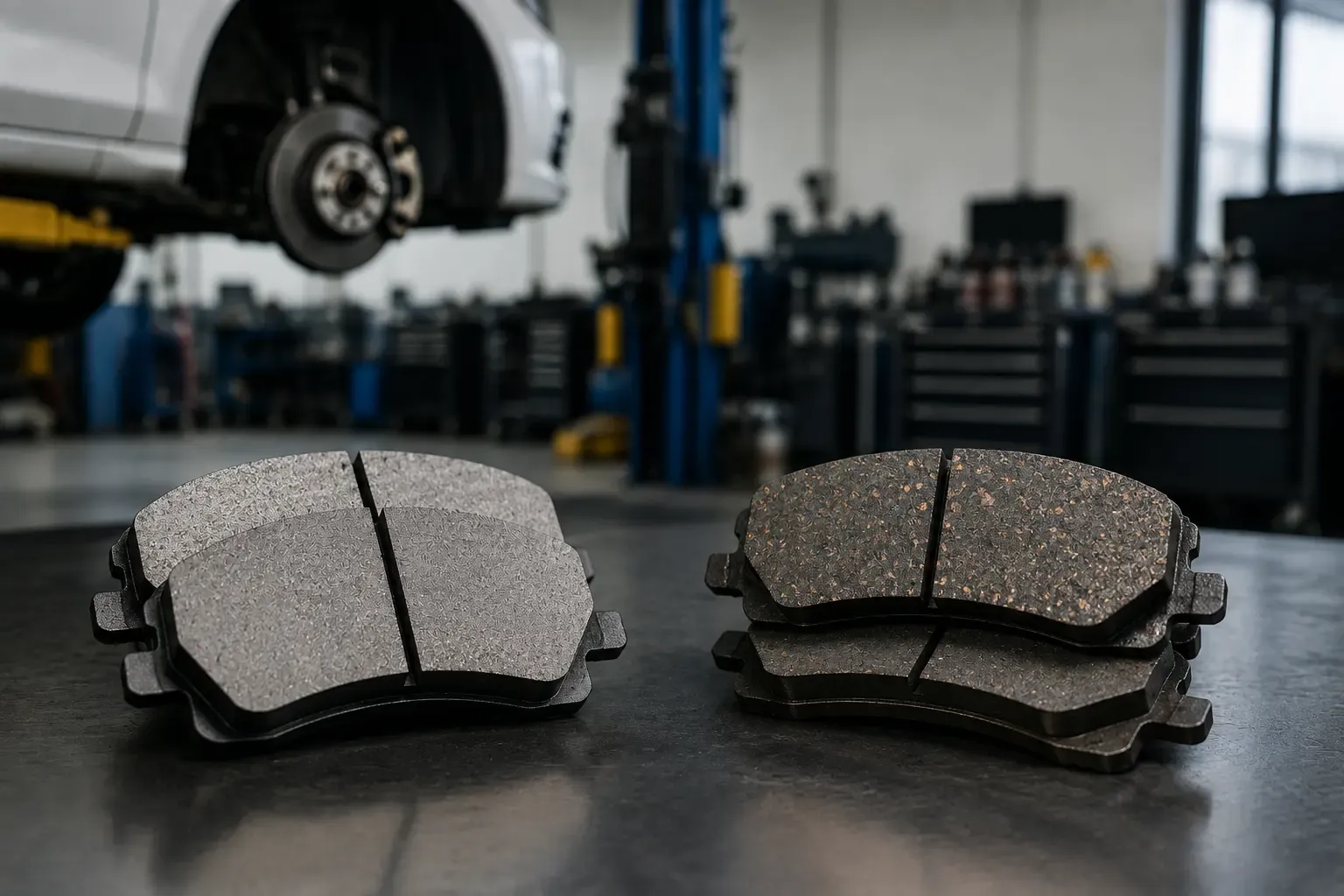
The exact combination and proportion of these materials determine how the brake pad performs.
This is why two brake pads that look almost identical can behave very differently in actual use.
For professional brake pad manufacturers, friction material formulation is one of the core technologies behind product performance.
The objective is not simply to maximize friction.
A well-designed formulation must balance multiple characteristics, including:
- Friction coefficient
- Friction stability
- Noise
- Dust
- Wear resistance
- Heat resistance
- Rotor compatibility
- Pedal feel
- Service life
Different markets and vehicle applications may require different balances between these characteristics.
What Are the Main Types of Brake Pads?
Brake pads are commonly classified according to their friction material.
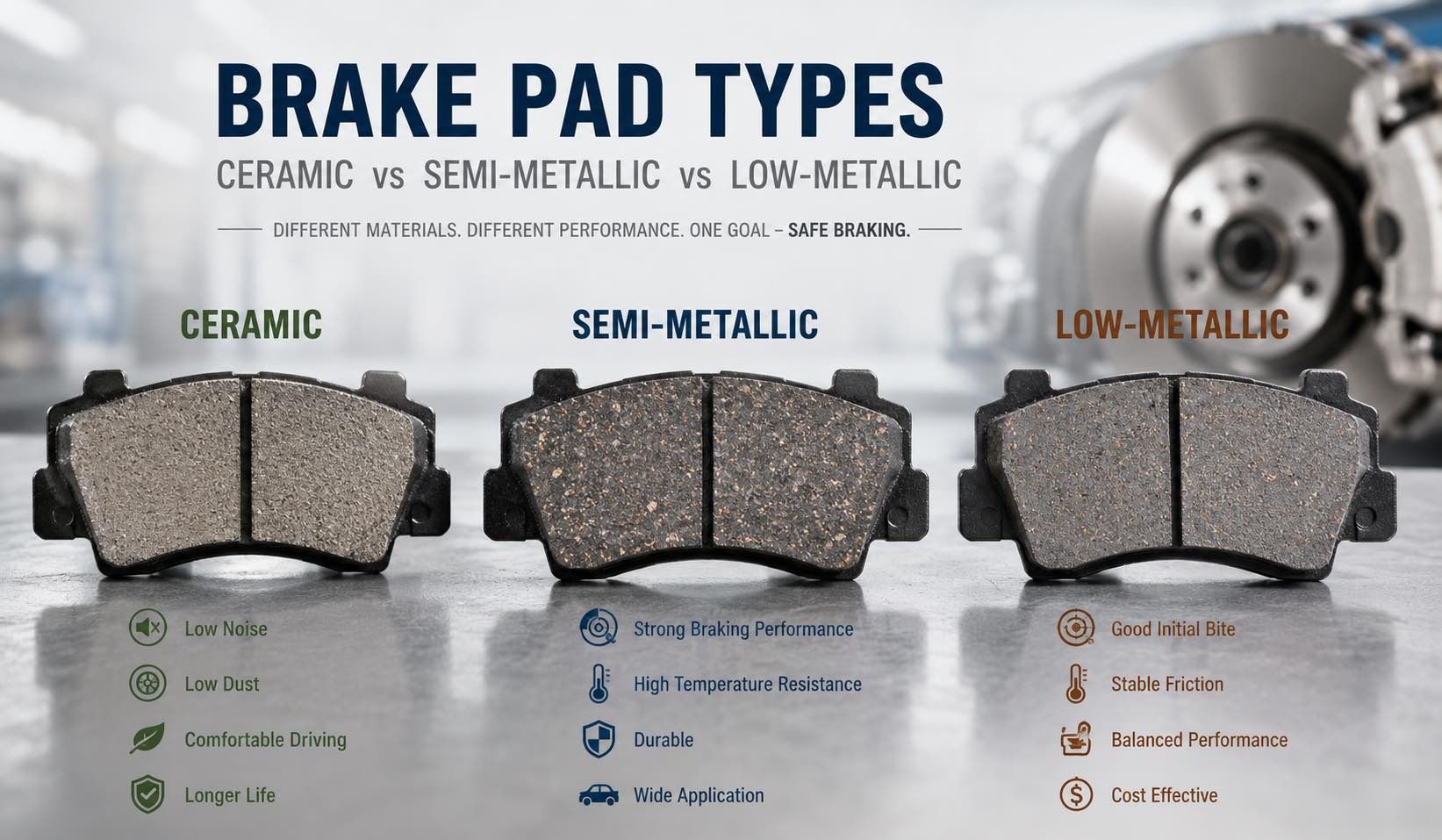
For the automotive aftermarket, three important categories are ceramic brake pads, semi-metallic brake pads, and low-metallic brake pads.
1. Ceramic Brake Pads
Ceramic brake pads typically use ceramic fibers and other friction materials with relatively low metallic content.
They are widely used in passenger vehicles and are particularly popular in markets where drivers value comfort, low noise, and cleaner wheels.
Advantages of Ceramic Brake Pads
Ceramic brake pads can offer:
- Low braking noise
- Low visible brake dust
- Smooth braking feel
- Stable friction performance
- Good service life
- Comfortable everyday driving
Typical Applications
Ceramic brake pads are commonly suitable for:
- Passenger cars
- SUVs
- Urban driving
- Premium aftermarket product lines
- Markets with strong demand for low-noise and low-dust braking
For distributors and private label brake pad brands, ceramic brake pads are often positioned as a premium or comfort-focused aftermarket option.
2. Semi-Metallic Brake Pads
Semi-metallic brake pads contain a relatively high proportion of metallic materials combined with other friction components.
Their formulations are generally designed to provide strong braking performance and good heat resistance.
Advantages of Semi-Metallic Brake Pads
Semi-metallic brake pads can provide:
- Strong braking performance
- Good heat dissipation
- Stable friction at higher temperatures
- Good durability
- Wide application range
Compared with ceramic formulations, some semi-metallic formulations may generate more noise or brake dust. However, their strong braking characteristics make them suitable for many demanding applications.
Typical Applications
Semi-metallic brake pads are widely used for:
- Passenger vehicles
- SUVs
- Commercial vehicles
- Heavy-load applications
- High-temperature braking conditions
They are a common choice for automotive aftermarket buyers looking for a balance between braking performance, durability, and cost.
3. Low-Metallic Brake Pads
Low-metallic brake pads contain a smaller amount of metallic material than typical semi-metallic formulations.
They are designed to combine effective braking performance with improved comfort characteristics.
Advantages of Low-Metallic Brake Pads
Depending on the formulation, low-metallic brake pads can offer:
- Good initial braking response
- Stable friction performance
- Effective heat transfer
- Good braking feel
- Balanced performance and cost
Typical Applications
Low-metallic brake pads are commonly used in:
- Passenger cars
- European vehicle applications
- Automotive aftermarket replacement
- Markets requiring responsive braking performance
For aftermarket distributors serving multiple vehicle brands, low-metallic formulations can be an important part of a complete brake pad product range.
Ceramic vs Semi-Metallic vs Low-Metallic Brake Pads
There is no single brake pad material that is best for every application.
The right choice depends on the vehicle, market, driving environment, and desired product positioning.
Feature | Ceramic | Semi-Metallic | Low-Metallic |
|---|---|---|---|
Noise | Low | Medium | Low to Medium |
Brake Dust | Low | Medium to High | Medium |
Heat Resistance | Good | Very Good | Good |
Braking Response | Smooth | Strong | Responsive |
Comfort | High | Medium | Good |
Typical Application | Passenger Cars / SUVs | Passenger / SUV / Commercial | Passenger Cars |
Typical Market Position | Premium / Comfort | Performance / Durable | Balanced |
These characteristics are general comparisons only.
Actual brake pad performance depends heavily on the specific friction material formulation, manufacturing process, quality control, vehicle platform, and test requirements.
This is particularly important for B2B buyers.
Two suppliers may both offer a product described as a "ceramic brake pad," but the actual formulation and performance can be significantly different.
How Should B2B Buyers Choose Brake Pads?
For professional automotive aftermarket buyers, brake pad sourcing should not be based on price alone.
Several factors should be evaluated before placing an order.
1. Vehicle Coverage
Check whether the supplier can support the vehicle applications required by your market.
A broad brake pad catalog can help distributors consolidate sourcing and reduce the number of suppliers they need to manage.
2. Friction Material
Choose the formulation according to your target market.
For example, customers focused on quiet and clean braking may prefer ceramic brake pads, while applications requiring stronger heat resistance may be better suited to semi-metallic formulations.
3. Consistency
A good sample is not enough.
For distributors and private label brands, batch-to-batch consistency is more important than one impressive sample.
Stable raw materials, controlled production processes, testing, and quality management all influence long-term product consistency.
4. Noise, Dust and Wear
Different markets have different expectations.
Some buyers prioritize low noise and low dust. Others care more about braking strength, durability, or competitive pricing.
The formulation should match the positioning of the product line.
5. Quality Management
Before selecting a brake pad supplier, buyers should evaluate the manufacturer's quality management system, testing capabilities, production controls, and traceability.
Certifications such as IATF 16949 and ISO 9001 can also help buyers evaluate whether a manufacturer has established standardized automotive quality management processes.
6. OEM and Private Label Capability
For importers, distributors, and automotive brands, the brake pad itself is only part of the sourcing requirement.
A capable brake pad manufacturer may also need to support:
- Custom friction formulations
- Private label packaging
- Product labeling
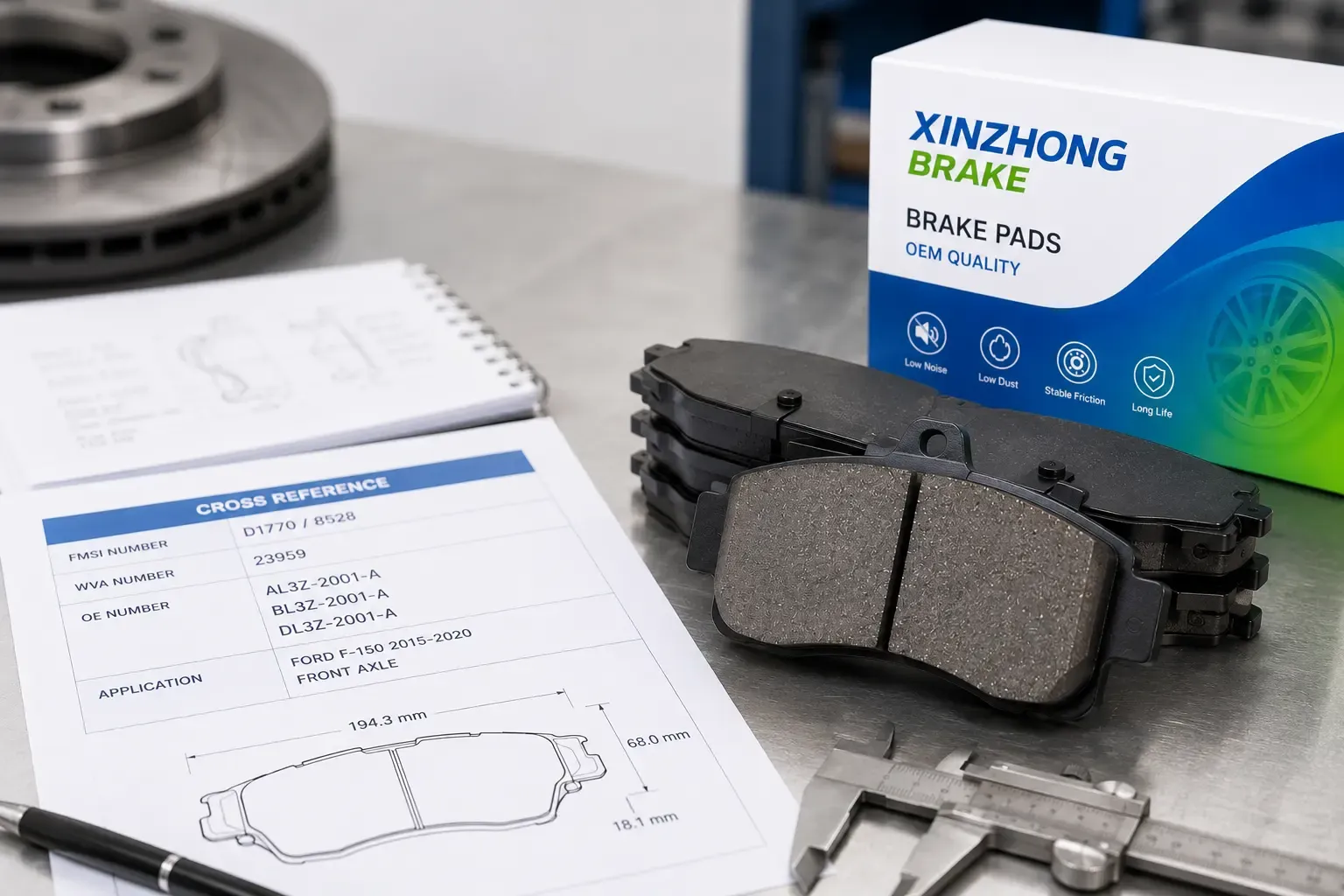
- Part number matching
- Catalog development
- Different market positioning
- OEM/ODM requirements
The right supplier should therefore be able to support both the product and the buyer's long-term aftermarket strategy.
Why Brake Pad Formulation Matters
One of the biggest mistakes in brake pad sourcing is treating friction material as a simple commodity.
It is not.
A brake pad formulation is a balance between friction, wear, temperature resistance, noise, dust, comfort, rotor wear, and cost.
Changing one component can affect several other performance characteristics.
That means a lower-cost formulation is not automatically more competitive if it creates excessive noise, unstable friction, premature wear, or customer complaints.
For distributors, the real cost of a brake pad includes more than the purchase price.
It can also include:
- Warranty claims
- Customer complaints
- Product returns
- Brand reputation
- Replacement costs
- Lost repeat business
For this reason, professional buyers should evaluate brake pads based on overall product consistency and market suitability, rather than unit price alone.
Choosing a Brake Pad Manufacturer for the Automotive Aftermarket
A reliable brake pad manufacturer should be able to do more than manufacture parts according to a drawing or reference number.
For long-term B2B cooperation, buyers should look at several capabilities:
- Friction material R&D
- Product testing
- Stable production processes
- Quality control
- Broad vehicle coverage
- Consistent batch production
- OEM/ODM capability
- Private label support
- Export experience
Xinzhong Brake (Qingdao) Auto Parts Co., Ltd. specializes in the development and manufacturing of automotive brake pads for global aftermarket customers.
With 200+ friction material formulations, 6,600+ brake pad references, and annual production capacity of 30 million pieces, we support a wide range of passenger car and commercial vehicle applications.
Our brake pad product range includes ceramic, semi-metallic, and low-metallic formulations, with OEM/ODM and private label services available for distributors, importers, wholesalers, and automotive brands.
Conclusion
Brake pad selection is ultimately a balance between vehicle application, friction material, braking performance, comfort, durability, and market positioning.
Ceramic brake pads are often selected for low-noise and low-dust applications.
Semi-metallic brake pads are widely used where strong braking performance and heat resistance are important.
Low-metallic brake pads provide another balanced solution for many passenger vehicle applications.
For B2B buyers, however, material type is only the starting point.
The more important question is whether the manufacturer can consistently produce the right formulation for your market and maintain that performance from one production batch to the next.
If you are sourcing brake pads for distribution, wholesale, private label, or automotive aftermarket projects, contact Xinzhong Brake to discuss your required vehicle applications, friction materials, specifications, and target market.
Frequently Asked Questions
What are the main types of brake pads?
The most common automotive aftermarket brake pad types include ceramic, semi-metallic, low-metallic, and other non-asbestos organic friction material formulations. Each type provides different characteristics in terms of braking performance, noise, dust, heat resistance, and wear.
Are ceramic brake pads better than semi-metallic brake pads?
Not necessarily. Ceramic brake pads are often preferred for low noise, low dust, and comfortable everyday driving, while semi-metallic brake pads can provide strong braking performance and good heat resistance. The best choice depends on the vehicle and application.
What type of brake pad is best for passenger cars?
Ceramic, semi-metallic, and low-metallic brake pads can all be used for passenger vehicles. The appropriate material depends on vehicle design, driving conditions, market requirements, and desired performance characteristics.
What should distributors consider when sourcing brake pads?
Distributors should consider vehicle coverage, friction material, braking performance, batch consistency, quality control, certifications, manufacturing capacity, packaging, and OEM/private label capabilities.
Can brake pads be customized for different markets?
Yes. Professional brake pad manufacturers can develop or select friction formulations according to different vehicle applications, driving environments, performance requirements, and market positioning. Packaging and private label requirements can also be customized for B2B customers.