Aug 28, 2026Brake Pad Knowledge
Front vs Rear Brake Pads: Key Differences for Parts Identification and Sourcing
Learn how front and rear brake pads differ in size, design, FMSI references and vehicle applications, and what buyers should verify before sourcing brake pads.
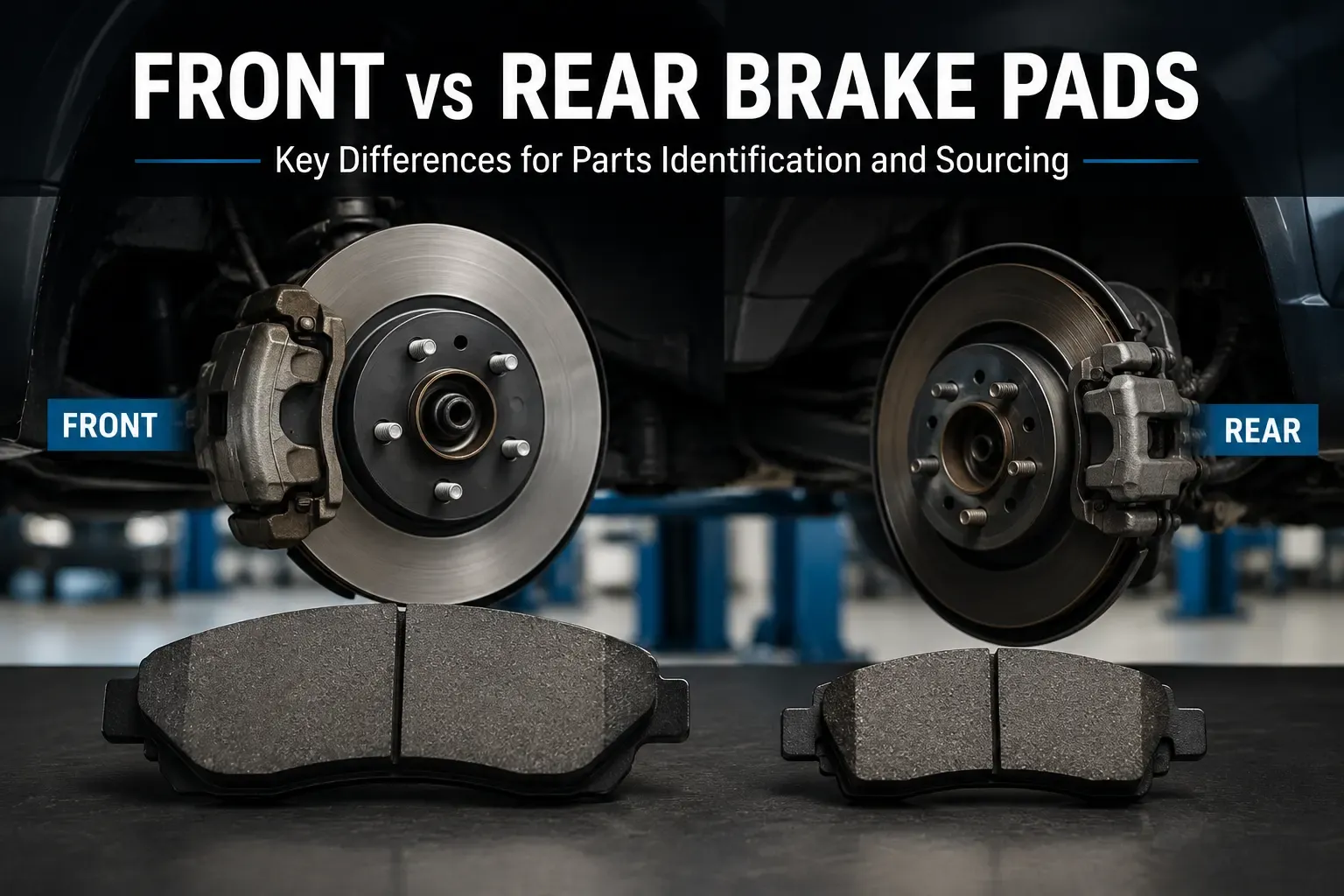
Front and rear brake pads on the same vehicle are usually different parts.
They may differ in pad dimensions, backing plate shape, friction material requirements, wear indicators, hardware, and FMSI or OE references.
For aftermarket distributors and importers, identifying only the vehicle make and model is therefore not enough. The axle position, model year, brake system, and part reference should also be confirmed before ordering.
A useful example is the Toyota Tundra, Sequoia, Land Cruiser, and Lexus LX570 application group. Selected vehicles use FMSI D1303 on the front axle and D1304 on the rear axle. Although both references may appear within the same vehicle range, they have completely different dimensions and part numbers.
Why Are Front and Rear Brake Pads Different?
During braking, vehicle weight transfers toward the front axle. As a result, the front braking system typically handles a larger share of the braking load.
This is one reason front brake components are often larger than their rear counterparts.
However, brake pad design is not determined by axle position alone.
Vehicle weight, caliper design, rotor dimensions, brake balance, engine configuration, electronic braking systems, and the manufacturer's brake system design can all affect the final pad specification.
That is why a buyer should not assume that every front brake pad follows one standard design or that rear pads are simply smaller versions of front pads.
Front vs Rear Brake Pads: A Real D1303 and D1304 Example
The difference becomes much clearer when comparing two actual FMSI references.
Specification | D1303 | D1304 |
|---|---|---|
Position | Front Axle | Rear Axle |
Retail Code | 8419 | 8420 |
Brake System | Advics | Advics |
Width | 143.6 mm | 116 mm |
Height | 84.3 mm | 45 mm |
Thickness | 18 mm | 17 mm |
OE Reference | 04465-60280 | 04466-0C010 |
Both references are found in selected Toyota and Lexus SUV and pickup applications, but their physical dimensions are clearly different.
The D1303 front pad is approximately 27.6 mm wider and 39.3 mm taller than the D1304 rear pad.
For a distributor, this is exactly why vehicle name alone should never be treated as sufficient product identification.
1. Pad Dimensions Can Be Very Different
Width, height, and thickness are among the fastest ways to detect an incorrect brake pad reference.
In this example:
D1303 Front: 143.6 × 84.3 × 18 mm
D1304 Rear: 116 × 45 × 17 mm
Even though both references can belong to the same vehicle family, the pad profiles are clearly not interchangeable.
When comparing supplier catalogs, buyers should check dimensions against the required FMSI or OE reference rather than relying only on a vehicle description.
2. Front and Rear Pads Use Different Part References
A vehicle can have completely different identification numbers for its front and rear brake pads.
These may include:
- FMSI numbers
- WVA numbers
- OE numbers
- Manufacturer-specific cross references
- Aftermarket brand references
For example, the Toyota and Lexus applications above use:
Front: FMSI D1303-8419 / OE 04465-60280
Rear: FMSI D1304-8420 / OE 04466-0C010
This distinction becomes particularly important when a distributor manages hundreds or thousands of brake pad SKUs.
A small reference-number error can result in purchasing the correct vehicle application but the wrong axle position.
3. Vehicle Fitment Must Be Checked by Axle Position
A search such as:
Toyota Tundra brake pads
is useful for finding a product category, but it is not precise enough for a purchase order.
A better sourcing request would identify:
Vehicle + Model Year + Axle Position + FMSI/OE Reference
For example:
Toyota Tundra rear brake pads, FMSI D1304
is much less ambiguous.
The same principle applies when building an aftermarket catalog. Front and rear references should be treated as separate SKUs even when they cover overlapping vehicle applications.
4. Brake System and Vehicle Configuration Still Matter
Even after identifying the front or rear axle, buyers should verify the actual brake system.
Different versions of the same vehicle may use different brake components because of:
- Model year
- Engine
- Trim level
- Market
- Caliper or brake system
- Vehicle configuration
Both D1303 and D1304, for example, are associated with Advics brake applications in the referenced Toyota and Lexus vehicle group.
This additional identification layer helps prevent fitment errors when the same model name appears across multiple generations or configurations.
5. Friction Formulation Should Not Be Selected by Axle Position Alone
It is tempting to simplify sourcing into front equals one formulation and rear equals another formulation.
That is not a reliable purchasing rule.
Friction formulation should be selected according to the complete brake system and the buyer's target performance requirements.
Depending on the market and product positioning, a brake pad supplier may need to consider noise control, friction stability, temperature performance, dust characteristics, rotor compatibility, and cost targets.
For private-label programs, buyers should therefore discuss both part identification and formulation requirements with the manufacturer.
Why Front-and-Rear Coverage Matters for Distributors
There is another side to this issue beyond technical fitment.
It is also a catalog strategy question.
If a distributor already sells front brake pads for a popular vehicle platform, checking whether the corresponding rear reference is available can improve SKU coverage.
For selected Toyota and Lexus applications, for example:
D1303 → Front
D1304 → Rear
Offering both references allows a distributor to cover more of the braking requirements within the same vehicle family rather than sourcing isolated SKUs.
For manufacturers, this also means that quotation discussions should not always stop at the reference initially requested by the buyer.
Related front or rear references may be commercially relevant to the same aftermarket program.
What Should Buyers Confirm Before Ordering?
Before placing a bulk brake pad order, confirm at least:
- FMSI, OE, or another reliable reference number
- Front or rear axle position
- Vehicle make and model
- Applicable model year or generation
- Brake system where relevant
- Required friction formulation
- Required hardware or wear-indicator configuration
- Packaging and private-label requirements
For large product lists, sending reference numbers instead of vehicle names alone can significantly reduce ambiguity during quotation and product matching.
Conclusion
The difference between front and rear brake pads goes far beyond installation position.
They can use different dimensions, backing plate designs, FMSI numbers, OE references, and vehicle configurations even when they belong to the same vehicle.
For distributors and importers, the safest sourcing approach is simple:
Identify the vehicle, identify the axle, then verify the part reference.
Xinzhong Brake supplies front and rear brake pad references for passenger cars, SUVs, light trucks, and commercial vehicles, with ceramic and customized friction formulations available for OEM and private-label programs.
For a quotation, send us your FMSI/OE references, vehicle applications, required formulation, quantity, target market, and packaging requirements.
Frequently Asked Questions
Are front and rear brake pads the same?
Usually not. Front and rear brake pads commonly have different dimensions, shapes, and part references and should not be treated as interchangeable.
Are front brake pads always bigger than rear brake pads?
No. Front pads are often larger because of front-axle braking demand, but this is not a universal identification rule. Always verify the actual reference and dimensions.
How can I tell whether a brake pad is front or rear?
Check the FMSI, OE, or other catalog reference together with the vehicle application and axle position. Pad dimensions and shape can provide additional confirmation.
Can the same vehicle use different brake pads depending on the year?
Yes. Brake systems can change between model years, generations, engines, and vehicle configurations.
Should distributors source front and rear brake pads together?
Not necessarily for every application, but related front-and-rear coverage can be useful when building a product range for popular vehicle platforms.