Sep 7, 2026Brake Pad Knowledge
Ceramic vs Semi-Metallic Brake Pads: Which Is Better?
Compare ceramic vs semi-metallic brake pads for noise, dust, braking, durability and applications. A practical guide for brake pad distributors and buyers.
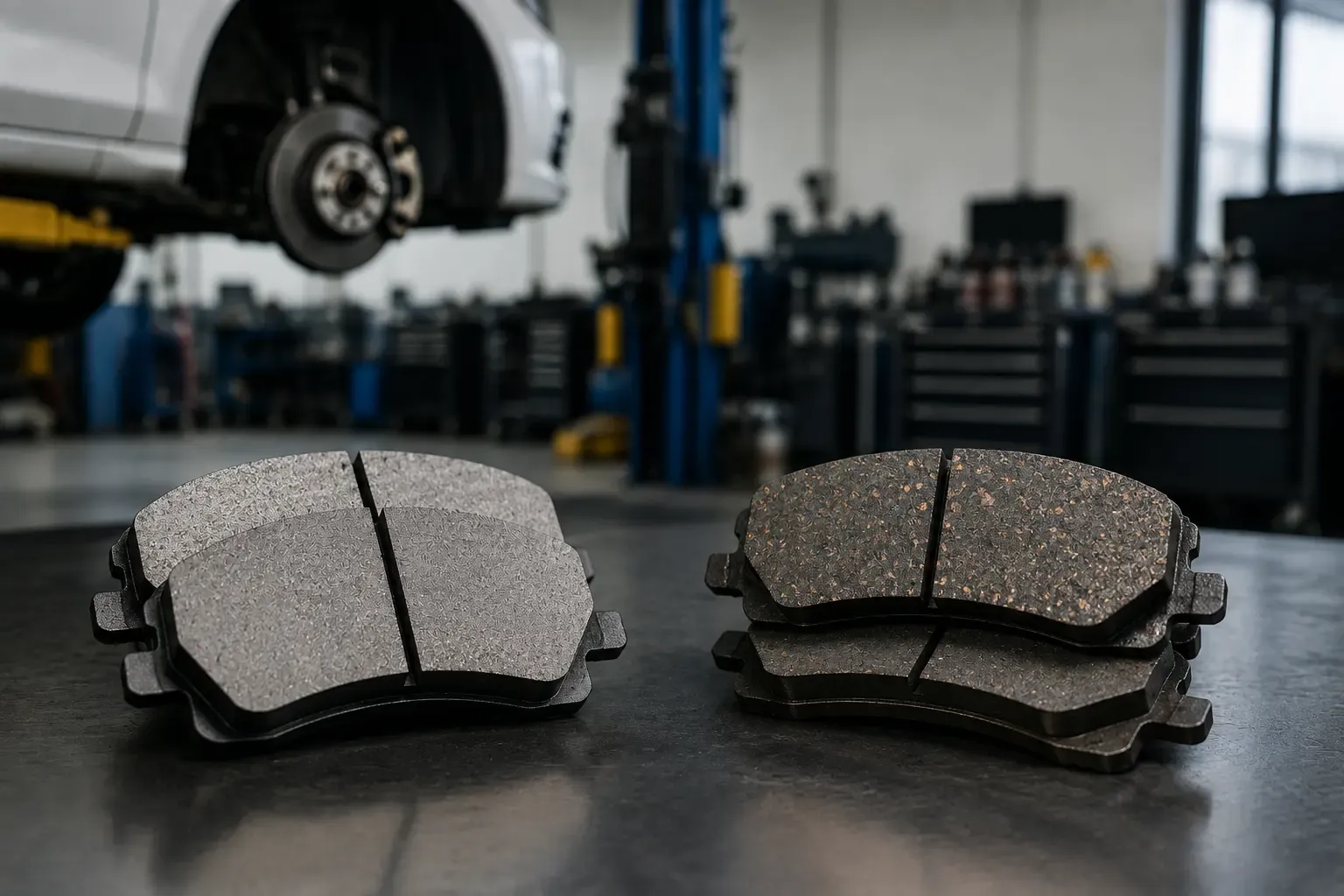
Ceramic and semi-metallic brake pads are two of the most common friction material options in the automotive aftermarket.
So which one is better?
There is no single answer.
Ceramic brake pads are generally preferred when low noise, low dust and driving comfort are priorities, while semi-metallic brake pads are often selected when stronger braking response, heat resistance and durability are more important.
For distributors and aftermarket buyers, the right choice should depend on the vehicle application, driving conditions, local market and customer expectations.
Ceramic vs Semi-Metallic Brake Pads at a Glance
Factor | Ceramic Brake Pads | Semi-Metallic Brake Pads |
|---|---|---|
Noise | Generally lower | Can be higher |
Brake Dust | Lower and cleaner | Usually higher |
Braking Response | Smooth and stable | Strong and responsive |
Heat Resistance | Good | Very good |
Driving Comfort | Excellent | Good |
Heavy-Duty Use | Limited depending on formulation | Better suited |
Typical Application | Passenger cars, SUVs | Passenger cars, SUVs, demanding applications |
Market Position | Comfort / premium aftermarket | Performance / durability |
These differences are general characteristics.
Actual brake pad performance depends heavily on the friction material formulation, manufacturing process and vehicle application.
Two ceramic brake pads from different manufacturers can perform very differently.
What Are Ceramic Brake Pads?
Ceramic brake pads use a friction material formulation containing ceramic and other friction-modifying components.
They have become popular in the passenger vehicle aftermarket because of their balance between braking performance and driving comfort.
Typical advantages include:
- Low braking noise
- Reduced visible brake dust
- Smooth braking feel
- Stable friction characteristics
- Good everyday driving comfort
- Rotor-friendly performance with a properly designed formulation
For markets where drivers care strongly about noise, wheel cleanliness and comfort, ceramic brake pads can be an attractive product category.
What Are Semi-Metallic Brake Pads?
Semi-metallic brake pads contain a higher proportion of metallic components within the friction material.
These materials help improve heat transfer and provide strong braking characteristics under demanding operating conditions.
Typical advantages include:
- Strong braking response
- Good heat dissipation
- Stable performance at higher temperatures
- Good durability
- Broad vehicle application
- Suitability for more demanding driving conditions
Semi-metallic formulations are therefore widely used across passenger cars, SUVs and other applications where braking performance and durability are major considerations.
Which Brake Pad Produces Less Noise?
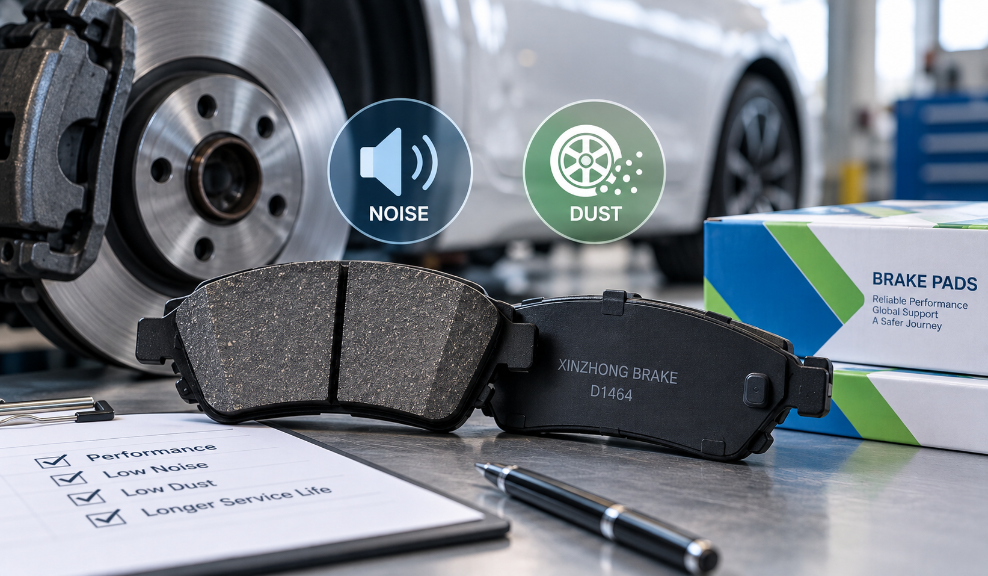
Ceramic brake pads generally have an advantage when noise reduction is the priority.
Their friction characteristics can help provide smoother and quieter braking during normal passenger vehicle use.
Semi-metallic brake pads may generate more braking noise depending on the formulation, vehicle and operating conditions.
However, material category alone does not determine noise performance.
Brake noise can also be affected by:
- Friction formulation
- Shim design
- Backing plate
- Rotor condition
- Installation quality
- Vehicle structure
- Operating temperature
A properly engineered semi-metallic brake pad can therefore still achieve excellent noise performance.
Which Brake Pad Produces Less Dust?
Ceramic brake pads are commonly chosen for low-dust applications.
This is especially important in markets where consumers care about keeping alloy wheels clean.
Semi-metallic pads may generate more visible dust because of their friction material composition.
For distributors targeting premium passenger vehicle customers, low dust can become an important selling point, not simply a technical specification.
Which Has Better Braking Performance?
This question needs more context.
Semi-metallic brake pads often provide strong initial bite and perform well under higher temperatures and demanding braking conditions.
Ceramic brake pads usually provide smoother and more progressive braking characteristics for normal passenger vehicle use.
That does not mean ceramic pads have poor braking performance.
A well-developed ceramic formulation can provide excellent stopping performance while maintaining low noise and low dust.
The real question should therefore be:
What braking characteristics does the target vehicle and market require?
Which Brake Pads Last Longer?
There is no universal winner.
Brake pad life depends on several factors, including:
- Friction material formulation
- Vehicle weight
- Driving habits
- Road conditions
- Operating temperature
- Rotor condition
- Brake system design
A premium ceramic formulation may provide excellent service life in normal urban driving.
A properly designed semi-metallic formulation may perform better under repeated high-temperature braking.
For B2B buyers, evaluating only material names without considering the actual formulation can therefore be misleading.
Ceramic or Semi-Metallic: Which Should Distributors Choose?
This is where the decision becomes more commercial.
If your customers mainly drive passenger vehicles in urban environments and care about comfort, quiet braking and clean wheels, ceramic brake pads may be a strong product line to develop.
If your market includes heavier vehicles, demanding road conditions or customers who prioritize braking response and durability, semi-metallic brake pads may be more suitable.
Many established brake pad distributors do not choose only one material.
Instead, they build different product lines for different market segments.
For example:
Comfort-Oriented Product Line
Ceramic formulations can be positioned around:
- Low noise
- Low dust
- Smooth braking
- Everyday driving comfort
Performance-Oriented Product Line
Semi-metallic formulations can be positioned around:
- Strong braking response
- Heat resistance
- Durability
- Demanding driving conditions
This allows distributors to serve different customers instead of forcing one friction material to cover every application.
Why Friction Formulation Matters More Than the Material Name
One mistake buyers sometimes make is comparing brake pads only by labels such as:
Ceramic vs semi-metallic.
The label tells you the general material category.
It does not tell you the complete performance characteristics.
Brake pad performance depends on how the entire friction formulation is engineered.
Raw material selection, ingredient proportions, manufacturing parameters and quality control can all affect:
- Friction coefficient
- Noise
- Dust
- Wear rate
- Temperature stability
- Rotor wear
- Pedal feel
This is why experienced buyers should evaluate the manufacturer's formulation capability and quality consistency, not only the material category printed on the box.
Choosing the Right Brake Pad Manufacturer
For distributors and private label brands, choosing a brake pad supplier is ultimately about more than choosing ceramic or semi-metallic materials.
A capable manufacturer should be able to recommend formulations based on:
- Target market
- Vehicle application
- Driving environment
- Required performance
- Product positioning
- Price target
Xinzhong Brake (Qingdao) Auto Parts Co., Ltd. is an IATF 16949 and ISO 9001 certified brake pad manufacturer.
Our product portfolio covers more than 6,600 brake pad references, supported by over 200 friction material formulations for different vehicle applications and market requirements.
We manufacture ceramic, semi-metallic, low-metallic and NAO brake pads and support OEM and private label programs for distributors and aftermarket brands.
Conclusion
Neither ceramic nor semi-metallic brake pads are automatically better.
Ceramic brake pads are generally stronger in low-noise, low-dust and comfort-oriented applications, while semi-metallic brake pads are often preferred for braking response, heat resistance and demanding operating conditions.
For distributors, the best strategy is to select friction materials according to the needs of the target market.
If you are building or expanding your brake pad product range, send us your part number list, target market and performance requirements.
We can help evaluate suitable friction material options for your OEM or private label brake pad program.
FAQ
Are ceramic brake pads better than semi-metallic brake pads?
Not in every application. Ceramic brake pads are often preferred for low noise and low dust, while semi-metallic pads can provide strong braking response and heat resistance.
Which brake pads are quieter?
Ceramic brake pads are generally quieter during normal passenger vehicle use, although actual noise performance also depends on formulation, brake system design and installation.
Do ceramic brake pads produce less dust?
Generally, yes. Low visible dust is one of the reasons ceramic brake pads are popular in comfort-oriented and premium aftermarket applications.
Are semi-metallic brake pads suitable for heavy vehicles?
Semi-metallic formulations can be well suited to demanding applications because of their heat dissipation and braking characteristics. The specific formulation should still be matched to the vehicle and operating conditions.
Can distributors order both ceramic and semi-metallic brake pads?
Yes. Many distributors carry multiple friction material product lines to meet different market requirements. OEM and private label programs can also be developed around different formulations.