Sep 2, 2026OEM & Manufacturing Insights
Brake Pad Samples: What Distributors Should Test Before Placing a Bulk Order
Learn what brake pad distributors should check and test when evaluating samples before approving an OEM or private label bulk order.
Receiving a good brake pad sample is an important step in choosing a supplier.
But it is not enough.
A sample can look good, fit correctly and even perform well during initial testing. The real question for a distributor is whether the manufacturer can reproduce the same product consistently across hundreds or thousands of sets.
Before approving a bulk order, buyers should therefore evaluate more than appearance.
They should verify product identification, dimensions, fitment, friction material, construction, braking performance and production consistency.
Here is a practical checklist for evaluating brake pad samples before moving to mass production.
1. Confirm the Brake Pad Reference First
Before testing performance, make sure you are testing the correct product.
This sounds obvious, but brake pad identification can become complicated when buyers and suppliers use different numbering systems.
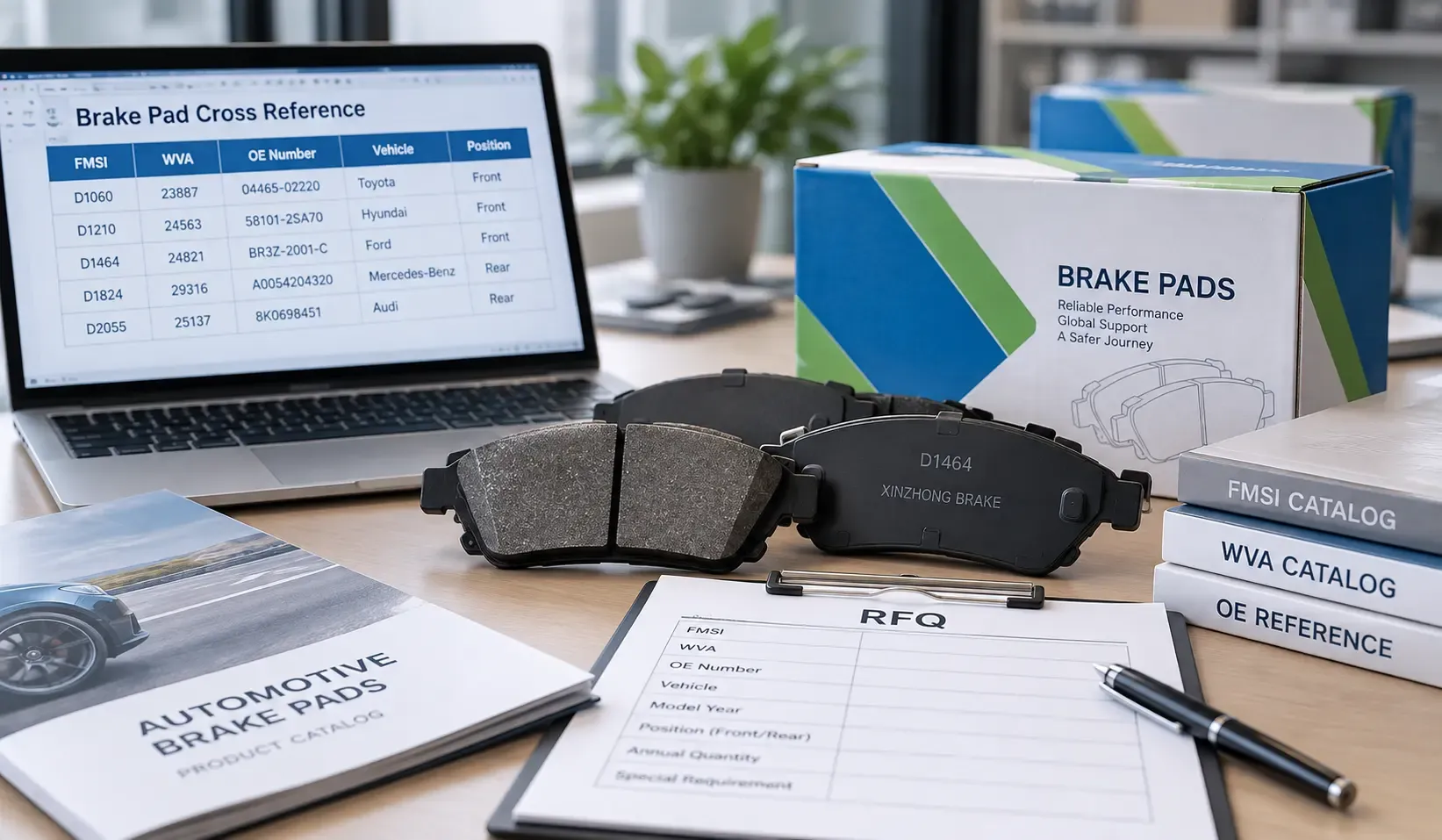
Depending on the market, a brake pad may be identified using:
- FMSI number
- WVA number
- OE number
- aftermarket cross-reference
- manufacturer internal code
- vehicle application
For example, two brake pads may look very similar but have different dimensions, clips, wear sensors or vehicle applications.
Before approving the sample, confirm that the reference matches the product you actually requested.
If you regularly work with different numbering systems, see our guide on How to Read Brake Pad Numbers: FMSI, WVA and OE Numbers.
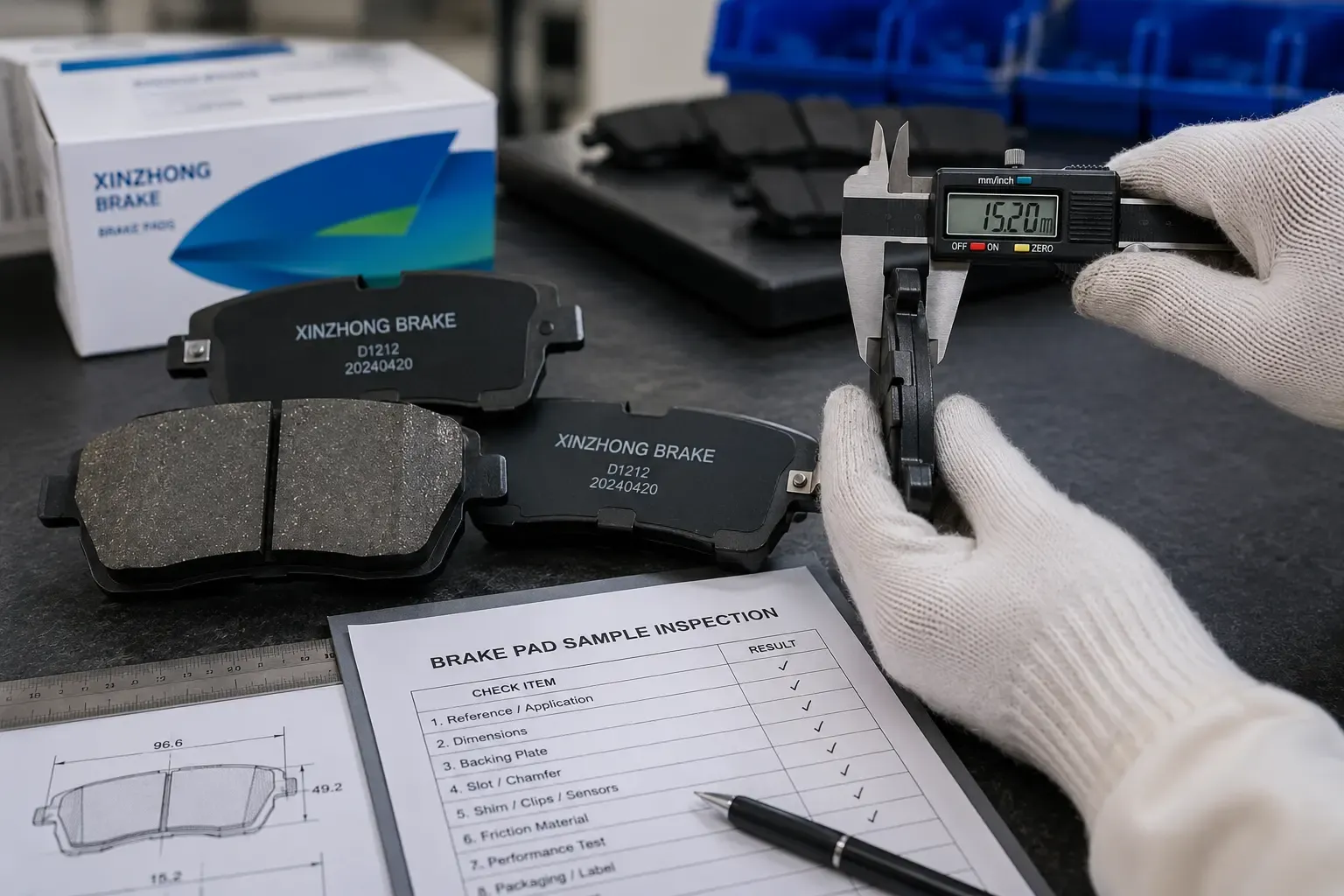
2. Measure the Actual Dimensions
Do not evaluate fitment only by looking at the brake pad.
Measure it.
The key dimensions normally include:
Item | What to Check |
|---|---|
Length | Overall pad length |
Height | Overall pad height |
Thickness | Total pad thickness |
Backing plate | Shape and mounting points |
Clips / ears | Position and dimensions |
Slots | Position and geometry |
Chamfers | Shape and consistency |
Compare these measurements with the confirmed specification or an approved OE/reference sample.
Even relatively small dimensional differences can create installation problems.
This is particularly important when developing a new reference or switching suppliers.
3. Inspect the Backing Plate and Pad Construction
The friction material gets most of the attention, but the backing plate is equally important to the finished brake pad.
Check whether the sample has:
- clean and accurate backing plate geometry
- correct holes and mounting features
- consistent coating
- secure friction-material bonding
- correct clips or attachments
- appropriate shim installation where required
- clean edges and finishing
Also compare multiple pieces from the same sample batch.
You are not only looking for defects.
You are looking for variation.
If four supposedly identical brake pads already show obvious differences at the sample stage, mass production deserves closer attention.
4. Check Slots, Chamfers, Shims and Accessories
Two brake pads using the same basic friction shape are not necessarily identical products.
Depending on the application, the design may include specific:
- slots
- chamfers
- noise-reduction shims
- wear indicators
- clips
- hardware
These details can affect installation, noise behavior and product positioning.
For distributors replacing an existing supplier, it is useful to compare the new sample directly with the product currently being sold.
Do not assume every design difference is a quality problem.
Instead, ask the manufacturer why the design is different and whether it matches the intended vehicle application.
5. Evaluate the Friction Material
This is where sample evaluation becomes more technical.
The friction compound determines much of the brake pad's performance.
Different applications and markets may require ceramic, semi-metallic, low-metallic or NAO formulations.
When evaluating the formulation, buyers should consider characteristics such as:
- friction stability
- wear resistance
- temperature performance
- noise behavior
- dust generation
- rotor compatibility
The goal is not to find one formulation that performs best in every category.
That formulation does not exist.
The goal is to confirm that the formulation is appropriate for the vehicle application, target market and product positioning.
A premium low-dust passenger car pad and a brake pad designed for demanding commercial use should not be evaluated using exactly the same priorities.
6. Do Not Judge Brake Performance From Appearance
A brake pad can look excellent and still perform poorly.
Likewise, visual differences in friction material do not automatically indicate better or worse performance.
Color alone tells a buyer very little about:
- coefficient of friction
- fade resistance
- recovery
- wear
- noise
- temperature stability
Performance needs to be verified through appropriate testing.
Depending on the product, market and buyer requirements, this may include laboratory testing, dynamometer testing or vehicle testing.
For important programs, ask the manufacturer what testing has been performed and what data can be provided for the proposed formulation.
7. Test More Than One Set Whenever Possible
Here is where many purchasing teams make a mistake.
They receive one excellent set of samples and assume mass production will be identical.
But one set tells you very little about manufacturing consistency.
When the project justifies it, evaluating multiple samples can help reveal differences in:
- dimensions
- surface finishing
- friction material appearance
- accessories
- printing
- packaging
- assembly
This becomes especially important when the order contains many references.
The problem distributors eventually face is rarely:
Can this factory make one good brake pad?
The real problem is:
Can this factory repeatedly make hundreds of references to the same agreed standard?
That is a much harder question.
8. Confirm Private Label Details Before Mass Production
For private label orders, product approval and packaging approval should be treated separately.
Before production, confirm details such as:
- brand printing on the backing plate
- box design
- product labels
- barcode information
- reference numbers
- quantity per box
- accessories
- instruction sheets
- carton markings
Do not leave these details until the container is ready to ship.
A brake pad can pass every performance test and still create a commercial problem if thousands of boxes contain the wrong barcode or application information.
For distributors, packaging accuracy is part of quality control.
9. Define the Approved Sample Clearly
Once the sample is accepted, both buyer and manufacturer should know exactly what has been approved.
The approved specification may include:
- reference number
- dimensions
- formulation
- backing plate design
- shim
- accessories
- product marking
- packaging
- agreed testing requirements
This creates a reference point for subsequent production.
Without a clearly defined standard, disputes become difficult.
The buyer may say:
This is different from the sample.
The factory may say:
It is within our normal specification.
A proper approval process reduces that ambiguity before mass production begins.
10. The Most Important Question: Can the Factory Reproduce the Sample?
This is the part distributors should care about most.
A supplier knows that samples are being evaluated.
Naturally, those samples may receive extra attention.
But your business does not depend on four sample brake pads.
It depends on what happens when the factory produces 4,000, 40,000 or more pieces across multiple references and repeat orders.
That is why sample approval should eventually lead to questions about the manufacturing system itself:
How are raw materials controlled?
How are formulations managed?
How are dimensions inspected?
How are production batches identified?
How is finished-product quality checked?
How are non-conforming products handled?
How is traceability maintained?
The purpose of sample testing is not merely to approve a product.
It is to reduce the uncertainty of placing a bulk order.
Brake Pad Sample Evaluation Checklist
Before approving your next brake pad order, use this simple checklist:
Check | Sample Approval |
|---|---|
Correct FMSI / WVA / OE reference | ☐ |
Vehicle application confirmed | ☐ |
Dimensions verified | ☐ |
Backing plate inspected | ☐ |
Slot and chamfer confirmed | ☐ |
Shim / clips / sensors confirmed | ☐ |
Friction formulation confirmed | ☐ |
Performance requirements evaluated | ☐ |
Multiple samples compared | ☐ |
Product printing approved | ☐ |
Packaging and labels approved | ☐ |
Bulk-production specification documented | ☐ |
From Sample Approval to Stable Bulk Production
For professional brake pad distributors, a successful sample is only the beginning.
The real value of a manufacturing partner comes from being able to reproduce the approved product consistently across different references, production batches and repeat orders.
Xinzhong Brake manufactures brake pads for passenger cars, SUVs, light trucks and commercial vehicle applications, with 6,600+ references and 200+ friction formulations.
Our manufacturing operations follow IATF 16949 and ISO 9001 quality management systems, and we support OEM/ODM and private label programs for international distributors and aftermarket brands.
If you are evaluating a new brake pad supplier, you can send us your FMSI, WVA, OE numbers, drawings or existing samples for reference checking and product evaluation.
FAQ
How many brake pad samples should a distributor test?
There is no universal number. It depends on the size and importance of the project. For larger programs, evaluating multiple pieces or sets can provide more information about manufacturing consistency than testing only one sample.
What should I check first when receiving brake pad samples?
Start with product identification and fitment. Confirm the FMSI, WVA, OE reference or vehicle application before moving to dimensional and performance evaluation.
Should brake pad dimensions be measured before bulk ordering?
Yes. Length, height, thickness and application-specific features should be checked against confirmed specifications or approved reference products.
Does a good brake pad sample guarantee good bulk production?
No. A sample demonstrates that a supplier can produce that particular sample. Buyers should also evaluate process control, batch consistency, quality management and traceability.
Can brake pad samples be customized for private label orders?
Yes. Depending on the manufacturer and project, samples may include customized product printing, packaging, labels, formulations and accessories before final mass-production approval.